You would never judge a website on one number. AI search is no different, yet most dashboards try.
AI search analytics is how you measure whether AI answers find, name, and recommend your brand.
The metrics that matter are a small set: mention rate, share of model, citation rate, prominence, sentiment, and AI referral traffic. Each answers a different question, and no single blended score replaces them.
Here is what each metric tells you, which ones people confuse, and the vanity numbers worth dropping from your report.
What is AI search analytics?
AI search analytics is the practice of measuring how your brand performs inside AI answers, the way web analytics measures how it performs on your site. Instead of sessions and bounce rate, you track how often AI engines mention you, whether they cite you, and how they describe you. It exists because the buyer journey moved into ChatGPT, Perplexity, and AI Overviews, where your old analytics cannot follow.
The shift is bigger than a new report tab.
In classic analytics, the click is the event you count. In AI search, the answer is the event, and most answers never produce a click.
So the whole measurement model moves from counting visits to counting appearances, citations, and how you are framed. Our guide on zero-click search covers why the click stopped being the thing to measure.
For an SEO team, the muscle memory transfers but the targets change.
Keyword rankings become prompt coverage, backlinks become citations, and click-through rate becomes citation rate. You are not throwing out the discipline. You are pointing it at a surface where the answer, not the link, is what your buyer actually sees.
AI search analytics counts appearances, citations, and framing, not visits. The click is no longer the event that matters.The one line to remember
Which AI search metrics actually matter?
Six, and each answers a different question the others cannot: whether you show up, how you compare to competitors, whether you are the cited source, where in the answer you land, how you are described, and whether any of it drives action. The table below pairs each metric with its question. Track all six, because a win on one can hide a loss on another.
| Metric | Question it answers | How to read it |
|---|---|---|
| Mention rate | Do you show up at all? | Appearances divided by total prompts tested |
| Share of model | How do you compare to rivals? | Your mentions as a share of all brand mentions |
| Citation rate | Are you the linked source? | Answers that link to you, not just name you |
| Prominence | Where in the answer do you land? | First recommendation beats a trailing mention |
| Sentiment | How are you described? | Positive, neutral, or negative framing |
| AI referral traffic | Does any of it drive action? | Clicks and conversions from AI assistants |
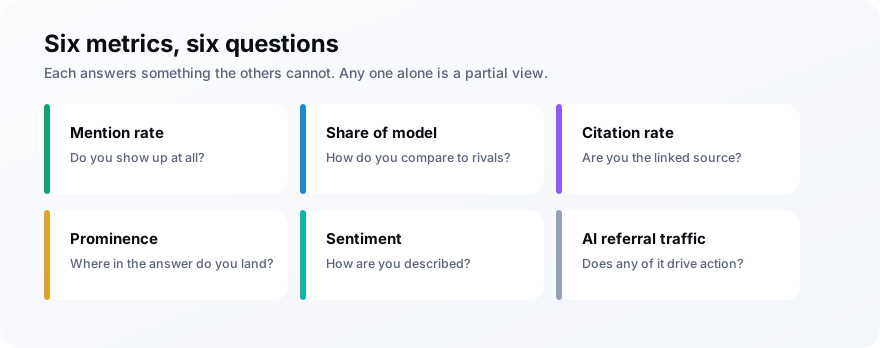
The reason to track all six is that they move independently.
Your mention rate can climb while your citation rate stays flat, which means AI is naming you more but still not treating you as a source. Your share of model can hold while sentiment sours.
A single number averages these into a shrug. Six numbers tell you what to fix.
Share of model is the one that reframes the whole report.
It is not enough to know you appear in 40% of answers; you need to know whether that beats or trails the competitors named in the same answers. Our guides on AI share of voice and tracking competitor AI visibility cover the comparative side, which is where the metric earns its keep.
Mention rate vs citation rate: what is the difference?
A mention is your name in the answer; a citation is a clickable link to your page. They are not the same, and the gap matters. You can be mentioned constantly with no citation, which means AI knows you but is not pointing anyone to you. Citation rate is the stricter, more valuable metric, because a cited source shapes the answer and can still earn the rare click.
Most tools blur the two, and that is a problem.
If a dashboard reports one figure for both, you cannot tell whether AI is recommending you or merely name-dropping you. Track them apart.
A high mention rate with a low citation rate is a content-authority gap: you are known, but not trusted enough to be the source. Our guide on whether Claude cites sources digs into how citation actually works across engines.
Citation rate is the one most worth raising.
A citation puts your URL in front of the reader and tells the engine your page was good enough to build the answer on. That is the closest thing AI search has to a first-page ranking, and it is the metric that best predicts whether the answer is working in your favor.
There is a clear content lever that moves it.
One 2026 analysis by Superlines found pages carrying statistics, citations, and quotations earn 30 to 40% higher visibility in AI responses. Citations tend to beget citations: the more sourced your page is, the more the engines treat it as source material worth naming.
Why does sentiment belong in your AI analytics?
Because being mentioned is worthless if the mention is negative. Sentiment tracks whether AI describes you positively, neutrally, or negatively, and it varies wildly by engine. One 2026 analysis found the sentiment gap between how Perplexity and ChatGPT describe the same brands can run as high as 14.8x. A rising mention rate with souring sentiment is a problem your mention count will never show you.
Each engine has what amounts to an editorial personality.
The same brand can read as a confident recommendation on one engine and a hedged, caveat-laden mention on another, as AirOps documents in its 2026 metrics work. If you only track whether you appear, you miss the half of the story that decides whether the appearance helps or hurts.
Sentiment is also the metric most worth reading by hand.
A model can recommend you while hedging, or list you among options it plainly rates below a rival, and a coarse positive-or-negative tag misses that. Read the actual wording on your top prompts, not just the label a tool assigns, because the nuance is where the reputation risk hides.
Does AI referral traffic tell you anything?
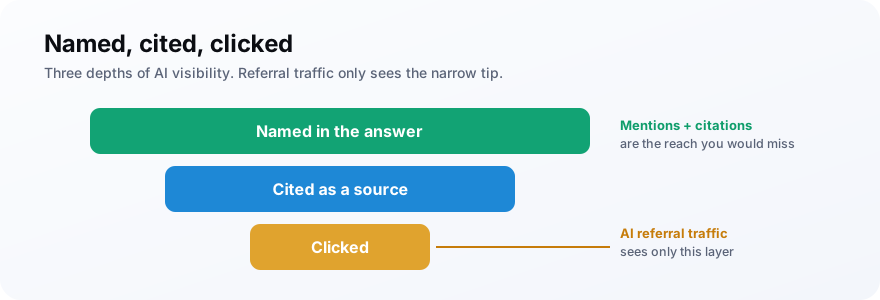
A little, but far less than it should. In May 2026, Google Analytics added a channel that separates traffic from AI assistants like ChatGPT and Gemini, so you can finally see the clicks that do arrive. The catch is that most AI answers never produce a click. Pew found only 1% of AI Overviews lead to a click on the cited source, so referral traffic badly undercounts your real reach in AI search.
Use it, but do not lead with it.
AI referral traffic is a real, useful bottom-of-funnel signal, and the clicks it does capture tend to convert well because the buyer arrived pre-sold by the answer. Watch it for quality over volume.
A handful of AI-referred visitors that convert can matter more than a spike of ordinary search traffic, because the assistant already did the recommending before they arrived. Small numbers, warm intent, and a short path to a decision.
Just never mistake it for your AI visibility.
If you judge AI search by referral traffic alone, you will conclude that almost nothing is happening, while a competitor quietly becomes the default recommendation in the answers your buyers read. The traffic is the tip of the iceberg. The mentions and citations are the rest of it.
Which AI search metrics should you ignore?
Ignore anything that looks big without meaning anything. A raw mention count with no denominator is vanity, because 400 mentions means nothing until you know out of how many prompts. A single blended visibility score with no breakdown hides which metric moved. And impressions, borrowed from ad dashboards, do not apply when there is no reliable way to count who saw an answer.
The pattern to distrust is any number that only goes up.
- Raw mention totals: impressive and meaningless without a denominator. Track mention rate instead.
- A lone blended score: fine as a headline, useless without the six metrics underneath it.
- Impressions or reach estimates: guesswork, since nobody can reliably count AI answer views.
- Total citations without competitor context: 50 citations is good or bad only relative to your rivals.
- Prompts run per month: a big prompt count is an input, not a result; testing 1,000 prompts tells you nothing about whether you appeared in any of them.
Every one of those makes a report look healthy while telling you nothing you can act on. The AI visibility score is fine as a summary, as long as you can open it up into the parts.
How do you actually collect these metrics?
You run your buyer prompts across the AI engines on a fixed schedule, capture each answer, and score it for all six metrics. Doing that by hand does not scale past a few prompts, so most teams pull the raw results through an API and compute the metrics themselves. The key is consistency: same prompts, same engines, same cadence, so the numbers compare over time.
Start with the prompt set, because everything else is built on it.
Pick the real questions your buyers ask an AI, cover every engine they use, and lock the list so your metrics stay comparable week to week. Our guides on AI search tracking and checking whether ChatGPT mentions you cover the setup.
Normalize before you compare, too.
Engines return different answer lengths and formats, and they change their output week to week, so a raw mention on one is not equal to a mention on another. Decide how you count a mention and apply it the same way everywhere, or your share-of-model numbers will drift for reasons that have nothing to do with your brand.
Then decide who does the math.
A dashboard computes the six metrics for you but hands you its own definitions. An API hands you the raw per-engine results, whether you were named, where, cited or not, and how you were described, so you can compute the metrics on your own terms and audit every one against the actual answer.
Frequently asked questions
What is AI search analytics?
What metrics should I track for AI search?
What is the difference between a mention and a citation in AI search?
Can I track AI search traffic in Google Analytics?
What is a good AI search citation rate?
What AI search metrics are vanity metrics?
Measure the six that matter
Do this next: build one report with all six metrics on it, mention rate, share of model, citation rate, prominence, sentiment, and AI referral traffic, measured on a fixed prompt set. Drop every raw total that has no denominator.
Then feed it real data. Pull the raw per-engine mentions and citations with MentionsAPI, compute the six yourself, and track them against your own baseline. A dashboard with six honest numbers beats one with a single flattering score.