A single number is easy to report. It is also easy to misread, and most AI visibility scores get misread.
An AI visibility score is a single 0 to 100 number that estimates how often and how prominently your brand shows up in AI answers from ChatGPT, Gemini, and Perplexity. It bundles mention rate, position, sentiment, and citations into one figure.
The catch: every tool builds it differently. So the number tracks your own brand over time, but compare it to another tool's score and it falls apart.
Here is what the score is made of, what counts as good, why two tools will hand you two different numbers, and which parts you should actually act on.
What is an AI visibility score?
An AI visibility score is a normalized 0 to 100 metric that measures how frequently and prominently a brand is cited or recommended across AI answer engines, as CampaignCreators defines it. A higher number means you show up more often, and higher up, when someone asks ChatGPT, Gemini, or Perplexity a question in your category. It is the AI-search version of a rank tracker, compressed into one figure.
The reason it exists is that the old way of measuring reach broke.
People now ask AI assistants the questions they used to type into Google. ChatGPT reached 900 million weekly users by early 2026, up from 400 million a year earlier per figures OpenAI shared with Reuters, and Google's AI Overviews reach 2 billion people a month. When the answer comes back as a paragraph naming three brands, a blue-link ranking cannot tell you whether you were one of them.
And the stakes are not small. Pew Research found AI summaries roughly halve the rate at which people click through to websites, so the AI answer increasingly is the destination. If your brand is not in it, you are not ranking lower, you are absent from the conversation.
An AI visibility score tries to fill that gap with one number you can track over time. Our primer on what AI visibility means covers the wider idea; this piece is about the score itself.
An AI visibility score is a trend line for your own brand, not a number you can hold up next to a competitor's from a different tool.The one line to remember
How is an AI visibility score calculated?
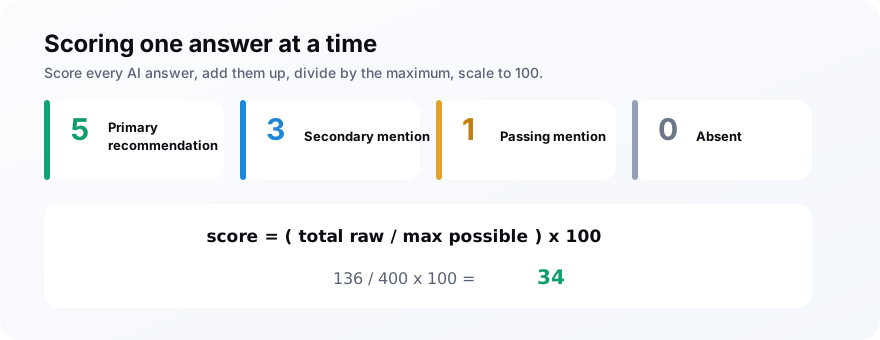
Most scores follow the same shape. You run a fixed set of prompts across several AI engines, check each answer for your brand, and score each appearance: full points if you are the top recommendation, fewer if you are a passing mention, zero if you are absent. Then you divide your total by the maximum possible and multiply by 100.
One published method, from CampaignCreators, makes the scoring concrete.
It awards 5 points for a primary recommendation, 3 for a secondary mention, 1 for a brief passing mention, and 0 when the brand is absent. Run 20 prompts across 4 AI tools and you have 80 scored events with a maximum of 400 points. A brand that racks up 136 points lands at a visibility score of 34.
Simpler tools skip the weighting and just track mention rate.
That version is your brand's appearances divided by total answers, times 100. Show up in 18 of 36 answers and your mention-based score is 50. More advanced scores weight by position, counting a first-place mention as 1.0, a second as 0.5, a third as 0.33, so being named first beats being buried at the bottom of a list.
What is a good AI visibility score?
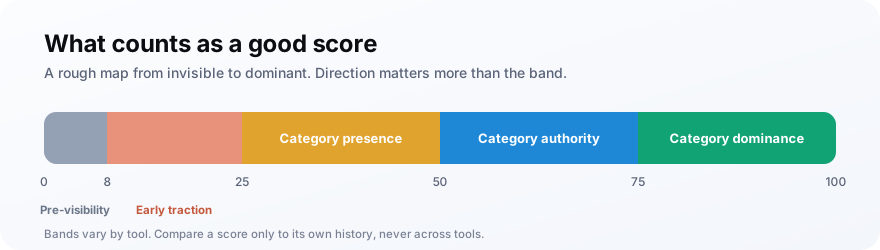
There is no universal pass mark, but the common bands run like this: under 8 is pre-visibility, 8 to 25 is early traction, 25 to 50 is category presence, 50 to 75 is category authority, and 75 to 100 is category dominance. Most brands that have never worked on AI visibility score in the single digits. Anything above 50 in a real, contested category is strong.
Treat those bands as a rough map, not a grade.
- 0 to 8, pre-visibility: AI engines rarely name you. You are effectively invisible in your category's answers.
- 8 to 25, early traction: You surface for a few prompts, usually as a secondary mention.
- 25 to 50, category presence: You are a regular option AI engines reach for, but not the default.
- 50 to 75, category authority: You are frequently a top recommendation across engines.
- 75 to 100, category dominance: You are named first for most relevant prompts, most of the time.
The honest read is that the band matters less than the direction.
A score of 30 that was 18 last quarter is a win. A score of 60 sliding from 72 is a problem, even though 60 sounds healthy. Because the number is relative to a prompt set someone chose, the trend against your own baseline is worth more than the raw value.
Why do AI visibility scores differ between tools?
Because a score is defined by three choices, and every tool makes them differently: which prompts it runs, how much each prompt counts, and how it decides what a mention is. Change any one and the number moves. A 2026 methodology audit found the same underlying data can produce scores across a 31-point range on weighting alone. So two honest tools will rarely agree on your brand.
The prompt set is the biggest lever.
Semrush says it runs around 2,500 curated prompts against AI platforms every month, and its 2026 AI Visibility Index analyzed 126 million AI search prompts. Profound, by contrast, leans on a dataset of roughly 400 million real conversations.
Those are two different windows onto the same web, so they surface different brands. A tool that tests fewer or different prompts is measuring a different question, and your score is only as representative as the prompts behind it.
Here is what that looks like in practice. Run 30 prompts and you might land at 42; run a different 30 that lean toward your strong topics and the same brand posts a 58.
Nothing about the brand changed. The measuring stick did, which is why a score with no visible prompt list behind it is close to meaningless.
Model version and timing add more drift.
AI engines change their answers week to week, and the same prompt can return a different set of brands on Monday and Thursday. Add different mention-detection rules on top, and you get the core problem several 2026 analyses landed on independently: AI visibility is really more than one metric, so any single blended score is a summary, not a measurement.
What does an AI visibility score actually tell you?
It tells you a direction, not a diagnosis. A rising score means you are showing up more, or more prominently, in AI answers over time, measured your way. What it hides is which prompts you win, which engine you are weak in, whether the mention was positive, and whether you were cited or just named. Those are the parts you act on, and the single number buries them.
It helps to see what gets compressed into the score.
| Signal | What it captures | What the single score hides |
|---|---|---|
| Mention rate | How often you appear at all | Which specific prompts you win or lose |
| Prominence | Whether you are first or an afterthought | The gap between named and recommended |
| Sentiment | Positive, neutral, or negative framing | A rise in negative mentions can still lift the score |
| Platform coverage | Consistency across engines | Strong on Perplexity, absent on ChatGPT reads the same |
| Citations | Whether AI links back to your pages | Being named without a link vs an actual citation |
The sentiment row is where this bites hardest. Picture a product recall.
AI engines start naming you constantly, but in warnings. Your mention rate jumps, so a naive score climbs, while the real story is that AI is now telling buyers to steer clear. A single number cannot tell famous apart from infamous, which is exactly why you read the underlying answers, not just the trend line.
Share of voice is only one of those inputs. People treat it as the whole score, and it is not.
You can hold steady share of voice while your visibility score moves, because a different signal changed underneath it. That is the whole risk of a blended number. It can climb for a reason you would never choose to act on, and sit flat while something you care about quietly breaks.
How do you improve your AI visibility score?
You raise the inputs, not the number. Find the buyer prompts where competitors get named and you do not, publish clear, sourced, answer-first content that AI engines can lift, and make sure the crawlers that feed AI search can reach you. Then re-measure the same prompt set so the score stays comparable to your own baseline. The score follows the underlying wins.
Start at the prompt level.
The score is an average, so chasing it directly is vague. Chasing a specific losing prompt is not. Pull the exact questions where an AI engine names a competitor instead of you, and treat each one as a content target with a clear answer a model can quote.
One thing to rule out before you blame your writing: crawler access. If you block the bots that feed AI search, like OAI-SearchBot, no amount of content will lift your score, so confirm those crawlers are allowed first.
Then set a cadence and hold it. Re-run the same prompts on the same engines every few weeks, because a score measured against a shifting prompt set tells you nothing. Change the recipe and you have thrown away your own baseline, which is the only comparison that means anything here.
Then check the mentions by hand before you trust any dashboard.
Run your real buyer prompts through the AI engines and read the answers. Our guide on how to check if ChatGPT mentions your brand walks through it, and the best AI visibility tools roundup covers the platforms, including scoring tools like Rankscale, that automate the tracking once you know what you are measuring.
Frequently asked questions
What is an AI visibility score?
How is an AI visibility score calculated?
What is a good AI visibility score?
Why do AI visibility tools give different scores?
Is an AI visibility score the same as share of voice?
How can I check my AI visibility score for free?
Track the score, act on the inputs
Do this next: pick one tool or one prompt set, write down the exact prompts and engines it uses, and treat that score as your baseline. Never compare it to a number from a different tool.
Then go one level down. Pull the raw per-engine mentions and citations behind the score with MentionsAPI, find the specific prompts you lose, and fix those. The score is the scoreboard; the prompt-level data is the game.