Being in the AI answer is table stakes. Owning more of it than your rivals is the goal.
AI share of voice is the metric that measures that ownership. It is the percentage of AI answers, across a defined set of prompts and engines, in which your brand is mentioned or cited, compared to the total mentions of every brand in your category. Where AI visibility asks "do I show up," share of voice asks the harder question: "of everyone the AI could name, how much of the airtime is mine." It is the AI-answer version of a metric marketers have tracked for decades.
What is AI share of voice?
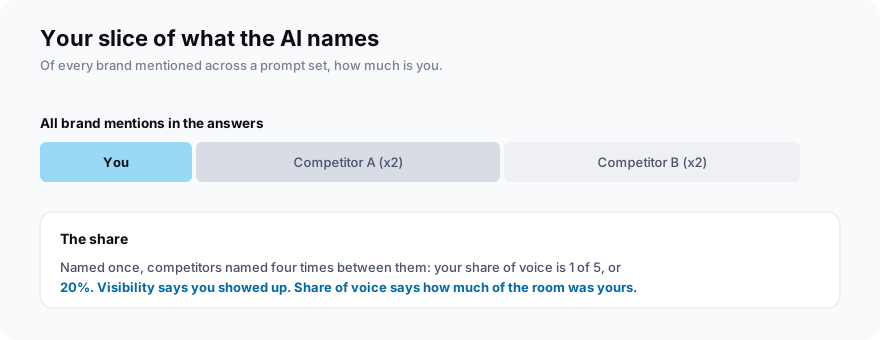
AI share of voice is your brand's slice of all the brand mentions an AI engine makes across a topic. Run a set of buyer prompts through ChatGPT, Perplexity, Gemini, or Google, and each answer names some brands. Share of voice is the portion of those names that are yours. Peec AI frames it as your share of influence whenever AI models mention the brands you track: your mentions over everyone's.
The word "relative" is the whole point. A visibility score tells you how often you appear on your own list of prompts.
Share of voice divides that by the competition, so it moves when a rival gains ground even if your own numbers hold steady. It is a competitive metric by design.
How do you calculate AI share of voice?
The base formula is simple, and every major tool agrees on it: your brand mentions divided by the total brand mentions across your category, times 100. Peec AI gives the textbook example, in its docs: if your brand is named four times and a competitor twelve, your share is four over sixteen, or 25%. Semrush uses the same base, ten mentions out of a hundred equals 10%.
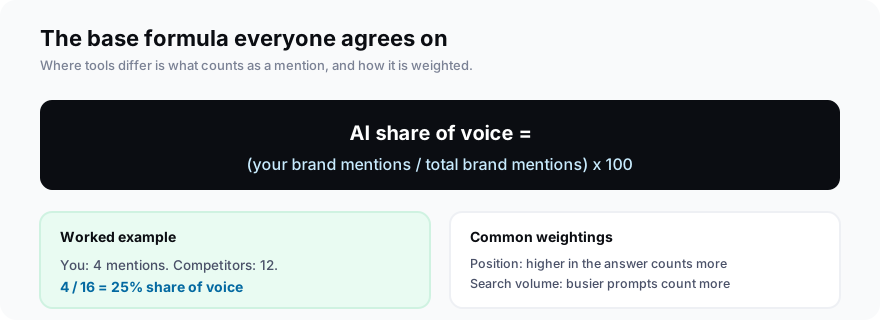
Here is the catch worth knowing before you compare two tools' numbers. There is no standard formula yet, and vendors weight it differently. Semrush factors in position, how high you appear in the answer, and for ChatGPT it weights by the query's search volume so high-demand prompts count more.
Ahrefs Brand Radar computes share on citations and impressions rather than raw text mentions. So the same brand can post a different share of voice in two tools, and both are right by their own definition.
A quick example of why that matters. Suppose you are named once, near the top of an answer, on a high-volume query, and a competitor is named twice near the bottom of a low-volume one.
A pure mention count hands the competitor a higher share; a position-and-volume-weighted score can flip it in your favor. Neither reading is wrong, but you need to know which one your tool runs before you trust the number.
Whichever method you pick, log the same four things for every answer so the number is reproducible: which brands were named, whether each was cited with a link or only mentioned in the text, where in the answer it landed, and how it was framed. Those columns let you compute a plain mention share today and switch to a weighted or citation-only share later without re-running everything, and they keep two people on the same team from reporting different figures for the same week.
The practical takeaway: pick one method and stay with it. Share of voice is most useful as a trend line you own, not as a number you compare across vendors who each count differently.
How is AI share of voice different from mention rate, citation rate, and sentiment?
Share of voice is one metric in a family, and mixing them up leads to bad decisions. Mention rate, or visibility, is absolute: how often you appear, with no competitor in the math. Citation rate is stricter: whether your URL is listed as a source rather than just your name in the text. Sentiment is the quality of the mention. Share of voice is the only competitive one.
Analysts often stack these into a ladder. At the bottom is cited: your URL is one of the sources the answer drew from. In the middle is mentioned, your brand name in the text a reader sees; at the top is recommended, where the engine actively suggests you.
Share of voice usually counts the mention rung, but the rung that converts is recommended. So watch how far up the ladder your mentions actually sit.
| Metric | What it measures | Relative? |
|---|---|---|
| Share of voice | Your mentions vs all competitors | Yes |
| Mention rate / visibility | How often you appear at all | No |
| Citation share | Your URL cited as a source | Sometimes |
| Sentiment | How you are framed (positive/negative) | No |
| Prominence / position | Where in the answer you appear | No |
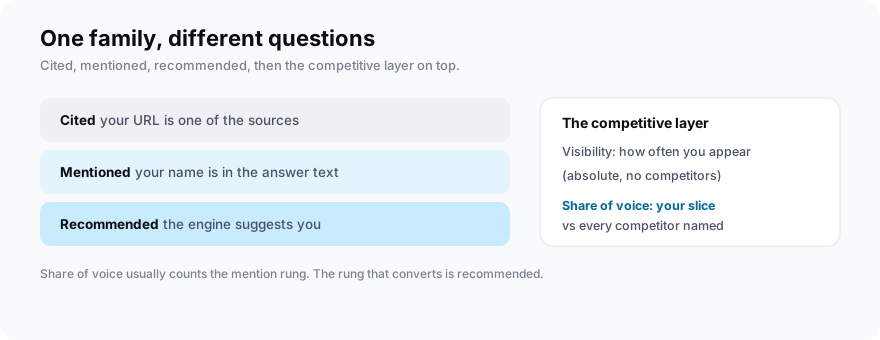
The distinction that trips teams up most is visibility versus share of voice. Peec AI puts it cleanly: visibility measures how often a brand is mentioned, while share of voice tells you how often it is mentioned compared to all of your tracked competitors.
You can have strong visibility and weak share of voice if the AI names five rivals every time it names you. We go deeper on the absolute side in our guide to AI visibility.
Visibility tells you whether the AI sees you. Share of voice tells you whether it sees you more than the competitor you are trying to beat.The one-line distinction
Why does AI share of voice matter?
It matters because AI answers name only a handful of brands, and the ones they name are the ones buyers hear about. When an AI summary appears, it compresses the whole market into a few sentences. Share of voice is how you know whether your brand made the cut or your competitor did, in a channel that recommends rather than lists.
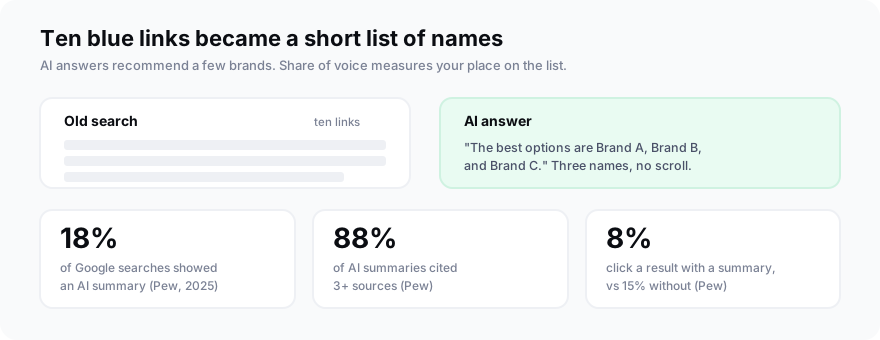
The numbers behind the shift are real. Pew Research Center found that 18% of Google searches produced an AI summary in March 2025, and that 88% of those summaries cited three or more sources. When a summary appeared, users clicked a traditional result just 8% of the time, versus 15% without one.
The click is being replaced by the mention, and the mention is what share of voice counts.
The channel is also growing. Semrush measured AI referral traffic rising 66% in 2025, from 462 million to 767 million monthly visits. It is still a small slice of total traffic, but the direction is not subtle.
Gartner has predicted traditional search volume could fall 25% by 2026 as people move to AI chatbots. Treat that one as a contested forecast rather than a fact. The trend it points at, though, is exactly the one share of voice is built to track.
There is a deeper reason marketers care. In classic marketing theory, share of voice tends to lead market share: brands that win an outsized share of the conversation tend to grow into it. Whether that holds for AI answers is not yet proven, but the logic is why teams treat AI share of voice as an early indicator, not a vanity number.
How do you measure AI share of voice across engines?
You measure it by running a representative prompt set through each engine on a schedule and recording, for every answer, which brands were mentioned or cited and where. Then you compute the share per engine and blend the results. The method is consistent across tools: a prompt library, multiple engines, repeated runs, and a competitor list you score against.
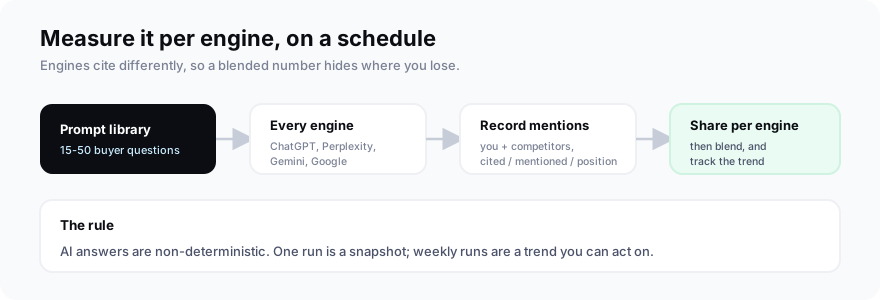
Three details make the difference between a real measurement and a screenshot. First, use a prompt set that reflects how buyers actually ask, spanning category, comparison, and use-case questions, not just your brand name.
Second, measure per engine, because ChatGPT reads Bing, Google grounds its own index, and Perplexity runs its own retrieval, so they cite different sources and your share differs on each. A single blended number hides where you are losing.
On prompt-set size, most practitioners land between fifteen and fifty prompts. Too few and a single volatile answer swings your whole score; too many and low-intent questions dilute the ones that matter. Weight the set toward the questions your buyers ask at the decision stage, then expand it as you learn which prompts move revenue, so the number stays tied to outcomes rather than trivia.
Third, run it on a schedule. AI answers are non-deterministic and shift week to week, so one run is a snapshot, not a trend. Weekly tracking turns share of voice from a number into a line you can act on.
Doing this by hand across dozens of prompts and several engines does not scale, which is why teams use an API to query each engine and parse the mentions automatically. The how-to for the ChatGPT slice is in our guide to checking ChatGPT mentions.
How is AI share of voice different from traditional share of voice?
Traditional share of voice measured your slice of advertising, search rankings, or social mentions. AI share of voice measures your slice of what the AI actually says when someone asks. The idea is the same, the surface is new, and the surface changes the tactics. You do not buy AI share of voice with ad spend; you earn it by being the source the model trusts and the brand it names.
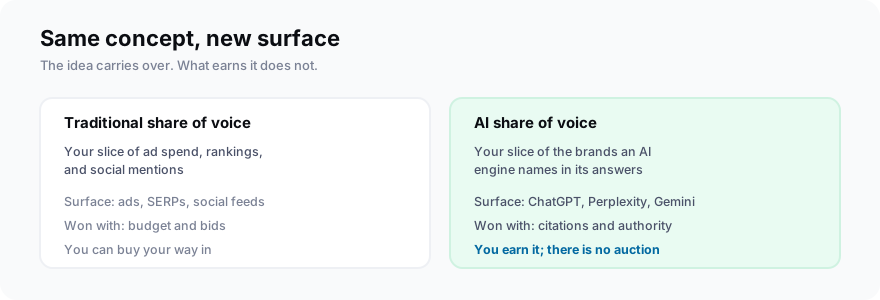
That is also why it is harder to game. There is no auction for a spot in an AI answer, so share of voice reflects genuine authority: clear, well-sourced content the model can quote, and a brand it has learned to associate with the category. The full playbook for earning it is our AI search optimization guide.
How do you improve your AI share of voice?
You improve it by becoming the clearest, most-cited answer on the questions your buyers ask, then by widening the set of prompts where that is true. Lead pages with direct answers a model can lift, earn third-party authority on the sources each engine trusts, and keep content fresh. Every point of share you take comes from a competitor, so the work is both to raise your own mentions and to out-answer the rivals holding the slots you want.
Three levers do most of the work. The first is answer-shaped content: pages that state the answer in the first line, in plain language a model can lift without rewriting, get quoted more than pages that bury the point under a preamble.
The second is third-party authority. Each engine leans on different sources, Perplexity and ChatGPT on the open web and review sites, Gemini on Google's own index, so a mention on the outlets an engine trusts lifts your share on that engine specifically.
The third is entity consistency. Describe your brand the same way across your site, your profiles, and the places that cite you, so the model learns one confident association between your name and your category.
Notice that none of these is a one-time fix. Share of voice is a stock, not a flow, so a burst of content raises it briefly and then it decays as competitors publish and models refresh. The teams that hold share treat it as a standing program, revisiting their highest-intent prompts every few weeks and reclaiming any slot a rival has taken since the last check.
Start narrow. Win share of voice on your ten highest-intent prompts before chasing the long tail, because those are the questions where a mention turns into a customer. Then expand outward, one prompt cluster at a time, and watch the line move.
Frequently asked questions
What is AI share of voice?
How do you calculate AI share of voice?
What is a good AI share of voice?
How is share of voice different from AI visibility?
Mentions vs citations: what is the difference in AI answers?
How do you track AI share of voice across engines?
Measure the slice, then grow it
Do this next: pick your ten most important buyer prompts, list the competitors who show up on them, and measure your share of voice on each engine as a baseline. That single number, tracked weekly, tells you more about your AI standing than any absolute visibility score.
Then work the gap. Pull that baseline with MentionsAPI, keep your visibility fundamentals in order, and watch your share climb as you out-answer the brands ahead of you.