You can ask ChatGPT if it recommends you, get a confident yes, and still be wrong. The next person who asks gets a different answer.
By hand, that check is a trap. It feels like an answer, but it is really one sample pulled from a system that hands everyone something slightly different. Knowing whether ChatGPT names your brand means measuring a rate, not reading a screenshot. What follows is how to do that, and where a few lines of code beat an afternoon of manual prompting.
Can you check whether ChatGPT mentions your brand?
Yes, but not by asking it once. ChatGPT reaches 900 million weekly users, so being named there matters. But its answers are generated fresh each time and vary from person to person. To check reliably you run the questions your buyers ask, repeat each one several times, and read the answers for your brand name. That gives you a mention rate, which a single chat never can.
The mistake is treating ChatGPT like a search box that returns one true result. It does not. Where a Google query gives one ranked list, ChatGPT writes a different answer each time it runs. Checking it means sampling, the way you would poll anything that changes.
Why one ChatGPT answer tells you nothing
Because ChatGPT is not deterministic. The same prompt returns different answers depending on the user, their settings and memory, and the moment you ask, even at low temperature. One run might name you, the next a competitor, the next nobody. So a single screenshot is a single sample, and it tells you nothing reliable about how often ChatGPT actually names your brand.
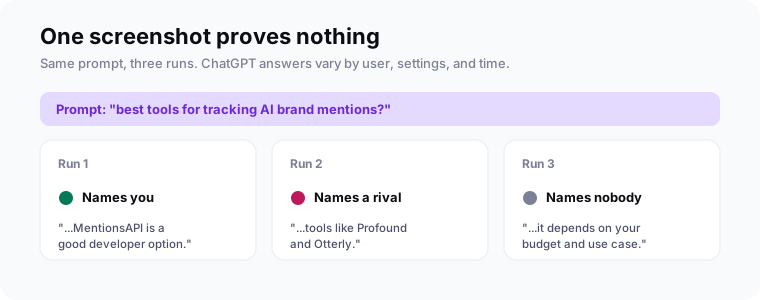
We dug into exactly why this happens in does ChatGPT give everyone the same answer. The short version: the same question is a different question depending on who asks it, which is exactly why you measure a rate instead of trusting a lucky screenshot.
Mentions vs citations: what you are actually checking for
You are checking for your brand name in the answer text, not for a link. Those are different things. In a BuzzStream study of 12,000 AI responses, only 23.1% of brand mentions were backed by a citation in the same response. So most of the time ChatGPT names a brand with no clickable source, which means watching for links misses roughly three of every four mentions.
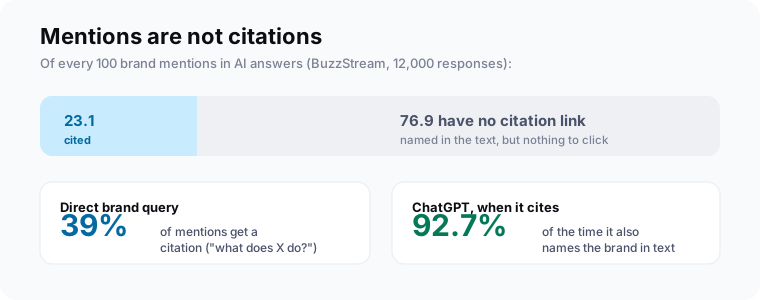
The same study found ChatGPT is relatively good on the flip side: when it does cite a source, it names the brand in the text 92.7% of the time. And when a brand is the direct subject of a query, like "what does Asana do?", 39% of mentions come with a citation. But the headline still holds: to find your mentions, you have to read the words, not scan for hyperlinks.
If you only look for links to your site, you will miss most of the times ChatGPT talks about you. The mention is in the sentence, not the citation.The core idea
Three ways to check ChatGPT mentions
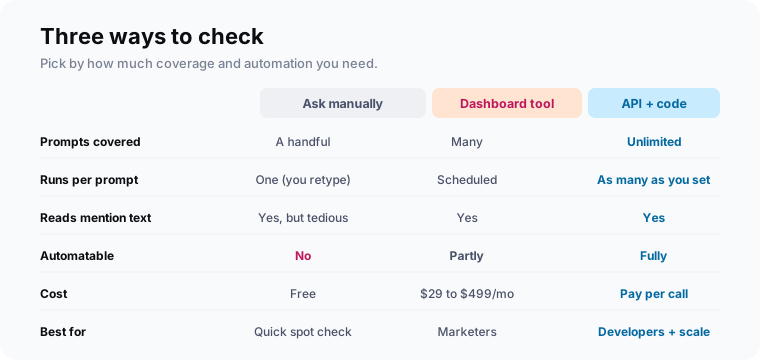
There are three. You can ask ChatGPT by hand, use a monitoring dashboard, or call an API from your own code. Asking by hand is free but does not scale and cannot be automated. A dashboard runs scheduled checks for a monthly fee. An API lets you run any number of prompts on your own cadence and pay per call. For developers and for scale, the API wins.
| Ask manually | Dashboard tool | API + code | |
|---|---|---|---|
| Prompts covered | A handful | Many | Unlimited |
| Runs per prompt | One (you retype) | Scheduled | As many as you set |
| Automatable | No | Partly | Fully |
| Cost | Free | $29 to $499/mo | Pay per call |
| Best for | Quick spot check | Marketers | Developers + scale |
If you want a no-code starting point, our free AI visibility checker walks through the manual method, and the best AI monitoring tools compares the dashboards. The rest of this guide is the code path.
How to check ChatGPT mentions with code
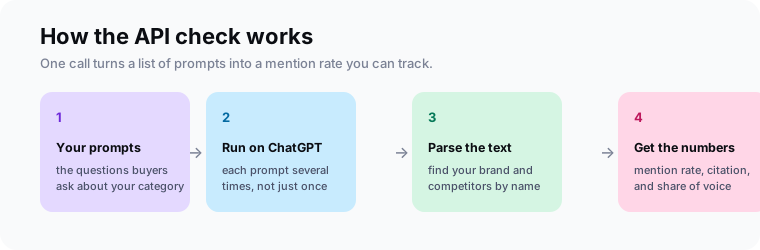
Send your prompt and brand name to an API, and read the structured result. With MentionsAPI you POST to /v1/check with a query, your brand, and the ChatGPT provider (openai). It runs the prompt, reads the answer, and returns a brand_mentions array that tells you whether ChatGPT named you, at what rank, and with what sentiment. One prompt is one call.
Start with a single check to see the shape of the data:
curl https://api.mentionsapi.com/v1/check \
  -H "Authorization: Bearer $MENTIONSAPI_KEY" \
  -H "Content-Type: application/json" \
  -d '{
    "query": "best tools for tracking AI brand mentions",
    "brand": "MentionsAPI",
    "providers": ["openai"]
  }'
That returns your brand mentions for one run. But one run has the same problem as one screenshot. So loop: run several prompts several times each, and count how often ChatGPT names you. That ratio is your mention rate.
const prompts = [
  "best tools for tracking AI brand mentions",
  "how do I check if ChatGPT recommends my product",
  "top AI visibility platforms for developers",
];

const RUNS = 5; // ask each prompt several times, not once
let hits = 0;

for (const query of prompts) {
  for (let i = 0; i < RUNS; i++) {
    const res = await fetch("https://api.mentionsapi.com/v1/check", {
      method: "POST",
      headers: {
        Authorization: `Bearer ${process.env.MENTIONSAPI_KEY}`,
        "Content-Type": "application/json",
      },
      body: JSON.stringify({ query, brand: "MentionsAPI", providers: ["openai"] }),
    });
    const data = await res.json();
    const named = data.brand_mentions.some((m) => m.brand === "MentionsAPI");
    if (named) hits++;
  }
}

const total = prompts.length * RUNS;
console.log(`Mention rate: ${((hits / total) * 100).toFixed(1)}% (${hits}/${total})`);
The response you are reading looks like this, trimmed to the parts that matter:
{
  "providers": [
    { "provider": "openai", "model": "gpt-4o", "content": "For tracking AI brand mentions, tools like MentionsAPI..." }
  ],
  "brand_mentions": [
    { "brand": "MentionsAPI", "provider": "openai", "rank": 1, "sentiment": "positive", "context": "tools like MentionsAPI..." }
  ],
  "citations": [
    { "canonical_url": "https://mentionsapi.com", "providers_cited": ["openai"] }
  ]
}
The brand_mentions array is the whole game. You do not parse prose yourself; you check whether your brand is in that array, at what rank, and with what sentiment. Do that across every run and you have a number you can put on a dashboard. Our quickstart has the same call in Python if you prefer.
How to read the results
Turn the raw runs into four numbers. The headline one is your mention rate, the share of runs that named you at all, and it is the figure worth trending. Next to it, citation rate tells you how many of those mentions carried a link, measured against that 23.1% baseline. Share of voice compares how often you showed up against named competitors, and sentiment captures how you were described when you did. A single screenshot gives you none of this; a repeated check hands you all four.
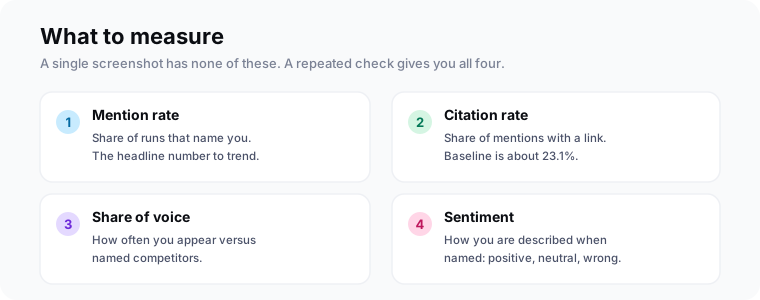
The API returns rank and sentiment on each mention, so share of voice and sentiment fall out of the same call. Add your competitors to the brand list and you can see who ChatGPT names instead of you, which is usually the more useful chart.
How often should you check?
Weekly is a sensible baseline. AI answers drift as models update and as the web behind them changes, so a number you pulled once is stale within weeks. Run your check on a schedule, and run it more often around a launch, a competitor move, or a big content push. Once it is scripted, a weekly run costs you nothing in effort.
That cadence is where the code path earns its keep. A screenshot only ever freezes one guess in time, whereas a scheduled check keeps a live trend line you can watch for drift. We go deeper on cadence and what to log in AI search tracking.
Frequently asked questions
How do I check if ChatGPT mentions my brand?
Can I check ChatGPT brand mentions with an API?
Why does ChatGPT give me a different answer every time?
Does ChatGPT link to my site when it mentions me?
How often should I check whether ChatGPT mentions my brand?
Is checking ChatGPT the same as checking Google rankings?
Measure the rate, not the screenshot
If you take one thing away from this, make it this. Write down the five questions your buyers actually ask ChatGPT, run each one five times through /v1/check with your brand name, and look at the mention rate that comes back. That one number will tell you more than any screenshot, because it samples a system that answers everyone a little differently.
After that, put it on a schedule. Pull a weekly mention rate for you and your top competitors, keep your source-side work going, and watch where the line moves. Do that for a month or two and "I think ChatGPT mentions us" turns into a number you can actually defend.