Share of voice is something you buy. Share of model is something a machine decides about you. That is a very different game.
Share of model is your brand's share of what AI models say about your category.
If buyers ask ChatGPT ten questions about CRM software and your product is named in seven answers, your share of model is 70%.
It is the AI-era successor to share of voice, with one twist that changes everything: share of voice is rented through media spend, and share of model is earned. Here is what the metric is, how to calculate it, and why it belongs on your dashboard.
What is share of model?
Share of model is the percentage of AI answers in your category that mention or recommend your brand, measured against your competitors. The term was popularized by Jack Smyth at Jellyfish in 2024 as a way to measure how visible a brand is to large language models. In short, it is your slice of everything an AI says when buyers ask about what you sell.
The idea caught on because the old way of measuring presence broke.
Writing in Marketing Week, Tom Roach framed share of model as what language models "know" about a brand, and therefore what they will tell the millions of buyers now asking AI instead of Google. If a model does not know you, you are not in the answer, and the buyer never hears your name.
Share of model spans two things the model does.
Part of it lives in the model's trained knowledge, what it absorbed about your brand during training, and part in live retrieval, what it pulls from the web in the moment. A strong share of model means you show up in both, as one glossary puts it: your footprint across the model's parametric memory and its live outputs.
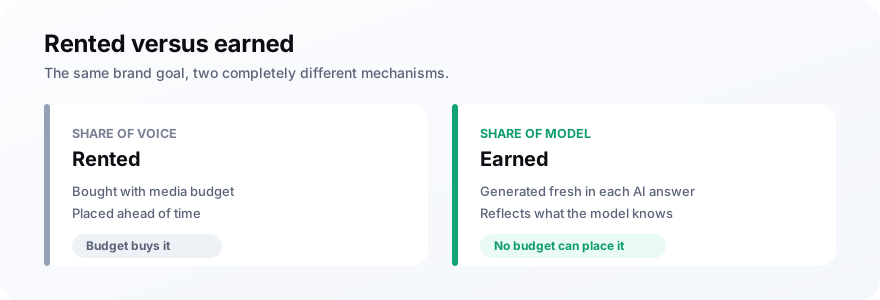
Share of voice is rented. Share of model is earned. You cannot place your way into an AI answer.The one line to remember
How do you calculate share of model?
Take the AI answers that mention your brand, divide by the total brand mentions across every prompt you test in your category, and multiply by 100. Run a fixed set of buyer prompts across ChatGPT, Gemini, Claude, and Perplexity. Because the answers are stochastic, sample each prompt several times and average. The result is one number: your share of the category's AI answers.
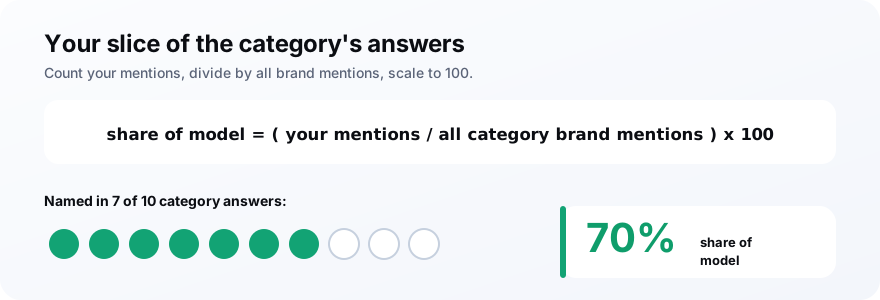
One detail separates a real number from a guess: repetition.
A language model can name three brands on one run and a different three on the next, for the same prompt. If you ask once, you measure noise. Sampling each prompt several times and averaging is what turns share of model into a figure you can track.
And it has to span engines.
Your share of model on Perplexity can look nothing like your share on ChatGPT, so a single-engine number is only ever part of the picture. Measure every engine your buyers use, then read them together and separately.
Share of model vs share of voice: what changed?
Share of voice measured how much of a category's advertising you owned, which you bought with media spend. Share of model measures how much of a category's AI answers you own, which you cannot buy at all. The old metric was rented through ad placements. The new one is earned from what the model learned and retrieves, and that shift from placed to generated is the whole story.
| Axis | Share of voice | Share of model |
|---|---|---|
| How you get it | Bought with media spend | Earned from content and authority |
| Where it lives | Ads and organic listings | AI answers and model knowledge |
| How it forms | Placed ahead of time | Generated fresh in each answer |
| What moves it | Budget and flighting | Model updates and retrieval authority |
| Can you buy it? | Yes | No |
There is also a practical reason the metric spread fast.
Share of voice got hard to calculate as ad spending fragmented across dozens of channels. Share of model is sitting in plain sight: you can read it straight from the AI answers themselves, for free, without anyone reporting their budget.
Analysts have a tidy way to put the contrast.
You can pay to hold an ad slot, but you cannot pay a model to recommend you, as one comparison of share of voice and share of LLM spells out. The AI answer is a verdict the model reaches, not an inventory slot you can book in advance.
How is share of model different from AI share of voice?
They overlap, but they are not the same. AI share of voice is the operational metric: your mentions as a share of category mentions. Share of model is the broader idea behind it, your brand's standing inside the model across both trained knowledge and live retrieval. Think of share of model as the concept and AI share of voice as one way to measure it.
The distinction matters when you act on the number.
A pure mention count tells you how often you appear. Share of model asks the bigger question of whether the model actually reaches for you as an authority, which includes prominence and preference, not just presence. Our guide on AI share of voice covers the exact measurement; this piece is about the concept it serves.
Why does share of model matter?
Because what a model knows about your category is now market intelligence you can read. Share of model shows whether AI treats you as a default option or forgets you exist, which increasingly shapes what buyers shortlist before they ever visit a site. It turns an invisible influence into a number you can track and defend.
It doubles as competitive and reputation intelligence.
Because you measure every brand in the category, share of model shows who the model treats as the default, where you are gaining, and where a rival quietly owns a question you should. It also surfaces how you are described, since the same answers that name you also frame you. Read together, that is a live map of how AI sees your market.
The strategic bet comes straight from the old share-of-voice playbook.
Decades of research by Les Binet and Peter Field showed that brands whose share of voice runs ahead of their market share tend to grow, and those behind it tend to shrink. Share of model revives that logic for AI: grow your share of the answers ahead of your share of the market, and the theory says real growth follows.
The honest caveat is that the link is still being proven.
Share of model is new, and no one has fully shown that moving it moves revenue yet. Treat it as a leading indicator worth growing and watching, not as a guaranteed line to sales. The brands measuring it now are the ones who will know first whether it pays off.
What counts as a good share of model?
There is no universal good number, because share of model is relative to your category and your competitors. In a category with three serious players, 33% is par and 50% is strong. In a crowded one with twenty, 10% can lead. What matters is your share against named rivals on the same prompts, and whether it is climbing or slipping, not the raw percentage on its own.
Read it as a race, not a grade.
A 20% share that was 12% last quarter is a win. A 40% that is sliding from 55% is a warning, even though 40 sounds healthy. Because the number only means something next to competitors, the ranking and the trend carry more weight than the absolute figure.
Watch concentration, too.
If one competitor holds 60% of the category's answers, the model has a clear default, and dislodging it is hard but valuable. If the share is spread evenly, the category is still up for grabs, and early, consistent work can make you the name the model reaches for first.
What moves your share of model?
You move it the way you earn any AI citation, because you cannot buy it. Publish clear, answer-first content the engines can lift, earn third-party mentions in the places your buyers read, keep your key pages fresh, and make sure the AI crawlers can reach you. Share of model rises with authority and usefulness, on the timescale of model updates rather than ad flights.
The levers are the same ones behind any AI visibility metric.
The work in our guide on improving your AI visibility score applies directly: find the prompts a competitor owns, build the better answer, and earn the mentions that teach the model you are an authority.
One lever is unique to the concept, though.
Because part of share of model lives in training data, being widely and accurately written about across the web shapes what future models recall about you, before anyone runs a single live search. That is slow to build and hard for a competitor to copy, which is what makes it worth the effort.
How do you start measuring share of model?
Build a prompt set, run it across the engines, and count. The method is simple once you have the data, and the only hard part is getting consistent answers out of stochastic models.
- List the real questions buyers ask an AI in your category, 20 to 50 to start.
- Run each prompt across ChatGPT, Gemini, Claude, and Perplexity.
- Sample each prompt several times, since the same question yields different answers.
- Tally which brands get named, yours and every competitor.
- Divide your mentions by the category total, times 100, and track it over time.
The bottleneck is almost always the data, not the math.
Running hundreds of prompts across four engines several times each, by hand, is not realistic, so most teams pull the raw answers through an API and compute the share themselves. What matters is keeping the prompt set and sampling consistent, so the number compares over time. Our guides on AI search analytics and tracking competitor AI visibility cover the wider measurement setup.
Frequently asked questions
What is share of model?
How do you calculate share of model?
Who coined share of model?
What is the difference between share of model and share of voice?
Is share of model the same as AI share of voice?
How do you improve your share of model?
Start counting your share of the answer
Do this next: pick the ten questions a buyer in your category is most likely to ask an AI, run them across the main engines, and count how often you show up against your rivals. That rough number is your starting share of model.
Then make it a habit. Track it with MentionsAPI on a fixed prompt set, watch it against competitors, and treat it as the number that tells you whether AI is on your side. You cannot buy your way into the answer, so you had better be measuring whether you are in it.