A score is a symptom. You cannot treat it directly, so stop trying and go find the input that is actually sick.
You improve your AI visibility score by fixing the inputs behind it. The number itself is a result you cannot push on directly.
Diagnose which input is weak, whether you are rarely mentioned, mentioned but not cited, or cited but described poorly, then pull the specific lever that moves it.
The levers that work are mostly not classic SEO. Here is how to diagnose the score, which fixes actually earn AI citations, and how to prove the change worked.
How do you improve your AI visibility score?
Run a loop: diagnose, fix, re-measure. First break the score into its inputs and find the weak one. Then apply the change the data says moves that input, publish it against the exact prompts you are losing, and re-run the same prompt set to confirm the score rose. Chasing the composite number directly is vague; fixing a named input on a named prompt is concrete.
The mistake almost everyone makes is treating the score like a dial.
They see 34, they want 50, and they publish a pile of generic content hoping the number drifts up. It rarely does, because the score is an average of several different things. If your problem is that AI never cites you, more blog posts will not fix it.
The loop works because it is specific.
You are not improving your visibility in general. You are making one page the obvious answer to one prompt an AI keeps handing to a competitor, then checking whether it worked. Our guide on the AI visibility score itself covers what the number is made of.
You cannot raise a score you have not diagnosed. Find the weak input first, then fix that one thing.The one line to remember
Which input should you fix first?
Fix the input that is actually low, not the one easiest to work on. If you are rarely mentioned, the problem is reach and authority. If you are mentioned but never cited, it is content quality and sourcing. If you are cited but described badly, it is sentiment and accuracy. Each symptom points to a different fix, so diagnose before you touch anything.
| The symptom | What is weak | The lever |
|---|---|---|
| Rarely mentioned at all | Reach and authority | Third-party mentions, UGC, original data |
| Mentioned but not cited | Content quality and sourcing | Answer-first pages with stats and named sources |
| Cited but low in the answer | Prominence | Stronger, more specific answers than rivals |
| Cited but described poorly | Sentiment and accuracy | Fix wrong facts, publish clearer positioning |
| Strong on one engine only | Coverage | Tune the content to each engine separately |
Diagnosing means reading the actual answers, not the dashboard summary.
Run your buyer prompts, see where you land, and note which of those rows you are in. Our guide on AI search analytics covers the metrics that tell these symptoms apart.
A quick worked example makes the diagnosis concrete.
Say you appear in 8 of 20 prompts but are cited in only 2. Your mention rate is fine at 40%, but your citation rate is the real problem at 10%. That points you straight at sourcing and content quality, and it stops you wasting a month chasing more mentions you do not actually need.
How do you win the buyer prompts you're losing?
Rewrite the page to be the easiest answer to lift. Lead with a direct, self-contained answer in the first 40 to 60 words, because AI engines pull opening statements far more than buried ones. Write your headings as the questions buyers actually ask. Then back the claims with specific numbers and named sources. The Princeton GEO study found adding statistics or citations each raises AI visibility by 30 to 40%.
Start with the losing prompt, not the page.
Pull the exact question an AI keeps answering with a competitor, and build the cleanest possible answer to it. That is a tighter target than rewriting your whole site, and it maps directly to the score, because the score is measured on prompts.
Structure the page for extraction.
A short answer up top, question-form headings, a comparison table or list, and a few sourced stats give the engine clean, liftable chunks. Our guides on answer engine optimization and generative engine optimization go deep on the structure.
What actually earns AI citations?
The biggest levers are not the SEO ones. Third-party brand mentions correlate with AI citations about three times more strongly than backlinks, and nearly half come from user-generated content like Reddit and Quora. Fresh content, original data, and high entity density all multiply your citation odds. Getting cited is more about being talked about and being useful than about traditional ranking signals.
Here are the levers that move citations, ranked by how much the 2026 data says they matter:
- Entity density: pages with 15 or more named entities show about 4.8x the citation probability of thin pages.
- Original data and research: first-party data correlates with roughly 4.1x more citations.
- Freshness: content under 30 days old earns an estimated 3.2x more AI citations than older pages.
- Third-party mentions: brand mentions beat backlinks as a citation signal by about 3x, and 48% come from UGC.
- Stats and citations on the page: each adds 30 to 40% AI visibility, per the Princeton study.
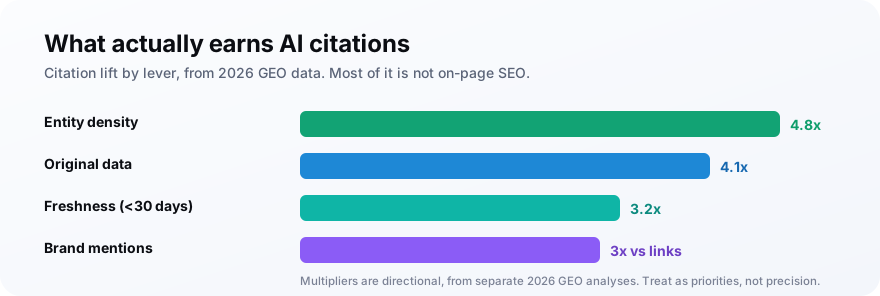
Notice how little of that is on-page SEO.
Two of the top levers, mentions and original data, live mostly off your own site. You raise them by publishing research worth citing and by earning conversation in the communities your buyers read, not by tweaking title tags.
The mentions lever is the one most teams underrate.
One 2026 citation-signals analysis found brand mentions correlate with AI citations roughly 3x more strongly than backlinks, and 48% of citation-driving mentions come from user-generated content. That means a helpful Reddit answer or a mention in a respected roundup can move your AI visibility more than a month of on-page work.
Do you optimize differently for each engine?
To a point, yes, because the engines reward different things. One analysis of 680 million citations found only 11% of domains are cited by both ChatGPT and Perplexity. ChatGPT leans toward in-depth, encyclopedic pages that cover a topic in full. Perplexity favors tightly structured pages with question headings, visible statistics, and named sources. A page built for one is not automatically built for the other.
That is why your score can be strong on one engine and weak on another.
If Perplexity cites you but ChatGPT does not, the fix is not more of the same content. It is a more complete, better-organized version of the page, because depth is what ChatGPT reaches for. If the reverse is true, tighten the structure and add visible data.
You do not need two separate sites, though.
You need pages complete enough for ChatGPT and structured enough for Perplexity, which is the same discipline applied a little harder. Diagnose which engine you are losing, then fix for that one, rather than optimizing in the abstract.
Does schema or technical SEO move the score?
Crawler access does; fancy schema is debatable. If you block the bots that feed AI answers, nothing else matters, so allow GPTBot, PerplexityBot, and the search crawlers first. Schema markup is common on cited pages, but the evidence it causes citations is weak: one Ahrefs study of 1,885 pages found no statistically significant citation uplift from adding JSON-LD schema. Fix access and freshness before you pour hours into structured data.
Crawler access is the one technical thing that can zero out your score.
A single overbroad robots.txt rule can quietly block the search crawlers that build AI answers, and then no content in the world gets you cited. Check that you allow the search bots first. Our guide on OAI-SearchBot covers which OpenAI bot you must keep open to stay in ChatGPT search.
Schema is worth a little effort, not a lot.
Basic structured data helps classic search and cannot hurt, so add it. Just do not treat it as the key to AI citations when a controlled study could not find that effect. Spend the hour on a sourced rewrite instead.
How do you make the gains stick and prove them?
Keep the content fresh and close the measurement loop. AI engines strongly favor recent pages, so update your key answers on a schedule rather than once. Then re-run the same prompts on the same engines and compare to your baseline, because a score you cannot reproduce is not a result. The gains stick when freshness and re-measurement become a habit.
Freshness is not a one-time refresh.
Since a large majority of AI citations come from recently updated pages, the pages you care about need real updates on a cadence, new data, new examples, a revised answer. A page you last touched a year ago is a page slowly falling out of the answers.
The freshness effect is not small.
A 2026 citation-factors study found 76.4% of ChatGPT citations came from content updated in the past 30 days, and that AI-cited pages ran about 25.7% fresher than organic top-10 results across roughly 17 million citations. A quarterly refresh of your most important answers is how you stay in the set.
The payoff of the loop is that none of this stays guesswork.
Once you instrument it, you watch a specific prompt flip from a competitor's name to yours. That single flip, holding on the next check, is what a real improvement actually looks like, and it is a far better signal than a score that drifted up for reasons you cannot name.
And measure on the same prompts every time.
If you change the prompt set between checks, you cannot tell whether your work or the wording moved the score. Lock the prompts, lock the engines, and compare only against your own baseline. That is the difference between improving the score and just watching it wander.
Set expectations on timing, too.
Because engines re-crawl often and favor fresh pages, a strong answer-first rewrite can surface in citations within a few weeks. Authority and third-party mentions take longer to build. Expect the first movement on your losing prompts in two to six weeks, not overnight and not next quarter.

Frequently asked questions
How do you improve your AI visibility score?
What content gets cited by AI the most?
Does freshness affect AI visibility?
Does schema markup improve AI visibility?
How long does it take to improve an AI visibility score?
What is the single biggest factor in getting cited by AI?
Fix one input, then prove it
Do this next: run your buyer prompts, find the one where an AI names a competitor instead of you, and figure out which input is weak, mention, citation, or sentiment. Fix that one thing on that one answer.
Then prove it moved. Re-run the same prompt with MentionsAPI a few weeks later, compare to your baseline, and only then move to the next losing prompt. Improving an AI visibility score is not one big push. It is this loop, run over and over on the prompts that matter.