The biggest AI assistant does not have its own search engine yet. That is the opening.
Meta AI is the assistant most people already have, whether they went looking for one or not. It runs on Llama and lives inside Facebook, Instagram, WhatsApp, and Messenger, which is how it passed one billion monthly active users, a milestone Mark Zuckerberg announced on Meta's Q1 2025 earnings call. That makes Meta AI SEO worth doing, even though almost nobody is doing it deliberately yet.
This guide covers how Meta AI finds and cites sources, how to earn those citations, why your Google and Bing ranking is the real lever, how Meta AI differs from ChatGPT, and how to measure your visibility inside an assistant that mostly answers in private chats.
Is Meta AI worth optimizing for?
Yes, on reach alone. Meta AI is the most widely distributed assistant in the world, built into apps billions of people already open every day, which is how it crossed a billion monthly users faster than any standalone chatbot. The audience is not a niche you have to go find.
The honest caveat is the shape of that use. Around 63% of Meta AI interactions happen inside WhatsApp, and much of that is casual and conversational, not web search. So the winnable prize is the slice of queries that do trigger a web-grounded answer, which is exactly where citations, and your pages, come into play.
That shape makes Meta AI especially worth it for consumer and local brands. If your buyers live in WhatsApp, Instagram, and Messenger, a Meta AI mention reaches them inside the app they already trust, which is a placement no amount of Google ranking hands you on its own.
How does Meta AI find and cite sources?
Meta AI runs on Llama, and for anything that needs live information it grounds the answer in outside search results rather than a search index of its own. It pulls from Bing and Google, picking one per query, then names a small number of sources. The pages it cites are largely the pages already ranking on those engines.
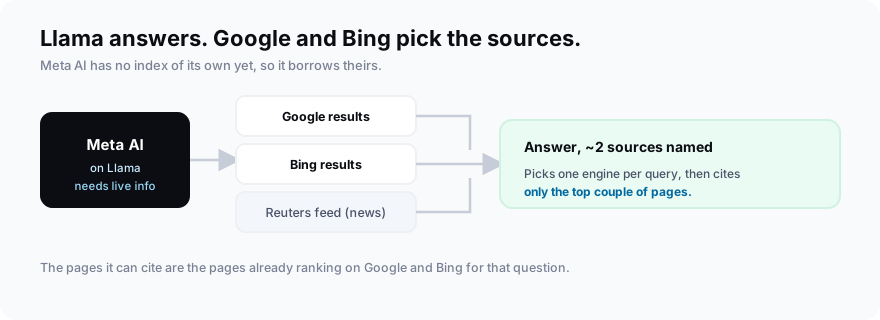
Meta first wired in Bing in 2023, then added Google in 2024, and signed a Reuters deal so the assistant can answer news questions from a licensed feed. For a current event, Meta AI reaches for those live sources. For an evergreen how-to, it leans on the ranking web pages behind the query.
News is the special case worth calling out. For breaking topics Meta AI leans on the licensed Reuters feed and live search rather than your evergreen pages, so timely, clearly-dated content in your category is how you land in those answers. Evergreen authority wins the how-to questions; speed wins the news ones.
One number defines the opportunity. Meta AI cites roughly two sources per answer, against twenty or more on Perplexity. The slots are scarce, so the bar to be one of them is high, and the reward for clearing it is a near-monopoly on the answer.
Does Meta AI actually show its sources?
Sometimes, and less often than you would like. On web-grounded questions Meta AI names its sources, but many replies are conversational and answer straight from Llama with no link shown. So there are two wins to separate: being the page Meta AI reads, and being the page Meta AI names. The second is rarer here than on any other major engine.
This is the familiar mention-versus-citation split. A mention is your brand named in the answer text, while a citation is your URL shown as a source. On Meta AI, with only about two slots, the two come apart often.
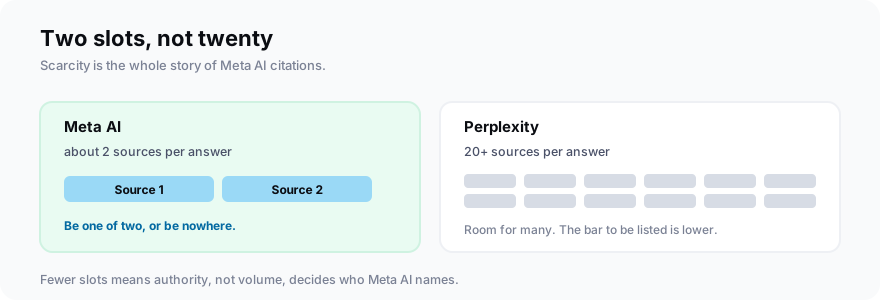
The practical read is that Meta AI rewards being the single clearest answer, not being one voice in a crowd. Where Perplexity might cite you as source nineteen of twenty-three, Meta AI cites you or it does not. For the ChatGPT version of this same distinction, see our guide to checking ChatGPT mentions.
How do you get cited by Meta AI?
You get cited by being the clearest, best-sourced, most authoritative answer to a real buyer question, and by ranking for it on Google and Bing. Lead the page with a direct answer, back it with named statistics and sources, and keep it current. Authority is the lever, because Meta AI is choosing from a very short list.
The controlled research backs this. The Princeton team behind the original Generative Engine Optimization study (KDD 2024) tested nine content changes and found the largest visibility gains, on the order of 30 to 40%, came from adding verifiable statistics, credible quotations, and citing your sources. Those are authority signals, and authority is what wins a two-source answer.
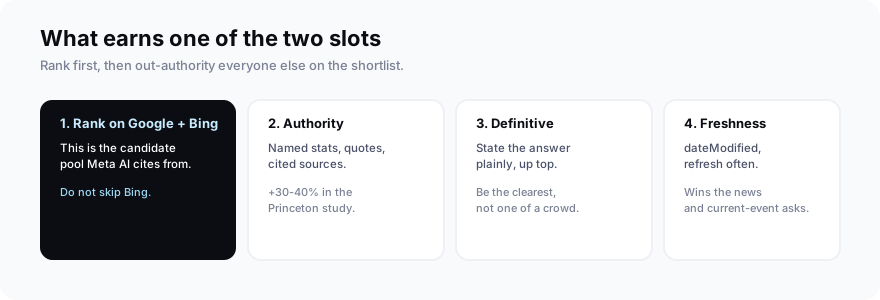
Freshness matters too, and for a specific reason. Meta AI routes news and current-event questions through live Bing, Google, and its Reuters feed, so recently updated pages have an edge on anything time-sensitive. Put an honest dateModified in your schema and refresh your key pages on a real cadence.
Then point all of it at the questions your buyers actually ask, not your brand name. Category comparisons, definitional answers, and use-case questions are where a citation becomes a customer. Win a few of those clearly before you chase the long tail.
Scarcity should change your strategy, not just your effort. With only two slots, depth beats breadth: one page that is the definitive answer to a question outperforms ten thin pages that each half-cover it. Concentrate your authority where you most want to be the brand Meta AI names.
Meta AI does not run a ranking you can reverse-engineer. It borrows Google and Bing, then keeps only the most authoritative two. Earn both.The one-line rule
Why your Google and Bing SEO is your Meta AI strategy
Because Meta AI grounds its web answers in Google and Bing, the pages ranking there are the candidate pool it cites from. That means your existing SEO is doing double duty already, and the fastest way to appear in Meta AI is to climb those two engines for your key questions. There is no separate Meta AI algorithm waiting to be gamed.
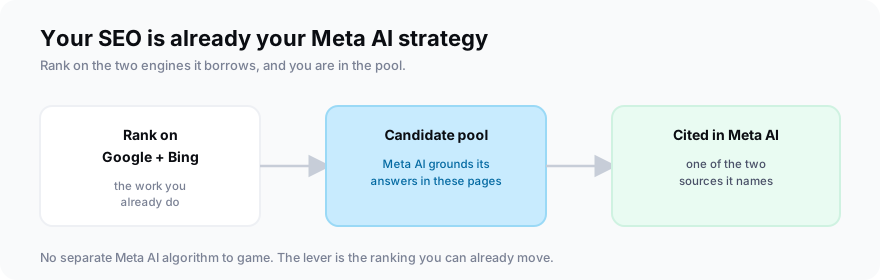
The overlooked half is Bing. Most teams optimize for Google and forget Bing exists, yet Meta AI weighs it as one of its two grounding sources. Submitting your sitemap to Bing Webmaster Tools and earning Bing visibility pays off unusually well here, because the competition for Bing rankings is thinner.
So start where the field is thin. Audit your Bing rankings for your ten priority questions, fix the gaps in Bing Webmaster Tools, and you often move into Meta AI's shortlist faster than by fighting for the crowded Google positions everyone else chases.
There is one caveat worth stating plainly. Meta is building its own search index to cut its reliance on Google and Bing. When that lands, the grounding shifts, so bet on durable authority rather than a single engine, because authority is what survives the switch.
How is getting cited in Meta AI different from ChatGPT?
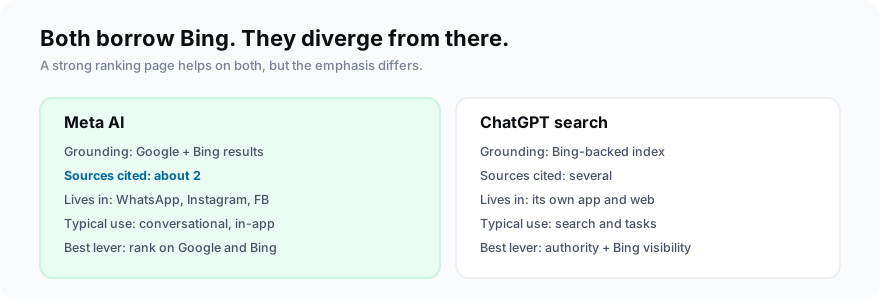
Meta AI grounds on both Google and Bing and cites about two sources; ChatGPT leans on a Bing-backed index and reads more broadly. Meta AI also lives inside private chats on WhatsApp and Instagram, so much of its use is conversational rather than search. The plumbing overlaps enough that a strong page helps on both, but the emphasis differs.
| Factor | Meta AI | ChatGPT search |
|---|---|---|
| Grounding | Google + Bing results | Bing-backed index |
| Sources cited | About 2 per answer | Several per answer |
| Where it lives | WhatsApp, Instagram, Facebook | Its own app and web |
| Typical use | Conversational, in-app | Search and tasks |
| Best single lever | Rank on Google and Bing | Authority + Bing visibility |
| Own index? | In development | Uses Bing |
The good news is that the work compounds. Because both engines lean on Bing, and Meta AI adds Google, a single authoritative page that ranks well earns you visibility across Meta AI, ChatGPT, and classic search at once. Our ChatGPT SEO guide and Grok guide cover the other engines in the same series.
Can you block Meta AI from training on your content?
Yes, and cleanly. Meta uses a crawler called Meta-ExternalAgent to gather public content for training Llama and improving Meta AI, and it honors robots.txt, so a disallow rule keeps it out. That is the opposite of a crawler like Bytespider, which ignores the file.
But separate two things before you block. The training crawler is not how you get cited in answers, which happens through Google and Bing grounding, so blocking Meta-ExternalAgent removes you from Llama's training data, not from Meta AI answers. It is also distinct from facebookexternalhit, the link-preview bot that renders your cards when people share you.
How do you measure your Meta AI visibility?
You measure it by running a fixed set of buyer prompts through Meta AI on a schedule and recording which brands it names each time, yours and your competitors. Because only about two sources appear per answer, a single ranking change can flip whether you are named at all, so one manual check tells you little. The trend from repeated runs is the signal.
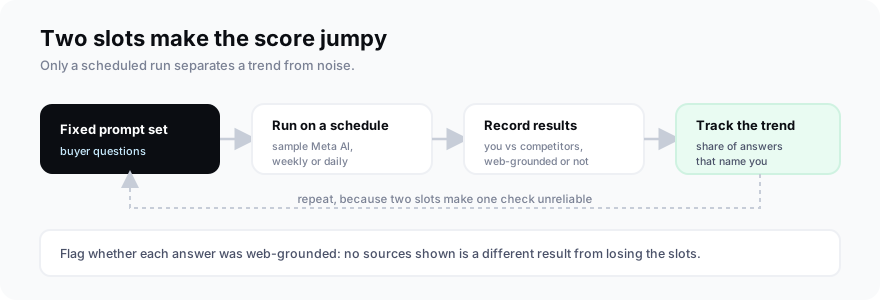
Meta AI is harder to measure than most, because so much of its use is private and in-app, and it has no broad public search API. So you sample it with representative prompts and track the share of answers that name you, the same way you track your AI share of voice across the other engines.
Log the same fields every run so the numbers compare: which brands were named, whether each was cited with a link or only mentioned, and whether the answer was web-grounded at all. That last flag matters on Meta AI, because a conversational answer with no sources is a different result from losing the two slots to a competitor.
Doing that by hand does not scale, and it will not catch a competitor climbing into one of the two slots. That is why teams query each engine through an API on a schedule and parse the results automatically, which is the whole point of monitoring competitor AI visibility.
Frequently asked questions
How does Meta AI decide what to cite?
Does Meta AI show its sources?
Does optimizing for Google and Bing help you show up in Meta AI?
How is getting cited in Meta AI different from ChatGPT?
Can you block Meta AI from your site?
How do you measure your Meta AI visibility?
Rank first, then earn the second slot
Do this next: pick your ten highest-intent buyer prompts, rank for them on Google and Bing, and make each page the most authoritative, best-sourced answer available. That is what puts you in Meta AI's two-source shortlist.
Then measure. Sample your Meta AI citations with MentionsAPI on a schedule, watch the trend against competitors, and keep your AI visibility fundamentals in order across every engine, because the same authority wins all of them.