Most guides treat DeepSeek like a smaller ChatGPT. It is a different kind of thing entirely.
DeepSeek SEO only makes sense once you see what DeepSeek actually is. It is an open-weight AI lab out of China whose models, the R1 reasoner and the V3 and V4 lines, are downloadable and cheap, which is why they run everywhere. It reached around 130 million active users by the end of 2025, but its real reach is bigger than that app number suggests.
This guide covers what DeepSeek is, whether it searches and cites, why optimizing for it is two jobs rather than one, how to win each, how it differs from ChatGPT, and how to measure where you stand. The short version: publish clean pages for its search mode, and get into the training data for everything else.
What is DeepSeek?
DeepSeek is a Chinese AI lab whose large language models are open-weight, meaning anyone can download and run them. Its R1 reasoning model triggered the January 2025 market shock by matching frontier quality at a fraction of the cost, and its V3 and V4 models continued that. The models are cheap, capable, and, crucially, not locked inside one app.
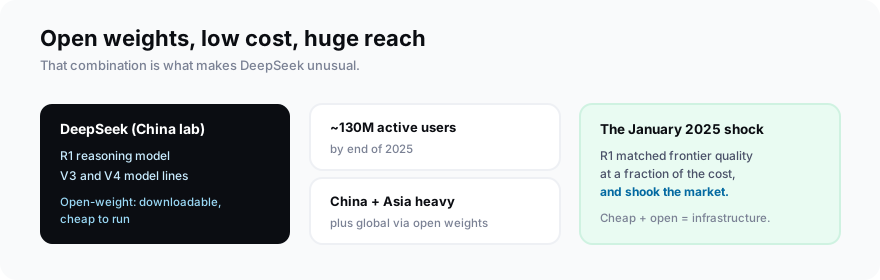
Price is why it spread. DeepSeek's API runs at a fraction of frontier pricing, cents per million tokens, and the weights are free to self-host, so developers reach for it as a cheap default. Cheap plus open is what turns a model into infrastructure other products quietly build on.
The audience skews toward China and Asia. DeepSeek is one of the most-used AI apps in China, and China, India, and Indonesia make up roughly half its monthly active users. If your buyers are Western enterprise, DeepSeek matters less to you directly than ChatGPT does, but its open weights still carry your brand into tools your buyers use.
So who should care most? Developers first: if you sell to them, DeepSeek is probably already in your buyers' stack through OpenRouter or a self-hosted deployment, answering their questions with no search and no citation. If your market is global or price-sensitive, its cheap API makes it the model many products quietly default to, though Western enterprise brands can weight it lower.
One caveat belongs up front. DeepSeek censors China-sensitive topics, and the refusals are baked into the model weights during training, not just bolted on as an app filter. For commercial and technical questions this never comes up, but DeepSeek is not a neutral source on politically sensitive subjects.
Does DeepSeek search the web and cite sources?
Yes, but only when you switch it on, and most people never do. The DeepSeek app has a Search toggle that starts off; enable it and DeepSeek fetches live results, reads pages, and attaches numbered citations. Leave it off, which is the default, and the answer comes purely from the model with no sources at all.
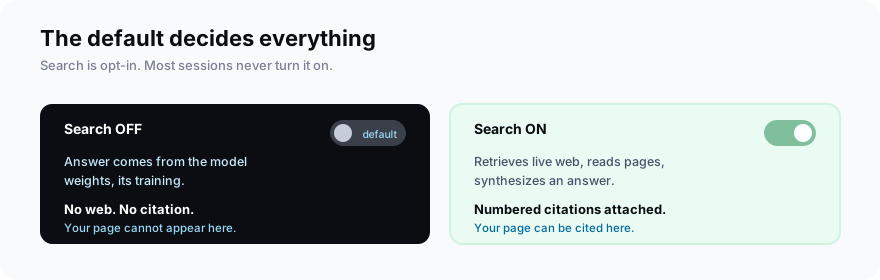
This is the opposite of Perplexity, which always searches, and unlike Grok, which grounds in real time. Search on DeepSeek is opt-in and separate from its Deep Thinking reasoning mode, so a large share of real DeepSeek answers never touch a live web page and cannot cite you.
When search is on, the usual caveats apply. A 2025 Nieman Lab analysis found DeepSeek, like other chatbots, sometimes attributes claims to the wrong source. Being cited is good, but the citation is not a guarantee the model represented you accurately.
Why DeepSeek SEO is really two problems
Because DeepSeek is open-weight, it is an ingredient, not a destination, and that splits your job in two. The DeepSeek app with search on is one surface, where you can be cited like on any retrieval engine. The far larger surface is the model itself, running inside other apps with no search, where the only way to appear is to be in what it learned.
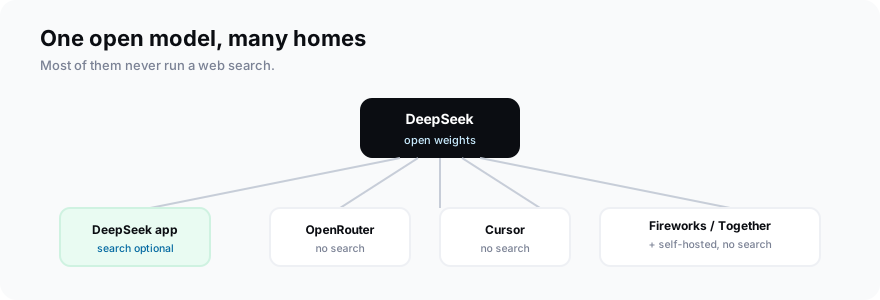
The distribution is real, not theoretical. DeepSeek's models are served through OpenRouter and Western hosts like Fireworks, Together, and DeepInfra, and dropped into coding tools like Cursor. The V4 Flash model became a common frontier substitute in agentic pipelines, which means DeepSeek answers reach people who never opened the DeepSeek app.
In every one of those places, there is no search box and no citation. The model answers from its weights. So the question shifts from "how do I rank in DeepSeek" to "is my brand part of what DeepSeek knows," which is a training-data question, not a ranking one.
Picture where you actually surface: a developer asking a coding tool that runs DeepSeek gets an answer straight from the weights, no search, no link. A researcher in the DeepSeek app with search switched on gets a cited answer. Same model, and only one of those two can ever show your URL.
For most engines you optimize a search result. For DeepSeek you also have to get into the model itself, because that is what answers when no one is searching.The one-line distinction
How do you get cited in DeepSeek's search?
You get cited by publishing the clean, direct, well-sourced page a retrieval system can lift. Lead with the answer, write in declarative statements rather than hedged prose, back claims with named statistics and sources, and keep the page crawlable. This is standard answer-engine optimization, and it is the same work that wins ChatGPT and Perplexity.
The research backs the authority angle. The Princeton team behind the original Generative Engine Optimization study (KDD 2024) found the biggest visibility gains, around 30 to 40%, came from adding verifiable statistics, quotations, and cited sources. Definitive, evidence-backed writing is what these models lift.
One DeepSeek-specific tuning: it reads structure well. Numbered lists, clear question-form headings, and definition-style formatting help its parsing pull a clean answer, which is what the practitioner guides for DeepSeek consistently report. Structure does not replace authority, but it makes your authority easier to extract.
Declarative writing is worth taking literally here. "DeepSeek's search is off by default" is liftable; "DeepSeek may in some cases not enable search automatically" is not. The model scans for extractable facts, so a sentence that states one plainly is far likelier to become the cited answer than a hedged one that buries it.
Point all of it at the questions your buyers actually ask, not your brand name. Category comparisons, definitional answers, and how-to questions are where a search-on citation turns into a customer. Win a handful of those clearly before you widen the net.
How do you show up when search is off?
You show up by being in the training data, which means being widely published and cited across the public web that DeepSeek learns from. When there is no search, the model answers from what it absorbed, so the brands it names are the ones that were prominent and well-referenced when it was trained. This is the slow lever, and for DeepSeek it is the dominant one.
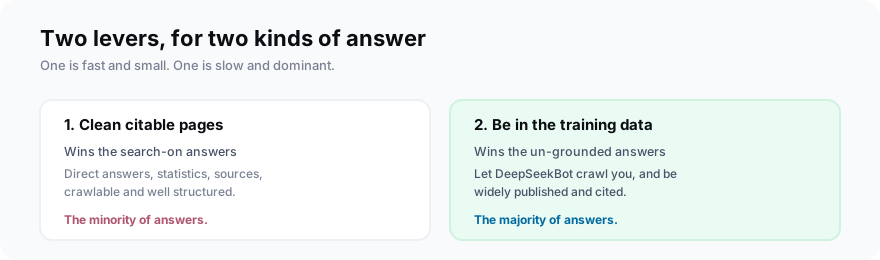
That makes one crawler decision matter. DeepSeekBot is the crawler that gathers public pages to train the model, so if you want to be in DeepSeek's knowledge, you let it in. Blocking it in robots.txt keeps your content out of the training set, which is the opposite of what you want if DeepSeek visibility is a goal.
There is a hard truth in the timing, though: when you win the training-data lever, you are optimizing for the next model, not this one. A brand that becomes prominent today shows up once DeepSeek trains a new version on today's web, which can be months away. That lag is why authority built now pays off later, and why waiting until you are invisible is waiting too long.
There is an honest tradeoff to name: letting DeepSeekBot crawl you feeds a training pipeline run by a Chinese company outside Western data rules, which some organizations will not accept. If that is you, block it and accept that you will be largely absent from DeepSeek answers. For most commercial sites, the visibility is worth the crawl.
How is DeepSeek different from ChatGPT?
DeepSeek is open-weight and search-off-by-default; ChatGPT is closed and grounds more readily. So most DeepSeek answers reflect training data with no citation, while ChatGPT reaches for the web and names sources more often. The optimization overlaps on authority, but the emphasis and the distribution are different.
| Factor | DeepSeek | ChatGPT |
|---|---|---|
| Model access | Open-weight, runs anywhere | Closed, OpenAI only |
| Web search | Off by default | Grounds readily |
| Typical answer | From training, no citation | Often web-grounded |
| Main lever | Be in the training data | Authority + Bing visibility |
| Audience | China and Asia heavy | Global, Western heavy |
| Reach | Also inside other apps | Mostly its own app |
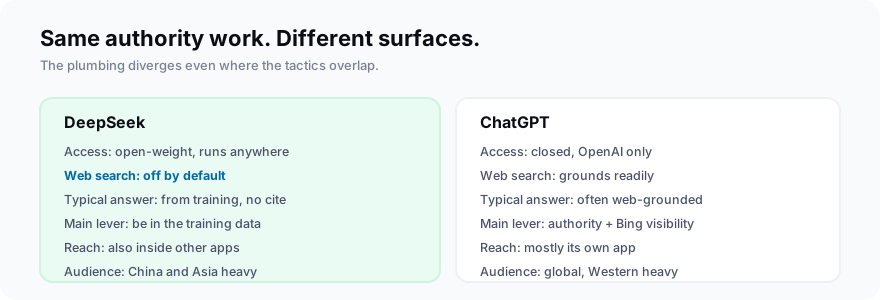
The useful takeaway is that your ChatGPT work is not wasted here. The authoritative, well-sourced content that wins ChatGPT is exactly what ends up in DeepSeek's training data and what its search mode lifts. Our ChatGPT SEO guide and Grok guide cover the neighbors in the same series.
How do you measure your DeepSeek visibility?
You measure it by running a fixed set of buyer prompts through DeepSeek, with search on, and recording which brands it names against your competitors. Because search is off by default, you also want to sample the no-search answers to see what the model says about you unprompted, which reflects your training-data presence directly.
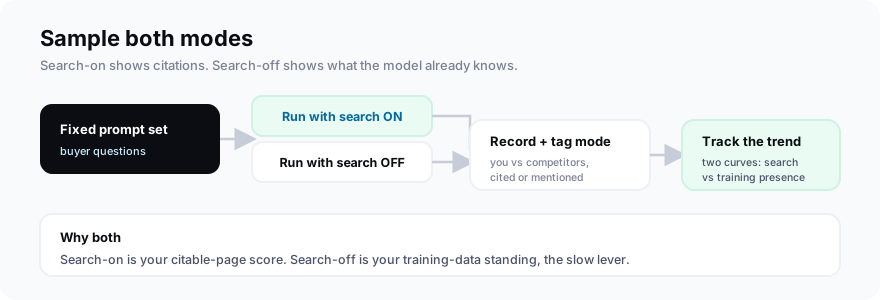
Log the mode with every result so the numbers mean something: whether search was on, which brands were named, and whether each was cited with a link or only mentioned. The search-on and search-off columns answer different questions, and mixing them hides which lever is working.
Doing this by hand does not scale, and it misses the drift between model versions. So teams query DeepSeek through an API on a schedule and parse the results automatically, the same way they track their AI share of voice across every other engine. The no-search answers are the closest thing you get to a live read on your training-data standing.
Watch competitors in both modes, too. If a rival is named in DeepSeek's un-grounded answers and you are not, that gap took months of publishing to open and will take months to close, which is exactly the kind of slow signal our competitor visibility guide is built to catch.
Frequently asked questions
Does DeepSeek search the web and cite sources?
How do you get cited in DeepSeek?
Should you let DeepSeek crawl and train on your site?
How is DeepSeek different from ChatGPT for citations?
Is DeepSeek search on by default?
Does DeepSeek censor answers?
Win the search page, then win the model
Do this next: publish clean, well-sourced answers to your ten highest-intent questions so DeepSeek's search mode can lift them, and make sure DeepSeekBot is allowed to crawl you so they reach the training data too. That covers both surfaces DeepSeek answers from.
Then measure both. Sample your DeepSeek citations with search on and your mentions with search off, watch the trend against competitors, and keep your AI visibility fundamentals in order across every engine, because the same authority wins all of them.