The tool is the easy part. The prompt list is where almost everyone gets it wrong.
Prompt monitoring is rank tracking for the AI era.
Instead of watching where you rank for a keyword, you watch what AI engines actually answer for the real questions your buyers ask, on a schedule, recording whether you are named, where, and who is named instead.
The hard part is not the tracking. It is picking the right prompts, the ones where a buyer might choose a competitor over you.
What is prompt monitoring?
Prompt monitoring is software that runs a fixed set of buyer prompts across AI engines like ChatGPT, Perplexity, and Gemini on a schedule, then records how your brand shows up in each answer over time. For every prompt, it checks whether you are mentioned, where you land, which competitors appear, and which sources the answer cites. It is how you measure your presence in AI answers without checking by hand.
One quick clarification, because the term has two meanings.
In AI engineering, prompt monitoring can mean watching the prompts users send into your own AI app, for abuse or quality. This guide is about the marketing sense: monitoring what AI answers say about your brand for the prompts your buyers use. Same two words, very different job.
Prompt monitoring is a rank tracker where the keyword is replaced by a real buyer question, and the answer names your competitors too.The one line to remember
How does prompt monitoring work?
You give the tool a list of prompts, it runs each one across the engines on a set cadence, and it logs the result every time. Because AI answers change and are stochastic, it runs each prompt repeatedly and tracks the pattern, not a single snapshot. The output is a time series: your mention and citation rate per prompt, per engine, moving week to week.
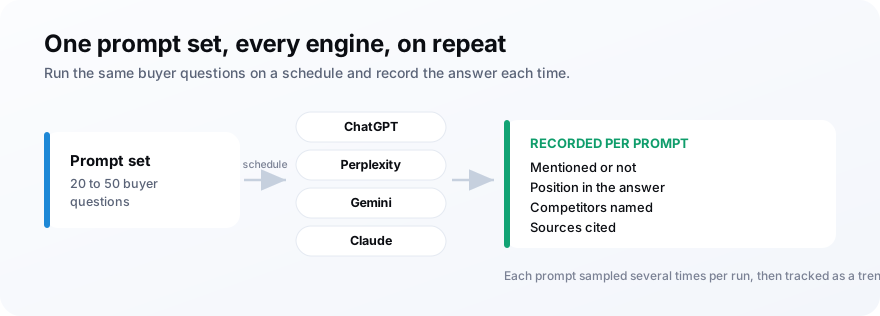
The scheduling and repetition are what make it monitoring, not a spot check.
Anyone can ask ChatGPT a question once and read the answer. Monitoring means asking the same questions on the same cadence, over and over, so you can see the day your mention rate drops or a new competitor starts showing up. A single run is a photo; monitoring is the film.
The payoff is the time series.
Once you have weeks of data, you stop guessing. You can point at the exact week a competitor entered an answer, tie a content change to a rise in your mention rate, and catch a slow slide before it becomes a quarter of lost visibility. A number you can trend is a number you can defend.
How is prompt monitoring different from keyword rank tracking?
The unit changed from a keyword to a prompt, and that changes everything downstream. A keyword had one ranking on one results page; a prompt has an answer that names a few brands and varies by run and by engine. There is no position one to hold. You are tracking whether you are in the answer at all, how prominently, and against whom, not a tidy rank number.
| Aspect | Keyword rank tracking | Prompt monitoring |
|---|---|---|
| The unit | A keyword | A buyer question |
| The result | One ranked list of links | An answer naming a few brands |
| Consistency | Stable from check to check | Varies by run and by engine |
| What you track | Your position, 1 to 100 | Mentioned or not, where, vs whom |
| Competitors | Seen on the same page | Named inside the same answer |
The competitor point is the one teams underestimate.
A rank tracker showed competitors on the same page, but you still each had your own link. An AI answer puts you and your rivals in the same sentence, ranked by the model, which makes prompt monitoring as much a competitive tool as a visibility one. Our guide on AI search tracking covers the cross-engine mechanics in more depth.
Which prompts should you monitor?
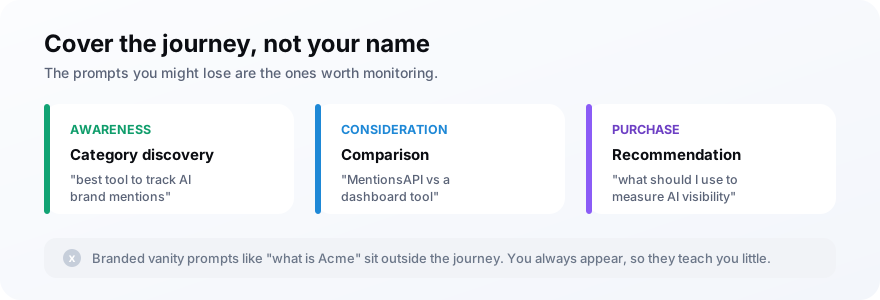
Monitor the questions your buyers actually ask, not your own brand name. The highest-value prompts are category and comparison questions, where an AI recommends someone and it might not be you. Map them to the buyer journey: discovery questions, comparison questions, and recommendation questions. Skip the vanity prompts that only confirm you appear when someone already searched for you by name.
This is where most prompt lists go wrong.
Teams load up on branded prompts, "what is Acme," because they look great in a report. But you almost always appear for your own name, so those prompts teach you nothing. The prompts that matter are the ones you might lose.
| Prompt type | What it reveals | Example |
|---|---|---|
| Category discovery | If AI names you with no brand hint | Best tool to track AI brand mentions |
| Direct comparison | How AI weighs you vs a rival | MentionsAPI vs a dashboard tool |
| Recommendation | If AI recommends you to a buyer | What should I use to measure AI visibility |
| Sentiment and reputation | How AI describes you | Is Acme reliable for enterprise |
Build the list from real buyer language.
The best prompts are the questions your buyers actually type, so mine them from sales calls, support tickets, and the searches that already bring people to you, as SE Ranking and others recommend. Prompts built on real demand, not guesses, are the ones worth watching, a point ReachLLM makes well.
A simple way to build the list from what you already have:
Pull the questions from your last 20 sales calls, the converting searches in your analytics, and the subject lines of your support tickets. Phrase each one the way a person talks to an AI, in full sentences rather than keywords. That gives you a prompt set grounded in real demand instead of a brainstorm.
One more filter helps: keep the buyer's intent, drop your own ego.
If a prompt only makes sense because you already know the company exists, it belongs in a reputation report, not a visibility monitor. The monitor is for the open questions where the model still gets to choose who to name.
What do prompt monitoring tools do?
They automate the whole loop: store your prompt set, run it across the engines on a schedule, parse each answer for brands and sources, and alert you when something changes. Most refresh daily or weekly and show your mention and citation rate per prompt, per engine, next to competitors. The category is young but crowded, with tools like SE Ranking, Otterly, PromptRush, and Promptwatch.
What separates them is coverage and whether you can trust the data.
Some watch one or two engines; some report a single blended score with no way to check it. Weigh them the way you would any measurement tool, on accuracy and engine coverage, which our guide on choosing an AI visibility tool walks through. For a wider list, see the best AI visibility tools.
Or you skip the dashboard and pull the data yourself.
If you want to build monitoring into your own reporting or watch many brands at once, an API hands you the raw per-prompt results to compute whatever you need, an option several tool roundups now call out alongside the dashboards.
How many prompts should you monitor, and how often?
Start with 20 to 50 prompts that cover your buyer journey, and run them at least weekly. That is enough to see real movement without drowning in noise. Run them more often, daily, for a launch or a reputation watch. The rule that matters more than the count: keep the same prompt set over time, or you cannot compare one week to the next.
Resist the urge to monitor everything.
A focused set of 30 prompts you actually review beats 300 you never open. Start narrow, on the questions closest to a buying decision, and expand only when a prompt earns its place by telling you something you act on.
Sampling is the detail that separates signal from noise.
Because the same prompt can name different brands on different runs, a single ask is unreliable. Running each prompt several times per cycle and averaging is what turns a volatile answer into a trend you can trust.
What should you watch for each prompt?
For every prompt, watch five things: whether you are mentioned, where you land in the answer, which competitors are named, which sources the answer cites, and how you are described. A mention with no citation, a slip from first to last, or a new competitor appearing are all signals a single visibility score would blur into one number.
- Mentioned or not: the baseline. Are you in the answer for this prompt at all?
- Position: first recommendation, or buried at the bottom of a list?
- Competitors named: who shares the answer, and is anyone new showing up?
- Sources cited: which URLs the answer links, and whether one is yours.
- Sentiment: whether the mention is a recommendation, a neutral note, or a warning.
Set alerts on the changes that matter, not every wobble.
A prompt flipping from naming you to dropping you, or a competitor entering a key answer, is worth a notification. Normal run-to-run variation is not. Our guide on AI search analytics covers how to turn these per-prompt signals into metrics you can report.
The mistakes that make prompt monitoring useless
Most failed setups share the same few errors, and each one produces a dashboard that looks fine while telling you nothing. These are the ones worth checking your own setup against.
- Vanity prompts: tracking your own brand name, where you always appear, instead of the category questions you can lose.
- One run per prompt: trusting a single stochastic answer instead of sampling several times and averaging.
- One engine: watching only ChatGPT while you quietly lose Perplexity and Gemini.
- A shifting prompt set: changing the prompts between checks, so nothing compares over time.
- No alerts: collecting data nobody reads until a competitor has owned an answer for months.
Fix those five and the monitor earns its place. Miss them and it is a green light on a broken gauge.
Frequently asked questions
What is prompt monitoring?
How does prompt monitoring work?
What prompts should I monitor for AI visibility?
How many prompts should I track?
How often should I run prompt monitoring?
Is prompt monitoring the same as rank tracking?
Monitor the prompts you can lose
Do this next: write down the ten questions a buyer in your category would ask an AI without ever typing your name. Those are the prompts worth monitoring, because those are the ones you can lose.
Then run them on a schedule and watch what comes back. Use MentionsAPI to monitor those prompts across ChatGPT, Claude, Gemini, and Perplexity, see who gets named each week, and act the moment a competitor takes an answer that should be yours.
The branded prompts can wait. The ones you might actually lose cannot.