A pretty dashboard is easy to build. Accurate data is hard, and it is the only part that matters.
Choosing an AI visibility tool comes down to one question most buyers skip: is the data accurate?
Nearly every tool will hand you a clean 0 to 100 score. But the same brand and the same prompt can return wildly different numbers depending on which tool you ask.
So evaluate accuracy first, then engine coverage, prompt control, and whether you can get the raw data. Here is how to run that evaluation before you sign anything.
How do you choose an AI visibility tool?
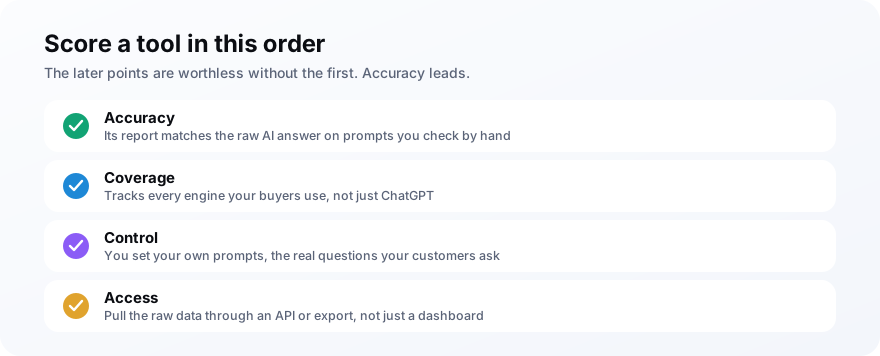
Score the tool on four things, in order: accuracy, coverage, control, and access. Accuracy is whether its reported mentions match what the AI actually said. Coverage is how many engines it tracks. Control is whether you can set your own prompts. Access is whether you can pull the raw data, beyond whatever the dashboard chooses to show.
Most buyers compare price and features and never test the one that decides everything: accuracy.
The order matters, because the later items are worthless without the first.
A tool that tracks nine engines with beautiful charts is useless if it tells you that you were mentioned when you were not. Coverage and design are easy to demo. Accuracy is the thing vendors hope you never test, so test it first.
A wrong number in a beautiful dashboard is still a wrong number. Test accuracy before you test anything else.The one line to remember
Why do AI visibility tools disagree on the same brand?
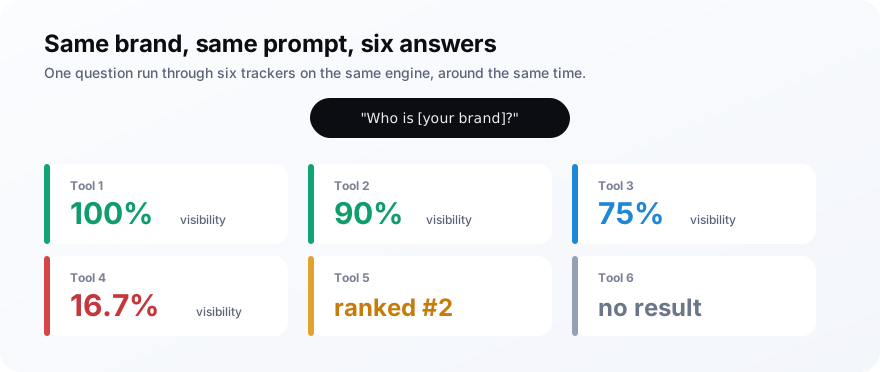
Because each tool runs its own prompts, samples at its own moments, and scores answers by its own rules, and AI answers shift through the day. In a 2026 test that ran one prompt about one brand across six tools, the reported visibility ranged from 16.7% on one tool to 100% on another, on the same engine. That is not a rounding error. It means a single tool's number is only meaningful against its own history.
The details of that test are worth sitting with.
Writing in a public teardown, the author ran the same prompt through six trackers. One tool reported the Gemini answer as a first-place mention with 100% visibility. Another, checking the same prompt less than a day later, reported the brand as not mentioned at all, 0%.
And a high score can hide a worse problem than disagreement.
In the same test, one answer cited the brand's website but attributed it to the wrong person. The visibility score looked great, while the AI was actively getting the brand wrong. A number that counts the mention but misses the error is telling you the opposite of the truth.
None of this is a bug in one bad tool.
A separate 2026 methodology audit found the same underlying data can produce scores across a 31-point range on weighting choices alone, before you add the day-to-day volatility of the answers themselves. Two honest tools can both be built correctly and still hand you very different numbers.
How do you test an AI visibility tool's accuracy?
Run the check by hand before you trust the dashboard. Pick five prompts your buyers actually use, ask the AI engines yourself, and read the answers. Then compare what you saw to what the tool reports. If the tool says you were mentioned and you were not, or misses a citation you can see in the answer, its score is decoration. Do this during the trial, before you pay for a year.
Here is the test, step by step.
- Write down five real buyer prompts, the actual questions your customers ask an AI.
- Run each one yourself in ChatGPT, Perplexity, Gemini, and any engine you care about, and screenshot the answers.
- Note whether your brand appears, where, and whether the answer links to you or gets a fact wrong.
- Open the tool and compare its report for those same prompts against what you just saw.
- Count the misses. A tool that disagrees with the raw answer on two of five prompts is wrong 40% of the time.
The point is not to catch the tool out. It is to learn how far you can trust it.
A tool that matches your manual read is one you can leave running. A tool that does not means every report it sends you needs a second check, which defeats the reason you bought it. Our guide on how to check if ChatGPT mentions your brand walks through the manual version of this test.
Re-run the test every few months, too.
Tools change their models and detection rules, and one that was accurate in the spring can drift by autumn. A short spot-check twice a year keeps you honest about the numbers you report upward, and catches a tool that quietly got worse after you signed.
Should the tool flag when AI gets your brand wrong?
Yes, and it is the feature most buyers do not know to ask for. Being mentioned is not the same as being described correctly. An AI answer can name you, link to you, and still say you were founded in the wrong year or serve the wrong market. A good tool flags those errors, on top of the mention itself.
This is where a raw mention count quietly fails you.
Some platforms now include accuracy or hallucination detection that surfaces when an engine states something false about your brand, as tool roundups like Frase's now call out. Without it, your dashboard cheerfully counts a mention that is actively pushing wrong information to buyers.
You can approximate the check yourself.
When you run your five test prompts, do not stop at whether you appear. Read what the AI says about you, and mark anything false. If a tool cannot show you the wording of the mention, it cannot help you catch the errors, and errors are the expensive part.
What engines and prompts should it cover?
It should track every engine your buyers use, not one or two. That means ChatGPT, Google AI Overviews and AI Mode, Perplexity, Gemini, Claude, and Copilot at a minimum, because a tool that only watches ChatGPT gives you a confident, incomplete picture. It should also let you write your own prompts, since canned prompt lists rarely match the questions your customers ask.
Coverage gaps are dangerous because they are invisible.
You can be a top recommendation on Perplexity and completely absent on ChatGPT, and a single-engine tool will happily report the half it can see. The engines behave differently enough that one is not a proxy for the rest, which is why our roundup of AI visibility tools weighs coverage so heavily.
Prompt control is the other half of the same problem.
If a tool runs its own fixed prompt list, it is measuring generic category questions instead of your buyers' real ones. A score built on prompts nobody in your market types is precise and useless. Insist on setting your own prompts, then measure those.
How many prompts it runs matters as much as which ones.
Semrush, for one, says it runs around 2,500 curated prompts against AI platforms every month, per its own 2026 index. A tool that checks a handful of prompts is sampling too thin to be stable, so ask how many prompts your plan actually covers and whether you can raise the number as you grow.
Which features actually matter?
Four features earn their keep: custom prompts, citation-source detection, accuracy flagging, and raw data export. The rest is packaging. Custom prompts test real buyer questions, citation detection shows which URLs each engine trusts, accuracy flagging catches when AI describes you wrong, and export lets you verify and build on the data instead of staring at a chart.
| What to check | Why it matters | How to test it |
|---|---|---|
| Accuracy | A wrong score is worse than none | Compare its report to the raw answer on 5 prompts |
| Engine coverage | You can be strong on one engine, absent on another | Confirm it tracks every engine your buyers use |
| Custom prompts | Canned prompts miss the questions your buyers ask | Try adding your own prompt and running it |
| Citation detection | Shows which URLs each engine trusts | Check it names the source pages, not just the mention |
| Raw data export | Lets you verify and build on the data | Look for an API or export, not just a dashboard |
One number to read carefully on any pricing page: how the tool counts usage.
Most AI visibility tools price on prompt count times refresh frequency times engine coverage. That means the honest way to compare two tools is to price the same prompt set, refreshed at the same cadence, across the same engines. A cheap plan that only refreshes monthly or skips engines is not cheaper, it is measuring less.
Do you need a dashboard or an API?
A dashboard is fine if one person checks a score now and then. An API is what you need if you track many brands, feed the data into your own reports, or want to verify every mention against the raw answer. Agencies and product teams almost always outgrow the dashboard. The question is whether you are buying a chart to look at or data to act on.
The accuracy problem is exactly why the raw data matters.
When a tool hands you a blended score, you have to trust its mention detection. When it hands you the raw per-engine results, whether ChatGPT named you, where, and which URL it cited, you can check the tool against the answer yourself. Raw data is auditable. A score is not. Our comparison of an AI monitoring API versus a dashboard goes deeper on when each one fits.
A quick way to decide: count your brands and your cadence.
One brand, checked monthly, is a dashboard job. Ten client brands refreshed weekly, feeding a report you send to someone else, is an API job. If you will ever pull the numbers into a spreadsheet or a slide, you want the data, not a screenshot of another tool's chart.
Frequently asked questions
How do I choose an AI visibility tool?
Why do AI visibility tools show different scores?
How do I know if an AI visibility tool is accurate?
What engines should an AI visibility tool track?
Do I need an AI visibility tool or can I check manually?
Should I use a dashboard or an API for AI visibility?
Buy the accuracy, not the dashboard
Do this next: before you compare prices, run the five-prompt accuracy test on any tool you are considering. Ask the engines yourself, read the answers, and check whether the tool agrees with what you saw. The one that matches reality is the one to buy.
Then make sure you can get the data out. Pull the raw per-engine mentions and citations with MentionsAPI, verify them against the real answers, and build your reporting on data you can trust instead of a score you have to take on faith.