One of these engines cares what X said ten minutes ago. The other does not.
That is the whole comparison in a sentence. For search visibility, Grok and ChatGPT differ most in what they read and how fresh it is.
Grok pulls from the live X post graph and the current web, so its answers move with the conversation. ChatGPT reads a broad Bing-backed index that updates on a slower clock. Same question, two different pools of evidence, and two different jobs for you.
Grok vs ChatGPT: what actually differs for visibility?
For visibility, the real difference is freshness and source type. Grok grounds answers in live X posts plus the open web, so recency and social chatter carry real citation weight. ChatGPT reads a broad, slower web index, so durable, well-referenced pages win. Grok rewards being talked about right now; ChatGPT rewards being documented well over time.
Neither is the smarter engine here. They are pointed at different data.
That means a tactic that wins one can be nearly invisible on the other. A burst of credible X posts about your launch can put you in Grok answers the same day and do almost nothing for ChatGPT that week.
The flip side is just as real. A deeply researched page that ChatGPT loves can go unnoticed by Grok if nobody credible is talking about it on X right now.
So the question is not which engine is better. It is which one your buyers actually open, and what each needs to see before it will name you.
Grok reads what people are saying now. ChatGPT reads what the web has settled on.The whole piece in one line
Which one is bigger, Grok or ChatGPT?
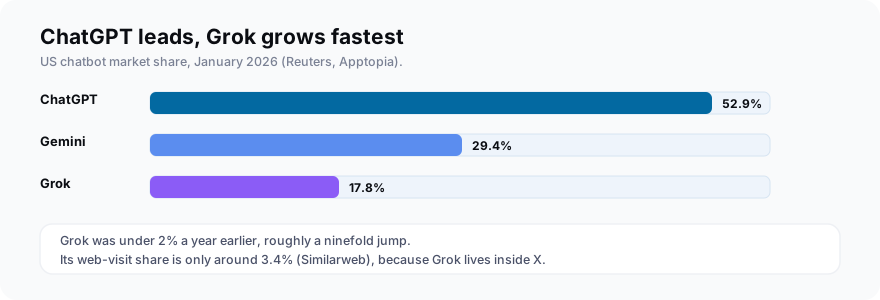
ChatGPT is much bigger, but Grok is growing fastest. Reuters, citing Apptopia, put ChatGPT at 52.9% of the US chatbot market in January 2026, with Gemini at 29.4% and Grok third at 17.8%. Grok's share was under 2% a year earlier, roughly a ninefold jump. ChatGPT also reaches about a billion people a week, a scale Grok is nowhere near.
The trend line is the part to watch, though. Grok went from under 2% to 17.8% of the US chatbot market in a single year, the fastest climb in the category.
So why care about the smaller engine at all? Because of where it lives, and because it is growing faster than anything else on the board.
Grok sits inside X, in front of a large, active, opinion-forming audience. Its web-visit share is only around 3.4% per Similarweb, far below its app usage, precisely because most people meet Grok inside the X app, not on a separate site.
So there are two kinds of big here. ChatGPT is big the way a search engine is big, a destination people go to on purpose.
Grok is big the way a feature is big, sitting in an app hundreds of millions already open for other reasons. If your buyers are on X anyway, Grok reaches them without asking them to go anywhere new, and that convenience is a real slice of the answers they see.
How does each one find and cite sources?
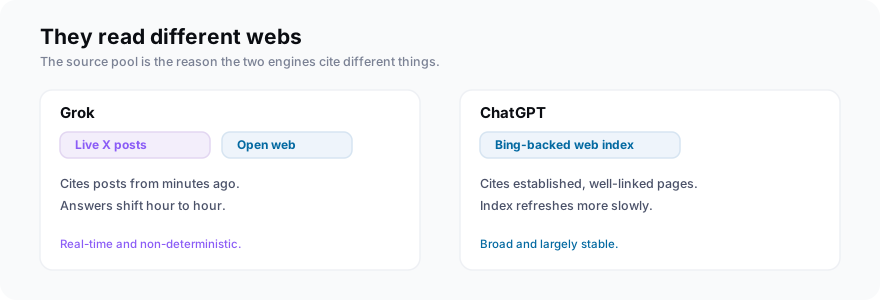
Both run a live search and answer with cited, clickable sources. The pools differ. Grok uses two tools, an X search over live posts and a web search over the open internet, and can show a reasoning trace of what it read. ChatGPT retrieves through a Bing-aligned web index and links a handful of sources per answer. So Grok can cite a post from minutes ago; ChatGPT rarely can.
The X layer is the part no other major engine has. Per xAI's own docs, Grok can search live X posts as a first-class source alongside the web.
That is a genuine edge and a genuine catch. It means a credible account posting about you becomes citable in a way a blog post never is on ChatGPT.
It also means the citation surface is bigger than your own site. On ChatGPT, your pages and the pages that mention you are the game.
On Grok, the live conversation about you is a third input, one you influence but do not own. That is powerful when people are talking about you and quiet when they are not.
It also means Grok is non-deterministic. Ask it the same question an hour later and the live posts it pulls may have changed, so your citation can appear and vanish without you touching your site.
Why Grok and ChatGPT cite different sources
They cite different sources because they were built on different data. Grok grew out of X and treats the live post graph as a primary source, so social discussion and recency rank high. ChatGPT grew out of broad web pretraining and retrieval, so it leans on established, well-linked pages and consensus. The newest credible voice tends to win on Grok, while the best-documented page tends to win on ChatGPT.
You can see it in how each handles a fast-moving topic.
Ask about a tool that shipped this week, and Grok will often quote the X thread announcing it. ChatGPT is more likely to wait until enough durable pages exist to describe it, then cite those.
Picture launching a product on a Tuesday. If a handful of credible people in your space post about it that day, Grok can start citing you within hours, while the launch is still the conversation.
ChatGPT may not reflect the same launch for weeks, until reviews, docs, and roundups pile up in its index. Two engines, two clocks. If your news is time-sensitive, that gap is the whole game.
Grok vs ChatGPT: the visibility differences that matter
Here is the head-to-head. Read it as two playbooks, not a winner, because the column you care about depends on where your buyers actually ask.
| Grok | ChatGPT | |
|---|---|---|
| Primary sources | Live X posts + open web | Bing-backed web index |
| Recency | Minutes old, real-time | Days to weeks |
| Answers are | Non-deterministic | Largely stable |
| US chatbot share (Jan 2026) | 17.8% | 52.9% |
| Biggest lever | Credible X presence | Well-sourced pages |
| robots.txt control | Unreliable | Honors GPTBot |
Who should prioritize Grok over ChatGPT?
Prioritize Grok when your buyers live on X. Grok grounds answers in the live post graph, so audiences that argue and share on X are where its citations get decided. If that is your crowd, Grok punches above its 17.8% share for you specifically.
That describes some categories more than others.
Tech, crypto, finance, politics, sports, and media move on X, so Grok visibility matters sooner there. A local plumber or a niche ecommerce store sees far less of its audience on X, so ChatGPT and Google-facing work pay back faster for them.
Match the effort to the room. Chasing Grok for an audience that never opens X is motion without movement, and skipping it for an audience that lives there leaves easy citations on the table.
One more thing tips the call: how time-sensitive your topic is. If you sell on launches, trends, or news, Grok's speed is worth chasing even at its smaller size, because it can put you in the answer while the moment is still live.
How do you get cited by Grok and ChatGPT?
You get cited by both with one clean content base and two different distribution moves. Write clear, well-sourced, answer-first pages that any engine can trust, then push freshness and a credible X presence for Grok while building durable authority and references for ChatGPT. The writing discipline is shared; the amplification is not.
The shared base is the same one that wins AI citations everywhere. A Princeton study presented at KDD 2024 found that adding statistics, quotations, and cited sources lifted a page's visibility in generative answers by up to 40%. That helps you in both engines.
After that, the two split.
- For Grok, keep pages current and dated, since a fresh page can outrank a stronger stale one.
- For Grok, earn credible X accounts in your space talking about you, because the live post graph is a citation input.
- For ChatGPT, build durable, well-linked pages a slower index can settle on and trust.
- For ChatGPT, get into the third-party roundups and comparison pages in your category, since it leans on consensus.
- For both, front-load the answer, add schema, and back claims with named, dated sources an engine can lift cleanly.
The Grok half is the one most teams have never done. It is not a robots.txt or schema task, it is a distribution one.
The lever is getting credible accounts in your space to talk about you on X, because that discussion is what Grok's live layer reads. That does not mean buying follower counts. It means real, subject-matter voices your buyers trust posting something Grok can pull, which is closer to digital PR than to classic SEO.
The full per-engine playbooks are in our guides on Grok SEO and ChatGPT SEO. This piece is about choosing where to spend first.
How do you track your brand in both?
Track both by running your real buyer prompts through Grok and ChatGPT on a schedule and recording whether each named you and what it cited. Keep the two lines separate, because a blended score hides the split. Grok will swing more between runs, so sample it more often to see the real trend rather than a single volatile snapshot.
A one-time check is worse than useless on Grok. It catches a single moment of a feed that never sits still.
Watch two things per engine. How often you get mentioned at all, and how often your own page is the cited source, since those move for different reasons and need different fixes.
On Grok, add a third habit: note what is being said about you on X, not just whether you were cited. Because the live post graph feeds the answer, a shift in the conversation there often shows up in Grok citations a day or two later.
That early signal is something ChatGPT simply does not give you. Its slower index means change arrives gradually, so you tune it with patience rather than same-week reactions.
Frequently asked questions
Does Grok cite sources like ChatGPT?
Is Grok bigger than ChatGPT?
Why does Grok give different answers to the same question?
Does my presence on X affect Grok citations?
Should I optimize for Grok or ChatGPT first?
Can I block Grok the way I block GPTBot?
Pick your first engine, then measure both
Do this next: decide where your buyers actually are. If they live on X, Grok is worth real effort now. If not, put ChatGPT first for its reach and come back to Grok later.
Then measure each on its own. Pull a per-engine baseline with MentionsAPI, keep your Grok SEO and ChatGPT SEO tight, and watch which playbook moves which line.
The Grok vs ChatGPT choice is not really about which engine is better. It is about which one your buyers open, and giving each what it needs before it will say your name.