Everyone argues about which one writes a better paragraph.
Wrong fight. If you care about getting your brand named in AI answers, Claude and ChatGPT differ in one way that actually pays: what they cite.
Both now answer with live sources and clickable links. But they almost never cite the same page.
In OtterlyAI's June 2026 analysis of 379,321 Claude citations, only 13% of the domains Claude cited overlapped with ChatGPT, and just 4.2% at the URL level. Claude reaches for your own product and docs pages. ChatGPT reaches for Wikipedia, Reddit, and the roundups everyone else wrote about you. So the honest answer to which cites better is: it depends on what you need cited.
Does Claude or ChatGPT cite sources better?
Neither cites better in the abstract. They cite for different jobs. Claude is the selective reader, pulling a few clean pages it can verify, so its top 10 domains hold only 9.5% of all citations. ChatGPT is the broad poller, naming a handful of widely referenced pages per answer. Claude wins when you want depth from the source; ChatGPT wins when you want the general read.
So they answer two different questions about your brand. Claude mostly checks what your own site says. ChatGPT mostly checks what the rest of the web says.
Both matter. A buyer who opens Claude and a buyer who opens ChatGPT can get two different shortlists for the same query, sourced from two different corners of the web. Optimize for one and you are invisible in the other.
Claude reads your pages. ChatGPT reads the room. You need to win both reads.The whole piece in one line
How each one actually cites a source
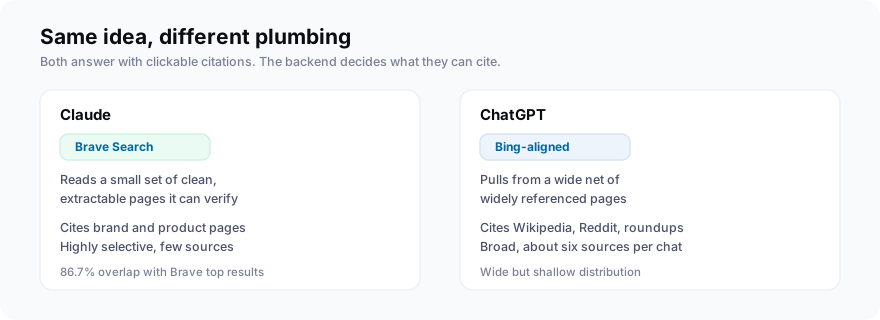
Both engines run a live web search, then write the answer with inline citations that link back to the pages they used. Anthropic launched Claude web search on March 20, 2025, and opened it to all plans globally that May. Claude pulls results through Brave Search, while ChatGPT retrieves through a Bing-aligned pipeline. Same idea, different plumbing.
That plumbing is the whole story. Claude can only cite what Brave surfaces.
One technical breakdown of Claude citations found an 86.7% overlap between the URLs Claude cited and Brave's top organic results for the same queries. If Brave ranks you, you are in the running. If it does not, Claude never sees the page.
ChatGPT works from a wider net. When it answers a question that triggers search, it pulls a small set of pages, usually a few per answer, and links them as citation cards. Profound's data puts ChatGPT at roughly 6 unique citations per conversation and about 4 per turn, with 66% of cited turns showing one to four sources.
Why Claude and ChatGPT cite completely different sources
They cite different sources because they run on different search backends and reward different page types. OtterlyAI's June 2026 study of 379,321 Claude citations across 16,406 domains found brand and product sites take 64.0% of Claude's citations, more than four times the next category, news and media at 14.9%. Claude cited Reddit zero times. On ChatGPT, Reddit and Wikipedia are near the top.
That is not a small difference in taste. It is two separate maps of the web.
Reddit is the cleanest example. It is one of ChatGPT's most-cited domains and showed up zero times in the entire Claude dataset, where social media accounts for just 0.9% of citations. The Reddit strategy every AI visibility post recommends helps you on ChatGPT and does nothing on Claude.
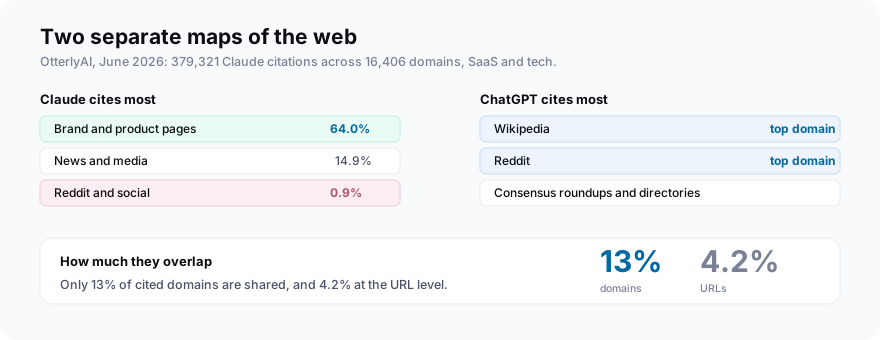
ChatGPT's side of that map is broad and shallow. Profound describes it as a wide but shallow market, where no single source dominates but the distribution is lopsided. Its most-cited domains, Wikipedia and Reddit, each sit in single digits as a share of all citations, yet appear in a large slice of answers.
The exact numbers move by study and category, which is worth saying plainly. A separate May 2026 synthesis by 5W Public Relations put Wikipedia at 13.15% and Reddit at 11.97% of US ChatGPT citations, over a quarter between them, with WSJ, NYT, and Bloomberg absent from the top 20. Different sample, same shape: ChatGPT rewards consensus, Claude rewards the source.
Here is how that plays out. Picture a mid-size project-management SaaS asking both engines, what is the best tool for remote teams.
ChatGPT is likely to lean on a Reddit thread, a Wikipedia entry, and two best-of roundups, then name whoever those agree on. Claude is likelier to open the vendors' own feature and pricing pages, read them, and cite the one whose docs answer the question cleanest. Same question, two different shortlists, built from two different piles of evidence.
Which one is more selective and accurate?
Claude is the more selective of the two. It cites fewer, cleaner pages and skips the long tail of low-structure content. In the OtterlyAI data, 32.9% of the domains Claude cited appeared exactly once, and only 3% of citations pointed at homepages, meaning Claude reaches for the deep answer page, not the front door. ChatGPT casts wider and repeats a small core of reference domains across many answers.
Selective is not the same as correct, so be careful with the word better here.
Both models can still get a citation wrong, especially when they answer from memory instead of running a live search. The fix on both sides is grounding.
When the engine actually searches and links the page, you can check the claim against the source in one click. That is the part that changed. A cited answer you can verify beats a confident answer you cannot.
For a brand, selectivity cuts both ways. Claude is harder to get into, because a thin or messy page will not clear its bar.
Once you are in, though, the payoff is bigger. ChatGPT names about six sources per answer, so a citation there makes you one voice in a crowd. Claude leans on a much smaller set, so being the page it picks often means being the answer, not a footnote in it.
Claude vs ChatGPT: the citation differences that matter
Here is the head-to-head in one view. Read it as two playbooks, not a scoreboard, because the column you care about depends on where your buyers ask their questions.
| Claude | ChatGPT | |
|---|---|---|
| Search backend | Brave Search | Bing-aligned |
| Cites most | Brand and product pages (64.0%) | Wikipedia, Reddit, consensus |
| Reddit share | Zero citations | One of its top domains |
| Sources per answer | A few, highly selective | ~6 per conversation |
| Top-10 domain concentration | 9.5% | Wide but shallow |
| You win by | Owning clean first-party pages | Owning the wider record |
One more piece of context on why both engines are worth the work. Anthropic now leads enterprise adoption, with 32% of enterprise LLM market share against OpenAI's 25% in Menlo Ventures' 2025 report. ChatGPT is the bigger consumer destination, passing 1 billion weekly users in 2026.
So Claude skews toward the buyers with budgets, while ChatGPT has the raw reach. You want to be named in both rooms.
How do you get cited by both Claude and ChatGPT?
You get cited by both by running two playbooks off one clean foundation. For Claude, make your own product, docs, and comparison pages the best answer on the web: structured headings, answer-first paragraphs, schema, and current facts, because Claude cites brand pages 64% of the time. For ChatGPT, fix the wider record: your Wikipedia presence, directory listings, reviews, and the roundups that name your category.
You do not need two content teams for this. Build one clean library, then tune it for each engine.
The Claude tuning knob is your own domain. An analysis of Claude-cited URLs shows a clear pattern in what it reaches for:
- Deep article pages, not the homepage. Only about 3% of Claude citations point at a home page.
- Content on /blog/ and resource paths, which made up more than half of cited URLs.
- Listicle and comparison pages, the best-of and alternatives format, which was close to half.
- Visible, recent dates. Roughly a quarter of cited URLs carried a year in the path.
- Clean semantic HTML with real H2s and answer-first paragraphs a model can lift in one chunk.
If you already do serious technical SEO, you are most of the way there. The full checklist lives in our guide on how Claude picks sources.
The ChatGPT tuning knob is everyone else's pages. Accurate third-party profiles, honest reviews, and inclusion in best-of lists move it more than another post on your own blog. The mechanics of how it retrieves and ranks are in our guide on how ChatGPT search works.
Your Wikipedia and entity footprint matters more on this side too. ChatGPT keeps returning to a small core of reference domains, and Wikipedia sits near the top of that core across every study I found.
You do not need a Wikipedia page to benefit. Consistent facts across the places that describe your category, your name, and what you do give ChatGPT a stable story to repeat instead of a contradictory one to guess at.
Skip the Reddit push if Claude is your target. At zero citations in the Claude dataset, it is wasted effort there, even though it carries real weight on ChatGPT.
How do you track citations across both engines?
Track them by running the same buyer prompts through Claude and ChatGPT on a schedule, then recording whether each engine mentioned you and which page it cited. Watch the two lines apart, never blended, because the engines pull from different sources. A single AI visibility score hides the split that tells you which playbook is working.
One blended number is worse than no number. It averages away the exact signal you need.
If Claude names you but ChatGPT does not, your own pages are strong and your wider record is weak. If ChatGPT names you but Claude does not, the reverse. You can only see that when you measure each engine on its own.
Record two things per engine, not one. Track your mention rate, how often you get named at all, and your citation rate, how often your own page is the linked source. They move separately.
A brand can be mentioned a lot on ChatGPT while its own site gets cited by Claude, and those two facts call for different fixes. Run the check on the same prompt set every couple of weeks so a change in either line is a signal, not noise.
Frequently asked questions
Does Claude or ChatGPT cite sources better?
Why do Claude and ChatGPT cite different sources?
Does Claude cite Reddit like ChatGPT does?
Where does Claude get its sources?
Which should I optimize for first, Claude or ChatGPT?
Do Claude and ChatGPT both show clickable citations?
Win both reads, then measure them apart
The Claude vs ChatGPT question is not which one is smarter. It is which sources each one trusts, because that is what decides whether your brand shows up.
Do this next: pick your five highest-value buyer prompts and run them through Claude and ChatGPT today. Note who each one cites. That baseline shows you which engine already sees you and which one you are invisible in.
Then split the work. Tighten your own product and docs pages for Claude, fix your directory and review record for ChatGPT, and pull a per-engine citation baseline with MentionsAPI so you can watch each number move on its own. The two engines reward different work, so measure them like two different channels.