Most AI visibility tools ask a question once and report the answer. Evertune asks it 100 times.
Evertune AI is a generative engine optimization platform that measures how often AI models mention and rank a brand, then helps the brand respond through content, partners, and ads. Its pricing runs from $60 a month to custom enterprise contracts. In this Evertune review, I cover what it measures, what it costs, where it falls short, and which Evertune alternatives fit which team.
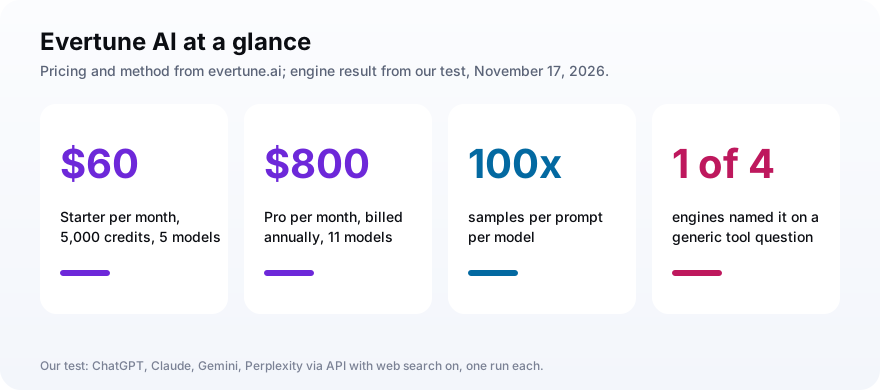
I read Evertune's pricing, methodology, and company pages on November 17, 2026. I also ran a small test the same day: three buyer questions sent to ChatGPT, Claude, Gemini, and Perplexity through their APIs with web search on, 12 answers in total.
Disclosure: MentionsAPI sells an API in the same category, so treat my comparison with that in mind. Our product was named in none of the 12 answers, and I report that below too.
What is Evertune AI?
Evertune is a New York company that calls itself "the marketing platform for brand discovery in AI search." It launched in April 2024 and measures how AI models describe a brand across up to 11 surfaces, including ChatGPT, Gemini, Claude, Perplexity, Copilot, Meta AI, DeepSeek, and Google's AI Overviews and AI Mode. It then sells tools to change that picture.
The founders come from ad tech. Brian Stempeck, the CEO, was the first commercial executive at The Trade Desk, and Evertune's team page lists co-founders Ed Chater and Poul Costinsky from the same world.
That background shows in the product. Evertune sells to marketing teams and agencies, and its Series A announcement of $15 million, led by Felicis in August 2025, brought total funding to $20 million. The homepage claims more than 700 advertisers and agencies as users.
The platform has three layers:
- Measurement: the AI Brand Index, word association, consumer preferences, and shopping intelligence.
- Demand data: EverPanel, a set of more than 150 million real user prompts used to show what people ask.
- Action: a content studio, site audit, partner tools, and an ads agent that buys media around AI chat.
Enterprise buyers can also purchase it through Google Cloud Marketplace, which Evertune announced in September 2026. That matters for companies that want to draw down existing cloud commitments instead of signing a new vendor contract.
How does Evertune measure AI visibility?
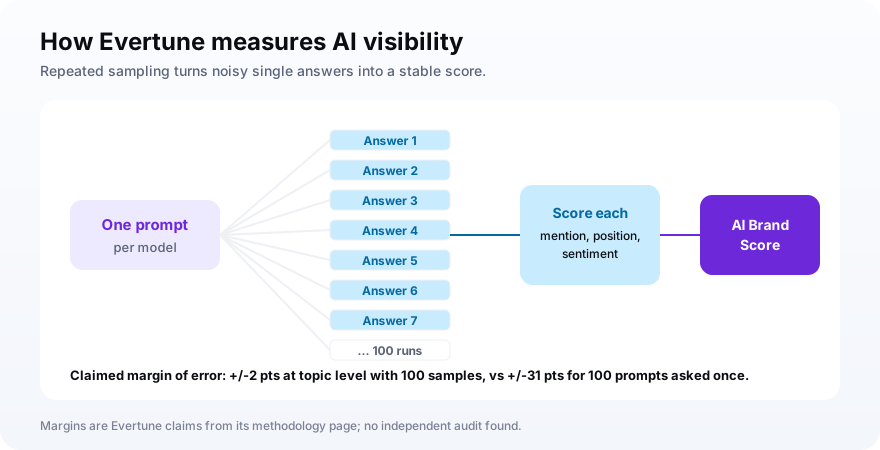
Evertune sends each tracked prompt to every model 100 times and scores the brand across all the answers. AI answers change from run to run, so a single answer is a sample of one. Evertune's methodology page claims a margin of error of plus or minus 2 points at topic level, against plus or minus 31 points for 100 different prompts each asked once.
Those margins are Evertune's own numbers, published on its methodology page, and I found no independent audit of them. The direction is right, though.
A SparkToro and Gumshoe study found less than a 1-in-100 chance that an AI tool returns the same brand list twice for one prompt, Search Engine Journal reported. Repeated sampling is the honest response to that.
I have seen the same thing in our own data. In an audit last week, ChatGPT named our brand on one run and dropped it on the same prompt about a minute later.
So whatever tool you use, judge a score by how many runs sit behind it. A single run records one answer and nothing more.
Evertune also separates two kinds of answers. It queries models through their APIs to see what the model knows from training, and it reports consumer-app results, which include live web search.
That split is useful. A brand can be strong in the model's memory and weak in search-backed answers, or the reverse, and the fix is different in each case.
Evertune pricing in 2026
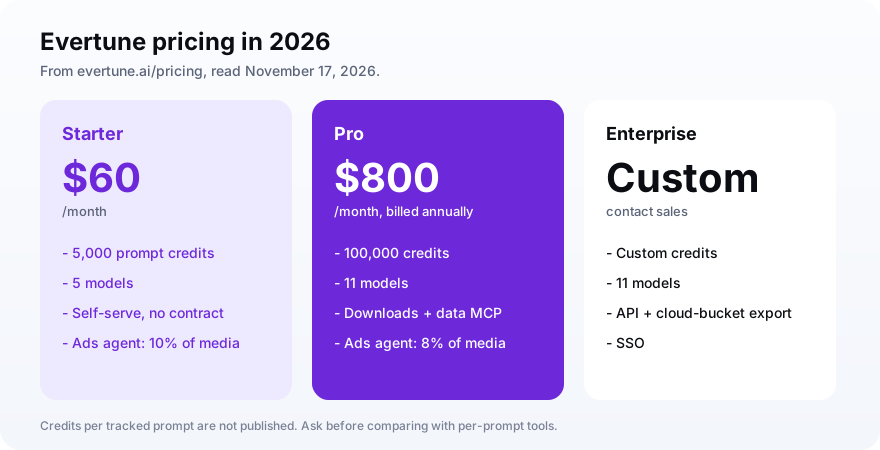
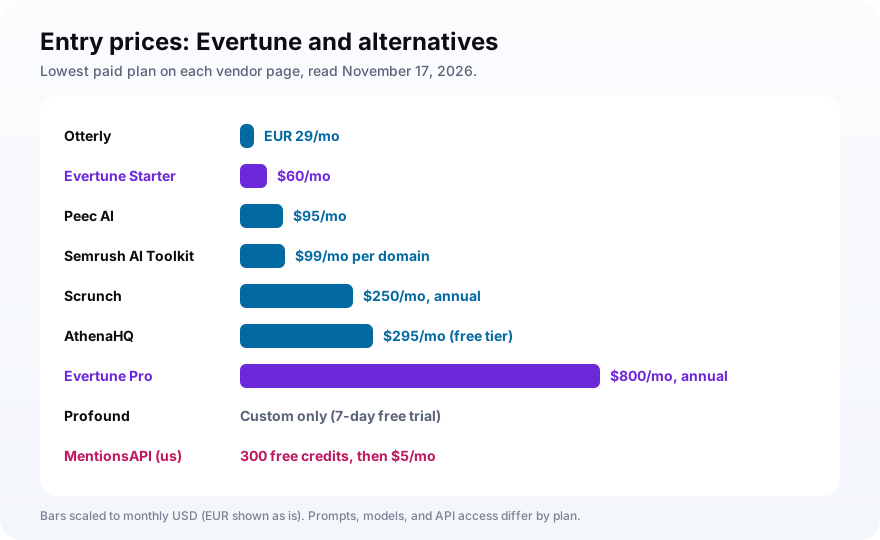
Evertune pricing has three tiers. Starter costs $60 a month for 5,000 prompt credits across five models, with self-serve signup. Pro costs $800 a month, billed annually, for 100,000 credits across all 11 models. Enterprise is custom. The ads agent adds a media fee of 10% on Starter and 8% on Pro, and only the ads agent has a free trial.
| Plan | Price | Credits and models | Data access |
|---|---|---|---|
| Starter | $60/mo | 5,000 prompt credits, 5 models | Dashboard only |
| Pro | $800/mo, billed annually | 100,000 credits, 11 models | Downloads, data MCP for Claude or ChatGPT |
| Enterprise | Custom | Custom | API, cloud-bucket export, SSO |
Prices are from Evertune's pricing page on November 17, 2026. Starter is new: Evertune announced it on October 20, 2026 as a self-serve plan with no contract.
Before then, Evertune was sales-led only, which is why some AI answers still say it has no public pricing. Claude told us exactly that in our test.
One thing the page does not spell out is how many credits one tracked prompt uses at 100 samples per model. Ask for that number before you compare Starter with tools that price per prompt.
Evertune pros and cons
Evertune's strengths are statistical depth, real consumer-prompt data, and a path from insight to action through content and ads. Its weaknesses are the price jump after Starter, API access locked to Enterprise, published accuracy claims nobody has audited, and an ads business that sits close to the measurement it sells. Weigh each against what your team will actually do with the data.
What Evertune does well:
- Heavy sampling, so one lucky or unlucky run cannot swing a score.
- EverPanel prompt data, which shows which prompts people really ask.
- Model-memory and consumer-app views side by side, which point to different fixes.
- Named customer results, such as Halo Collar moving from 67 to 91 on its AI Brand Score in ChatGPT.
Where it falls short:
- Pro costs $800 a month on an annual contract, more than 13 times Starter.
- No API below Enterprise, so developers cannot build on Starter or Pro data.
- Its margin-of-error figures and customer results are self-reported.
- It sells ads in AI chat, so the measuring and the selling come from one company.
Evertune's ads business and why it matters
Evertune measures AI visibility and also sells ads around it. Its ads agent buys media through partners including The Trade Desk, Index Exchange, and, since October 2026, DV360 and Yahoo through Experian, and it retargets people who saw AI answers about your category. That makes Evertune part analytics tool and part media buyer.
For a brand with a media budget, that is convenient. You see where you are weak in AI answers and can spend against the gap from the same screen.
It also means the company that scores your visibility earns a fee when you buy media. That fee is 10% of spend on Starter and 8% on Pro, as listed on the pricing page.
Nothing suggests Evertune bends its scores, and its sampling method is public. But if you are reporting AI visibility to a board, a second measurement from a tool with no media business is cheap insurance.
Is Evertune worth it? What four AI engines said
Evertune is worth it for brands that will spend money acting on what it finds, and probably too much for teams that only want to know whether AI names them. When we asked ChatGPT, Claude, Gemini, and Perplexity "Is Evertune worth it for tracking brand visibility in AI answers?", all four gave that same verdict on November 17, 2026.
ChatGPT and Perplexity cited only Evertune's own site. Claude cited 10 sources from six review and comparison sites, including G2, and Gemini cited 42 sources through Google's redirect links.
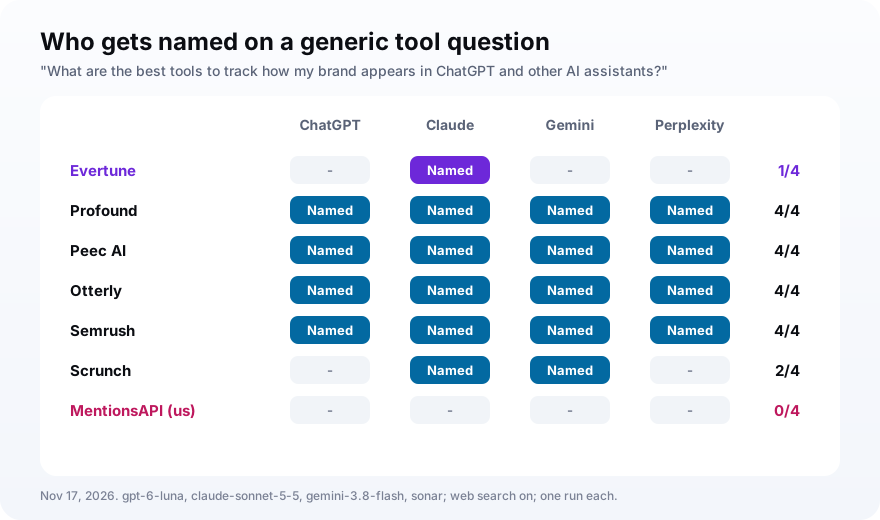
The more telling result came from a generic question. Asked "What are the best tools to track how my brand appears in ChatGPT and other AI assistants?", only Claude named Evertune.
Profound, Peec AI, Otterly, and Semrush were named by all four engines. For a company with $20 million in funding, Evertune is still missing from most generic tool shortlists.
How to test Evertune before you buy
Test Evertune on Starter with your real buyer prompts before you sign an annual Pro contract. Ask how many credits one prompt uses at 100 samples, check which five models Starter includes, and compare its scores with one independent check of the same prompts. A month of Starter costs $60, while a year of Pro costs $9,600.
- Write 10 to 20 prompts in the words your buyers use, including category and comparison questions.
- Ask support how many credits each prompt costs, so you know how far 5,000 credits go.
- Confirm which five models Starter covers, and whether consumer-app answers are included.
- Run the same prompts through a second tool or an API, a few times each, and compare the direction.
- Check whether you can export the data on your plan. Starter has no download or API.
- Only then price Pro, and ask whether monthly billing is possible.
If both measurements agree on where you are weak, you can trust the scores enough to act. If they disagree sharply, find out why before you spend on fixes.
Best Evertune alternatives in 2026
The best Evertune alternatives are Profound for enterprise teams, Peec AI and Otterly for low-cost self-serve tracking, Scrunch for agencies, Semrush AI Visibility Toolkit for Semrush users, and an AI visibility API for developers. When we asked the four engines for Evertune alternatives, Profound, Peec AI, Scrunch, Semrush, and Ahrefs appeared in every answer.
| Tool | Entry price | Best for | API |
|---|---|---|---|
| Evertune | $60/mo | Brands that will act through content and ads | Enterprise only |
| Profound | Custom (7-day free trial) | Enterprise marketing teams | Enterprise |
| Peec AI | $95/mo | Small teams and agencies | From $245/mo |
| Otterly | EUR 29/mo | Budget tracking of a few prompts | From EUR 189/mo |
| Scrunch | $250/mo, annual | Agencies with many prompts | Enterprise |
| AthenaHQ | Free tier, then $295/mo | Teams wanting a free start | Paid add-on |
| Semrush AI Visibility Toolkit | $99/mo per domain | Teams already on Semrush | No |
| MentionsAPI (ours) | Free 300 credits, then $5/mo | Developers building their own tracking | Yes, all plans |
All prices were read on each vendor's own page on November 17, 2026.
Profound
Profound is the closest match in ambition. It retired its $399 Starter and $499 Growth plans in September 2026, so its pricing page now shows a 7-day trial and custom Enterprise pricing only. Our Profound alternatives guide covers it in depth.
Peec AI
Peec AI is the cheapest serious option with an API. Starter is $95 a month for 50 prompts on three models, and Pro at $245 adds API access and 150 prompts, per Peec's pricing.
Otterly
Otterly starts at EUR 29 a month for 16 prompts, the lowest entry price here. Its Standard plan at EUR 189 includes 120 prompts and 2,000 API requests a month.
Scrunch
Scrunch sells by prompt volume, with 350 custom prompts from $250 a month on an annual plan. That makes it a fit for agencies tracking many clients.
AthenaHQ
AthenaHQ has a free Essential plan with a small credit allowance, and Starter costs $295 a month for 3,600 credits, per its pricing page. API access is a paid add-on below Enterprise. Our AthenaHQ review covers the details.
Semrush AI Visibility Toolkit
Semrush charges $99 a month per domain with no free trial, and 50 extra prompts cost $60 a month, per its knowledge base. It makes the most sense if your team already lives in Semrush. Our Semrush AI Visibility Toolkit review goes further.
MentionsAPI
Ours is an API, not a dashboard. It returns whether ChatGPT, Claude, Gemini, Perplexity, and Google's AI surfaces mention, rank, and cite a brand, so developers can build tracking into their own product.
It does not have Evertune's prompt panel or ads tools. A quick multi-engine check costs 150 credits fresh or 5 cached, and signup includes 300 free credits.
Evertune vs Profound vs Peec AI: which fits your team?
Choose Evertune if you are a consumer brand with a media budget and want measurement tied to ads and content. Choose Profound if you are an enterprise team that wants a managed platform. Choose Peec AI if you are a small team or agency that needs affordable tracking with an API. Developers who want raw answers to build on should start with an API instead.
| If you are | Pick | Why |
|---|---|---|
| A consumer brand with ad budget | Evertune Pro | Sampling depth plus ads and content in one place |
| An enterprise marketing team | Profound or Evertune Enterprise | Managed platform, custom contracts, API |
| A small team testing the channel | Evertune Starter or Otterly | Low monthly cost, few prompts |
| An agency with many clients | Peec AI or Scrunch | Prompt volume and multi-brand pricing |
| A developer or product team | An AI visibility API | Raw data you can store, join, and schedule |
Every engine agreed Evertune is serious. Only one put it on a shortlist when nobody asked about it by name.What our test showed
Whichever tool you pick, run your own check first. Our AI visibility audit guide shows how to build a prompt set and score it, and our guide on how to choose an AI visibility tool covers what to test during a trial.
Frequently asked questions
What is Evertune AI?
How much does Evertune cost?
Is Evertune worth it?
What are the best Evertune alternatives?
Does Evertune have an API?
Who founded Evertune?
Try Starter before you sign the Pro contract
Evertune is one of the more rigorous tools in AI visibility, and the new $60 Starter plan makes it cheap to test. Run your 10 most important buyer prompts on Starter for a month, and ask Evertune how many credits each prompt uses. Then compare the scores with one of the cheaper Evertune alternatives before you commit $9,600 a year to Pro.
If your team builds its own reporting, skip the dashboard question and start from the data.