AthenaHQ is one of the best-built AI visibility tools you can buy. It is also one of the most expensive to start.
Both things are true, and holding them together is the whole point of this review. AthenaHQ does the job well, and it asks for a real commitment before you find out if that job fits your workflow.
So this is a straight look at what it does, what it costs, where it shines, where it does not, and who should pick something else.
No affiliate angle, no hit piece. AthenaHQ is a good product that is right for some teams and overkill for others, and the goal here is to tell you which one you are before you spend.
What is AthenaHQ?
AthenaHQ is a generative engine optimization platform that measures how your brand shows up in AI answers and then helps you act on it. It was built by former Google Search and DeepMind people, is backed by Y Combinator, and already runs for enterprise names like ZoomInfo, SoFi, and Volkswagen. In its own words, it is a command center for AEO and GEO.
The pitch is closing the loop from measurement to action.
Most tools tell you whether AI mentions you. AthenaHQ tries to also do something about it, through content agents that generate on-page and off-page recommendations and, at higher tiers, take action. That ambition is what separates it from a plain tracker.
The pedigree shows up in the product. This is not a thin dashboard wrapped around an API.
The engineering is serious, the dashboard is genuinely clean, and the signals it surfaces tend to be the ones that matter rather than vanity numbers. When people call AthenaHQ a premium tool, the premium is in the build quality, not just the price tag.
AthenaHQ is a complete, done-for-you AI visibility platform. You pay platform prices for it.The one-line verdict
What does it track, and which AI engines?
AthenaHQ tracks brand mentions, citations, competitors, sentiment, and share of voice across the major AI assistants, and it flags hallucinations about your brand. Coverage is broad: the platform lists 11 or more models, including ChatGPT, Perplexity, Google AI Overviews, Gemini, Copilot, Claude, Grok, DeepSeek, Meta AI, and Mistral, with how many you get rising by plan.
Beyond monitoring, it layers on analysis most trackers skip.
Citation and source intelligence show which pages the models pull from. Competitor and share-of-voice views put your numbers in context. An Ask Athena copilot answers questions in plain language, and the content agents turn findings into specific recommendations.
The hallucination detection is a genuinely useful touch. It flags when a model states something false about your brand, an old price, a wrong feature, a product you retired.
That is a real problem as more buyers form opinions inside AI answers, and few trackers surface it cleanly. Higher tiers also add revenue attribution through Shopify and GA4, so you can tie AI visibility to actual sales rather than stopping at a mention count.
How much does AthenaHQ cost?
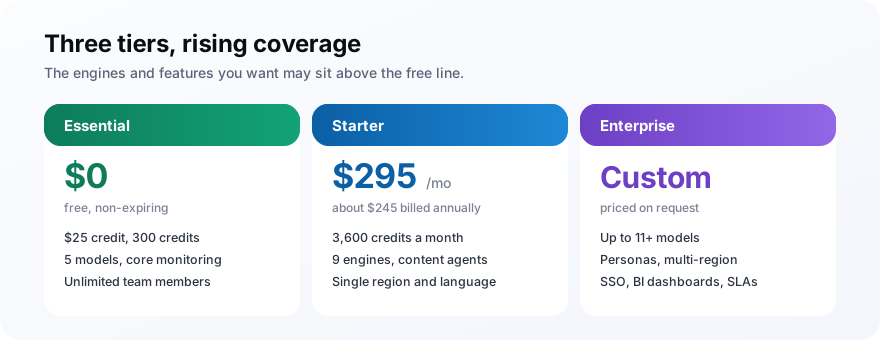
AthenaHQ has three tiers: a free Essential plan, a Starter self-serve plan at $295 a month, and custom Enterprise pricing. Starter includes 3,600 credits a month, where one credit equals one AI response, plus nine engines and the content agents. Annual billing knocks off roughly 17%, bringing it to about $245 a month.
The free tier is real, and better than most.
Essential gives you a $25 credit and 300 credits across five models, with unlimited team members, and it does not expire. That is enough to test core monitoring. What it is not is a trial of the paid features, because AthenaHQ does not offer a time-limited trial of Starter.
The credit math is where the sticker price gets slippery, so it is worth doing out loud. Starter includes 3,600 credits, and one credit is one AI response.
Track 50 prompts across nine engines once a day and that is 450 responses a day, which clears 3,600 in about eight days. Anything heavier, and you are buying add-on credits at a price quoted on request. The published $295 is the floor, not the ceiling, for an active account.
AthenaHQ pros and cons
The honest summary: AthenaHQ is the most complete self-serve monitoring platform in its class, held back mainly by price and a credit model that rewards careful forecasting. Here is the balance.
| Strengths | Weaknesses |
|---|---|
| Broad engine coverage, 9 on Starter | No time-limited trial of the paid plan |
| Content agents that take action | Credits scale with every model and check |
| Hallucination and competitor tracking | Best features are Enterprise-only |
| Clean dashboard, revenue attribution | Starter is single region and language |
| Real, non-expiring free tier | Starter at $295 is steep to begin |
The pattern in that table is worth naming. Nothing on the weakness side is a quality problem; it is all price and packaging, which is a very different kind of objection than a tool that simply does not work.
AthenaHQ does the work well. The friction is that the paywall sits early, the meter runs on every check, and the features that make the platform special are reserved for Enterprise. Those are business-model choices, not product flaws, but they decide whether it fits your budget.
Who is AthenaHQ for, and who should skip it?
AthenaHQ fits funded brands and agencies that want a complete, managed AI visibility platform and can absorb $295 a month or more. If you want measurement plus action in one dashboard, with broad engine coverage and enterprise features, it is one of the strongest picks in 2026. If any of those conditions is missing, the cost is hard to justify.
A few profiles make the call clearer.
- Enterprise marketing teams that want done-for-you monitoring and content action will get their money's worth.
- Agencies managing several clients can use the broad coverage and competitor views, if the credit math works at scale.
- Small teams and solo operators usually find $295 a month hard to justify for what starts as a monitoring need.
- Developers and data teams who just want the citation numbers do not need the platform layer at all.
That last group is the one most often oversold a full platform when what they needed was the data.
The tell is simple: if your team will not actually log into a dashboard and act on it weekly, you are paying for software that becomes a very expensive email report.
AthenaHQ rewards teams that will use the whole loop, measure, read the recommendations, and ship the content changes. If you only need the measure half, most of what you pay for sits unused, and that is exactly where a lighter, cheaper option wins.
The best AthenaHQ alternatives
The alternatives fall into three camps. Other GEO platforms compete on features, SEO suites fold AI tracking into an existing subscription, and AI visibility APIs give you the raw data to build your own. The right one depends on whether you want a dashboard or the numbers behind it.
- GEO platforms: Profound, Peec AI, and Scrunch offer similar dashboards at varying prices.
- SEO suites: Semrush and SE Ranking add AI tracking if you already pay for the suite.
- AI visibility API: MentionsAPI returns per-engine mentions and citations directly, pay-as-you-go, for teams that want to build rather than buy a dashboard.
Our roundup of the best AI visibility tools compares the field in full, including where each one fits.
A useful way to shortlist: decide first whether AI visibility is a standalone priority or part of your existing SEO work. If it is standalone and well-funded, a dedicated GEO platform like AthenaHQ or Profound makes sense.
If it is one line item inside broader SEO, adding it to a suite you already pay for is cheaper than a second platform. And if you mainly need the raw numbers to feed dashboards or automations you already run, the API route skips the platform premium entirely.
AthenaHQ vs an AI visibility API
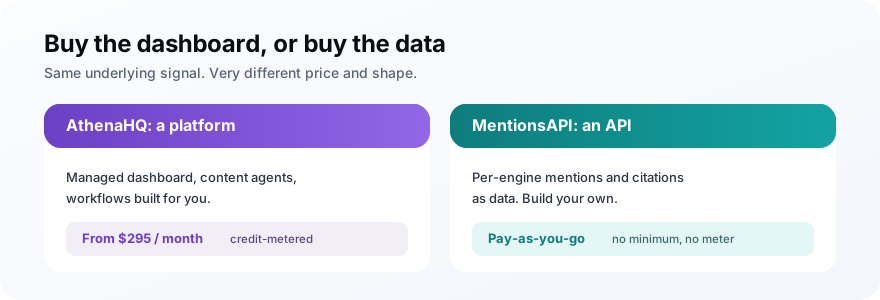
The real fork is platform versus API. AthenaHQ is a full platform: a dashboard, agents, and workflows built for you, priced accordingly. An AI visibility API gives you the same underlying signal, whether an engine mentions and cites your brand, as data you can put anywhere, usually for far less.
Neither is better in the abstract. They are different purchases.
If you want a team to open a polished dashboard every morning and follow its recommendations, a platform earns its price. If you want to pull AI citations into your own reporting, trigger alerts in your own stack, or track thousands of prompts without a per-check credit meter, an API is the cheaper and more flexible route.
The cost gap is not small, and it is the honest reason to pause before signing up.
A platform like AthenaHQ starts at $295 a month whether or not you use it fully, and each check spends a credit. A pay-as-you-go API charges only for the calls you make, so a team tracking a modest prompt set can pay single or low double digits a month for the same core signal, then spend the difference on the content work that actually moves the needle.
The trade you make is convenience. With an API you build the dashboard, the alerts, and the reporting yourself, or wire the data into tools you already run. For a developer or a data-savvy team, that is a morning of work, not a reason to pay platform prices every month.
Frequently asked questions
What is AthenaHQ?
How much does AthenaHQ cost?
Does AthenaHQ have a free trial?
What AI engines does AthenaHQ track?
Is AthenaHQ worth it?
What are the best AthenaHQ alternatives?
Test the free tier before you commit $295
Do this before you buy: list the engines you actually care about, the number of prompts you want to track, and whether you need a dashboard or just the data. Then run AthenaHQ's free Essential tier against that list to see how fast credits move.
If you need a managed platform and the budget fits, AthenaHQ is a strong, well-built choice. If you mostly need to know whether AI cites your brand, pull a per-engine baseline with MentionsAPI first and decide whether you ever really needed the platform on top.
The mistake to avoid is buying the platform for the measurement alone. Measurement is the cheap part now, available from an API for a fraction of the price.
What you are really paying AthenaHQ for is the action layer, the agents, the recommendations, the done-for-you workflow. If your team will use that, it is worth every dollar. If not, you are buying a $295 answer to a question a much cheaper tool already answers just as well.