Most audit guides list what to check. Few show what an audit finds when you run it on a real brand, including an unflattering one.
An AI visibility audit measures how often ChatGPT, Claude, Gemini, Perplexity, and Google's AI surfaces mention, rank, and cite your brand for the questions buyers ask, compared with competitors. A full audit, also called a GEO audit, adds two diagnostics: which sources the engines cite, and whether AI crawlers can reach your site. It ends with a ranked fix list.
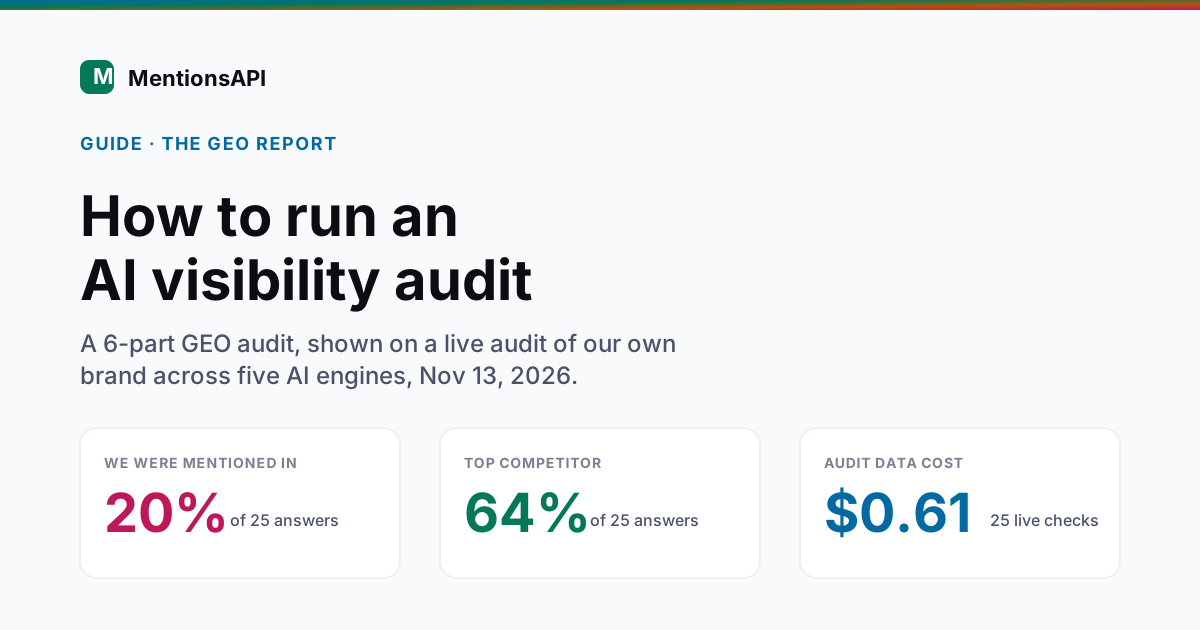
The worked example is our own brand. On November 13, 2026, I ran five buyer prompts through ChatGPT, Claude, Gemini, and Perplexity using their APIs with web search on, plus Google AI Mode, all via DataForSEO.
Disclosure: MentionsAPI publishes this blog and sells an API for this kind of tracking. I used a third-party data provider for the audit itself so the method works without our product, and the results are not flattering to us.
If you only want a quick manual check with free tools, start with our free AI visibility checker guide. This post covers the full audit you would hand to a team or a client.
What does an AI visibility audit include?
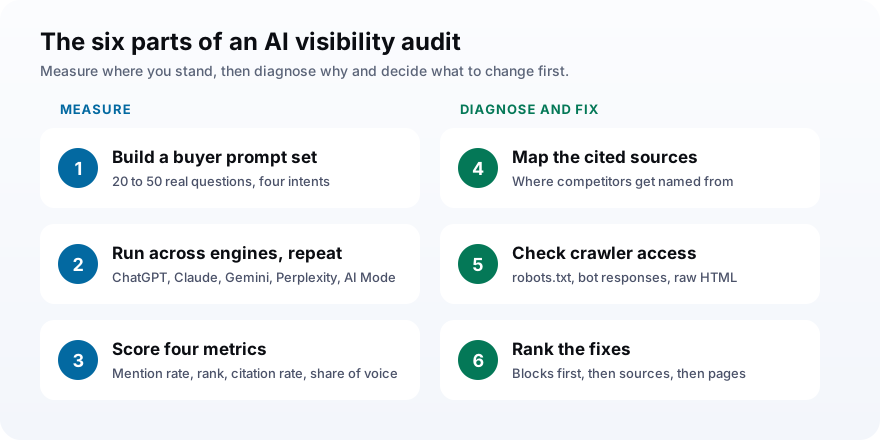
A complete AI visibility audit covers six parts: a buyer prompt set, runs across every AI engine that matters, scoring on four metrics, a map of the sources each engine cites, a technical access check, and a prioritized fix list. The first three tell you where you stand. The last three tell you why, and what to change first.
Step 1: Build a buyer prompt set
Write 20 to 50 prompts in the words real buyers use. Mix four kinds: category questions, problem questions, comparison questions, and alternatives to named competitors. Phrase them the way people talk to a chatbot, as full questions, because AI engines answer the question asked and your keyword list rarely matches it.
Good sources are sales call notes, support tickets, Reddit threads, and the People Also Ask boxes for your category. Aim for a mix like this:
| Prompt type | Example shape | What it reveals |
|---|---|---|
| Category | What are the best tools for X? | Whether you are on the default shortlist |
| Problem | How do I solve Y? | Whether engines connect your product to the pain |
| Comparison | A vs B for team type Z? | How you are positioned against named rivals |
| Alternatives | What are alternatives to competitor C? | Whether you are the go-to switch option |
For the worked example I used five prompts that span developer and marketer intent:
- What is the best API to track whether ChatGPT mentions my brand?
- Which tools monitor brand visibility in AI search engines like ChatGPT and Perplexity?
- How can a developer check brand mentions across ChatGPT, Claude, and Gemini programmatically?
- What are the best AI visibility tools for agencies?
- What is the cheapest way to track AI Overview citations for a list of keywords?
Five prompts is enough to show patterns, as you will see, but not enough to report a stable rate. Treat it as a pilot, then widen the set before you share numbers.
Step 2: Run every prompt across engines, more than once
Run each prompt on ChatGPT, Claude, Gemini, Perplexity, and Google's AI Overviews or AI Mode, and repeat each run at least three times. AI answers change between identical requests, so one run per engine records a sample, not a position. Keep location, language, and web search settings identical across runs so differences come from the engines.
I saw the variance before the audit even started. A test call of prompt 1 to ChatGPT named Semrush, Meltwater, and MentionsAPI and linked our docs. About a minute later, the audit run of the same prompt named only Semrush.
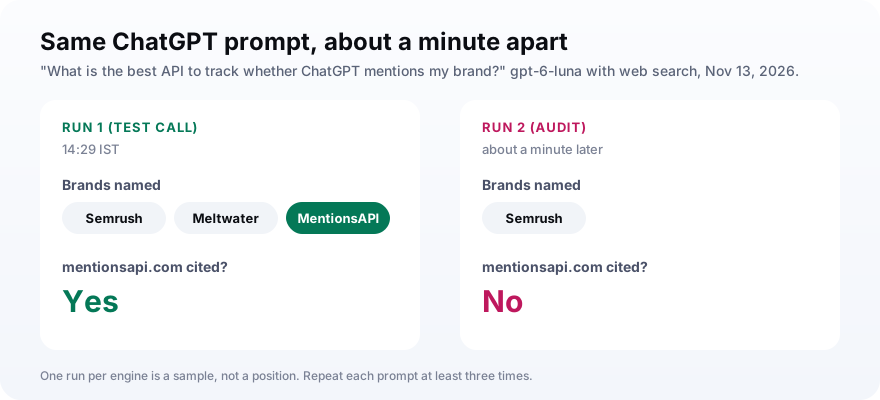
That matches outside research. A SparkToro and Gumshoe study found less than a 1-in-100 chance that an AI tool returns the same brand list twice for one prompt, Search Engine Journal reported.
Budget for the repeats. Our checks averaged about $0.024 each, so a full audit of 50 prompts across five engines with three runs, 750 checks, would cost roughly $18 in API calls at the same rates.
Decide up front whether you are testing APIs or the live apps people use. API answers with web search are cheap and repeatable, but a consumer app can answer differently, so label which one your numbers describe.
Step 3: Score mention rate, rank, citations, and share of voice
Score every answer on four metrics: whether your brand is mentioned, where it ranks among the brands named, whether your domain is cited as a source, and your share of all brand mentions. Report the first three as rates across runs. Share of voice puts your number next to competitors, so a low rate in a crowded category reads correctly.
Here is what our 25 checks returned:
| Engine | Mentioned (of 5) | Cited (of 5) | Best rank |
|---|---|---|---|
| ChatGPT (gpt-6-luna) | 0 | 0 | - |
| Claude (Sonnet 5.5) | 1 | 1 | 1st |
| Gemini (3.8 Flash) | 2 | n/a | 2nd |
| Perplexity (sonar) | 0 | 1 | - |
| Google AI Mode | 2 | 2 | 1st |
| All engines | 5 of 25 (20%) | 4 of 25 (16%) | 1st |
I defined rank as the order in which tracked brands first appear in the answer, and counted mentions only for a fixed list of 15 brands in our category. Write both rules down, because a different brand list changes every share number.
Gemini's sources came back as Google grounding redirect links, so its cited domains needed resolving and I scored its citations as unknown. Check for that before you report a zero.
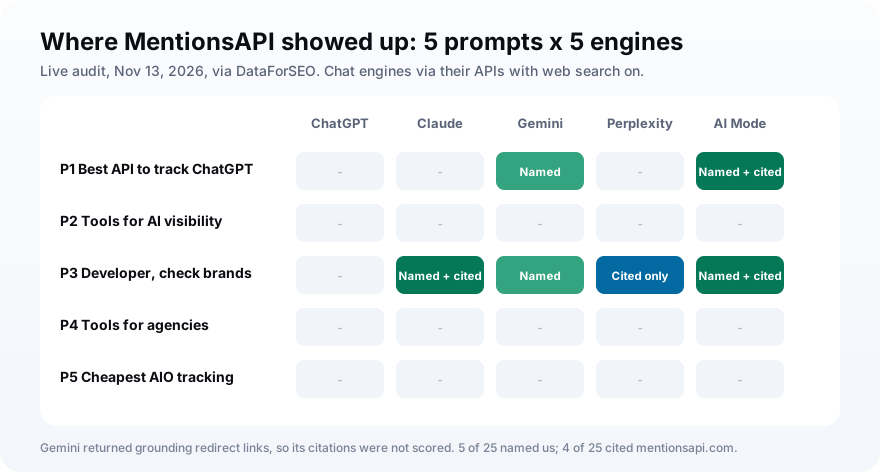
The pattern matters more than the total. We appeared on prompts 1 and 3, which ask about APIs and developers, and on none of the general tool questions marketers ask.
Perplexity also cited our site on prompt 3 without naming us. A citation without a mention still sends readers your way, so track the two separately.
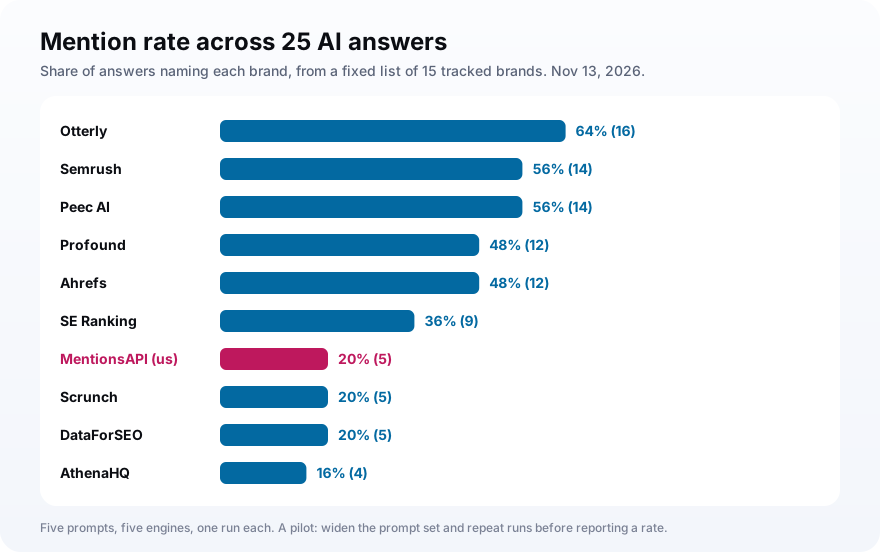
Otterly was named in 16 of 25 answers, and Semrush and Peec AI in 14 each. Across 99 brand mentions in total, our share of voice was about 5%.
Step 4: Map the sources the engines cite
List every domain cited in answers where competitors appear and you do not. Those pages are why the engines name them: comparison posts, review sites, community threads, and help docs. The map shows where to get mentioned, which is usually faster than hoping your own pages climb into the citation list.
On our two general prompts, the 10 answers cited 33 different domains, mostly third-party roundups. Zapier's blog, HubSpot, Wix, Reddit, and a long tail of AI-tool vendor blogs did the work.
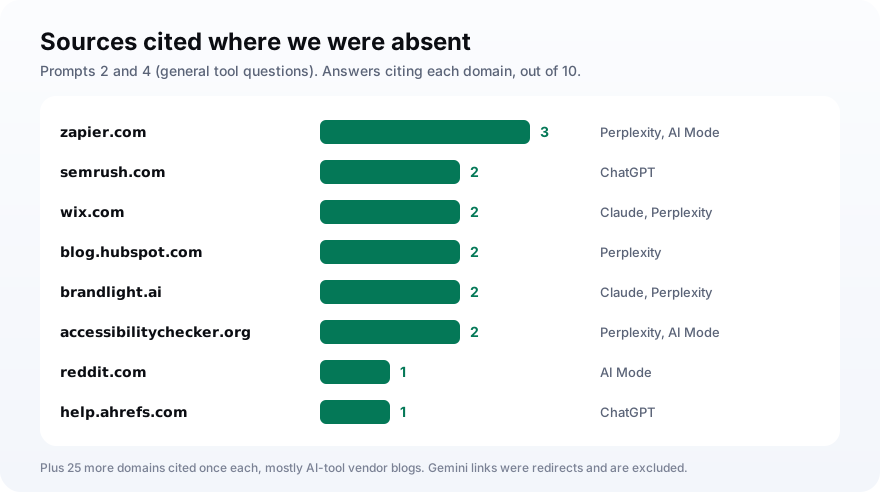
Engines also lean on different sources. ChatGPT cited semrush.com and Ahrefs' help center, Claude cited many small vendor blogs, and AI Mode cited Zapier and Reddit for the same questions.
Citations are worth chasing even when clicks are rare. Pew found that Google users clicked a cited source in just 1% of visits with an AI summary, per its July 2025 analysis, so being the named and cited answer is most of the visibility on offer.
Expect this map to move. A Semrush study found no keyword kept the same AI Overview URLs for a month, and only 6.7% of desktop URLs cited in week one were still cited in week four.
Step 5: Check that AI crawlers can reach your site
Confirm that AI crawlers are allowed in robots.txt, that your server returns real pages to their user agents, and that your main content is in the HTML instead of loaded by JavaScript after the page renders. Check GPTBot, OAI-SearchBot, ChatGPT-User, ClaudeBot, and PerplexityBot, plus the Google-Extended token. A blocked crawler caps your visibility, whatever your content says.
- robots.txt: an explicit Allow for each AI user agent, or no Disallow that catches them.
- Server response: request a page with each bot's user agent and expect a 200, not a 403 or a challenge page.
- Rendering: view the raw HTML and confirm your main text is there.
- Discovery: a current sitemap.xml, and an llms.txt if you want to point models at your most important pages.
Our site passed every check. All five crawler user agents got a 200, robots.txt names and allows each AI crawler, including Google-Extended, and both sitemap.xml and llms.txt resolve. So access was not our problem, which the audit proved quickly.
Step 6: Turn the gaps into a ranked fix list
Rank fixes by how many prompts and engines they affect and how fast they can ship. Technical blocks come first because they cap everything. Then target the third-party pages your competitors are cited from, then build or rewrite your own pages to answer the exact prompts you miss, in short answer-first sections that engines can quote.
Our own fix list, straight from the audit:
- Get included in the roundups cited on general prompts, starting with the Zapier and HubSpot style lists.
- Publish a page that answers "best AI visibility tools for agencies" directly, with a clear position for us.
- Show up in community threads, since Reddit was cited on general prompts by AI Mode.
- Keep the developer pages fresh, because that is where we already win.
- Rerun the same prompts weekly to see whether mention rate moves.
Crawlers could read every page we have. The engines still named the brands that other sites write about.What our audit taught us
For deeper guidance on the content side, our post on how to improve your AI visibility score covers answer-first structure, entity clarity, and third-party mentions.
The AI visibility audit scorecard
Put the results on one scorecard so the audit can be repeated and compared. Each row is a metric, how you compute it, your current value, and how to read it. Rerun the same prompts on the same engines and the scorecard becomes your trend line, which matters more than any single audit result.
| Metric | How to compute it | Our value | How to read it |
|---|---|---|---|
| Mention rate | Answers naming you / all answers | 20% | Compare with the top competitor, not with 100% |
| Citation rate | Answers citing your domain / all answers | 16% | Can exceed mention rate; track both |
| Average rank | Order among tracked brands when named | 1st to 2nd | Only meaningful with a decent mention rate |
| Share of voice | Your mentions / all brand mentions | About 5% | Depends on the brand list you fix up front |
| Access | Bots allowed, 200 responses, HTML text | Pass | A fail here caps every other metric |
Break each metric down by engine and by prompt type as well. Our blended 20% hid a split between developer prompts, where we did well, and general prompts, where we were absent.
How long does an AI visibility audit take?
Collecting the answers takes minutes with an API and a few hours by hand; our 25 checks ran in parallel and finished within minutes. The analysis takes longer, since reading answers, checking brand detection, resolving links, and mapping sources took most of an afternoon. A 50-prompt audit with repeats is a day or two of work for one person.
Do not skip the reading. Automated matching only finds the brands on your list, and it will count a product name used as an ordinary word, so a person has to check the edge cases.
Mistakes that make an AI visibility audit misleading
Most misleading audits fail in setup, before a single answer is scored. The prompt set is too narrow, the runs are too few, or the scoring hides the pattern. These are the mistakes I see most often in audits shared with clients, roughly in order of how much they distort the result.
- Using keyword-style prompts instead of the full questions buyers ask a chatbot.
- Running each prompt once and reporting the result as a rank.
- Testing only ChatGPT while buyers also use Gemini, Perplexity, and AI Mode.
- Counting mentions but ignoring which domains were cited.
- Reporting zero citations for an engine whose links are redirects you never resolved.
- Blending all prompts into one score and hiding that you win one intent and miss another.
Frequently asked questions
What is an AI visibility audit?
Is a GEO audit the same as an AI visibility audit?
How much does an AI visibility audit cost?
How many prompts should an AI visibility audit include?
How often should you run an AI visibility audit?
Can I run an AI visibility audit for free?
Run the audit, then rerun it
An AI visibility audit is worth doing once to find the pattern and repeatedly to see if your fixes work. Start with 20 prompts across five engines, repeat each run, score the four metrics, and map the cited sources before you write a single new page. The source map usually tells you where to start.
Our own audit took an afternoon and less than a dollar in API calls. The fix list it produced will take us months.