Most model comparisons argue about benchmarks. For visibility, one setting matters more.
DeepSeek's web search is off by default. ChatGPT reaches for the web on its own. That one difference decides whether either model can cite your page at all.
Get that straight and the rest of the DeepSeek versus ChatGPT question gets a lot clearer, because it tells you where your effort actually lands.
DeepSeek vs ChatGPT: what actually differs for visibility?
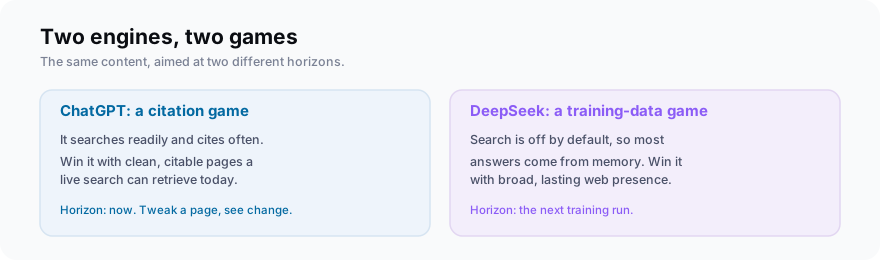
For getting cited, the real difference is when each model looks at the live web. ChatGPT searches readily and grounds a large share of answers in sources it links. DeepSeek searches only when a user turns on its Search toggle, and most never do, so most DeepSeek answers come straight from training with no citation. So you optimize ChatGPT mainly for retrieval, and DeepSeek mainly for training data.
That is a bigger split than any benchmark score.
On ChatGPT, a fresh, well-structured page can get cited today. On DeepSeek, unless the user searched, your page is invisible, and what matters is whether the model learned about you during training. Two engines, two entirely different jobs.
ChatGPT decides to search for you. DeepSeek only searches if the user asks, so it mostly answers from memory.The whole comparison in one line
Which one is bigger, DeepSeek or ChatGPT?
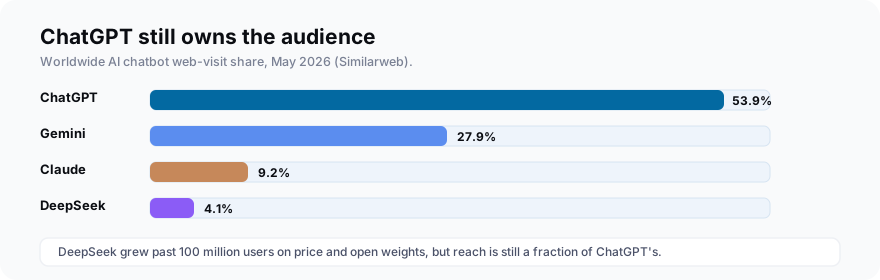
ChatGPT is far bigger. In Similarweb's May 2026 data, ChatGPT held about 53.9% of worldwide AI chatbot web-visit share, with Gemini near 27.9% and Claude around 9.2%, while DeepSeek sat at roughly 4.1%. DeepSeek grew fast, past 100 million users, but it still reaches a fraction of ChatGPT's audience.
The growth is real, though, and worth respecting.
DeepSeek went from a curiosity to a top-tier model in about a year, largely on price and open weights. It is not a threat to ChatGPT's lead yet, but it is the model that reset what people expect to pay, and that keeps pulling in developers and cost-sensitive users.
That price gap is not a footnote. DeepSeek's API runs a small fraction of what the big US models charge, so anyone building on a budget starts there.
The result is a quiet spread into tools and workflows where cost decides the model, not brand loyalty. So DeepSeek's audience is smaller than ChatGPT's but skews toward builders, which for a lot of B2B and developer-facing brands is exactly the audience they most want to reach.
Does DeepSeek cite sources like ChatGPT?
Only when you turn search on. DeepSeek's app has a Search toggle that starts off; enable it and DeepSeek retrieves live pages, reads them, and attaches numbered citations you can check. Leave it off, which is the default state most sessions stay in, and the answer comes straight from the model with no sources. ChatGPT reaches for the web far more readily and cites without the user doing anything.
This is the detail that breaks most DeepSeek visibility advice.
People write guides about ranking in DeepSeek search as if that is where the answers come from. For a minority of sessions, it is. For the majority, DeepSeek never searched, so no page, however good, could have been cited.
When search is on, DeepSeek behaves like a normal retrieval engine, and the usual rules apply: clean pages, answer first, named sources. The catch is simply that it is on far less often than ChatGPT's.
It is worth being precise about why the default matters so much. A citation only happens if the model fetched a page, and DeepSeek fetches a page only if the user asked it to.
ChatGPT decides to search on its own when a question seems to need current information, so the burden is off the user. That single design choice, who decides to search, is why ChatGPT cites you in far more of its answers than DeepSeek does, regardless of how good your page is.
Why DeepSeek visibility is a training-data game
Because most DeepSeek answers, and most apps built on it, never run a live search. DeepSeek is open-weight, published under the MIT license, so thousands of products download the model and run it themselves, usually with no search layer at all. In all of those, what the model learned during training is what it says about you, and there is no page to cite.
That flips the optimization target.
For ChatGPT, you want to be the page a live search retrieves. For DeepSeek, you want to be the brand the model already absorbed, which comes from being widely published, referenced, and discussed across the open web well before any single query.
It is a slower, less direct game. You cannot tweak a page on Monday and see a DeepSeek answer change on Tuesday, the way you sometimes can with a live-search engine.
Picture a new SaaS tool that launched last month. Ask ChatGPT with search, and it can find the launch coverage and name the tool today.
Ask DeepSeek with search off, and it may not know the tool exists yet, because it was not in the data the model trained on. Same question, and one engine can see the new brand while the other is still living in the past. For anything recent, that lag is the whole story on DeepSeek.
DeepSeek vs ChatGPT: the differences that matter
Here is the head-to-head for visibility. Read it as two different jobs, because winning one tells you little about the other.
| DeepSeek | ChatGPT | |
|---|---|---|
| Web search | Off by default, user toggles it | Reaches for the web readily |
| Cites sources | Only when search is on | In a large share of answers |
| Main visibility lever | Being in the training data | Being retrieved and cited |
| Model access | Open-weight, runs in many apps | Closed, ChatGPT only |
| Web-visit share (May 2026) | ~4.1% | ~53.9% |
| You win by | Broad, lasting web presence | Clean, citable live pages |
Should you optimize for DeepSeek at all?
Optimize for ChatGPT first, then add DeepSeek if your audience is there. ChatGPT reaches far more people and cites far more often, so it repays the work fastest. DeepSeek earns its place when you sell to developers, cost-sensitive buyers, or markets where it is popular, and when you care about the thousands of apps quietly running its open weights.
The encouraging part is that the two do not compete for your effort.
The same broad, well-sourced content that helps ChatGPT cite you also feeds the training data that DeepSeek learns from. You are not building two separate libraries, just making sure the one you have is both freshly citable and consistently present over time.
There is one more reason not to write DeepSeek off: its openness spreads it further than the app suggests. Because the weights are free to run, DeepSeek powers products that never mention it.
A customer-support bot, a coding assistant, a research tool inside another app may all be running DeepSeek under the hood. Being absent from DeepSeek's knowledge quietly means being absent from those too, which is a wider footprint than its 4% web share implies.
How do you get cited by each?
You win both by pairing fresh, citable pages with a broad, lasting web presence. For ChatGPT, publish clean pages that answer a question directly with named sources, so a live search can retrieve and quote them. For DeepSeek, do the same for the search-on minority, but also earn wide mentions and citations across the open web so you are in the training data behind most of its answers.
The shared base is the same one that wins AI citations everywhere.
A Princeton study presented at KDD 2024 found that adding statistics, quotations, and cited sources lifted a page's visibility in generative answers by up to 40%. That helps in a live search and, over time, in what the next model learns.
In practice the split comes down to a short list.
- For ChatGPT, publish clean, answer-first pages a live search can retrieve and quote.
- For ChatGPT, keep those pages fresh, since it favors current, well-structured content.
- For DeepSeek, earn broad mentions and citations across the open web, so you land in the training data.
- For DeepSeek, still keep citable pages ready for the minority of sessions that turn search on.
- For both, back claims with named, dated sources a model can lift cleanly and learn from.
The per-engine playbooks are in our guides on DeepSeek SEO and ChatGPT SEO. This piece is about where to spend first, and why the DeepSeek work looks different.
How do you track your brand in both?
Track both by running your real buyer prompts through DeepSeek and ChatGPT on a schedule, with DeepSeek's search both on and off, and recording whether each named you and what it cited. Keep the results separate, because a citation with search on and a mention with search off are different signals that need different fixes.
The search-off run is the one people skip, and it is the honest one.
It shows what DeepSeek says about you from memory, with no page to lean on, which is how most of its users actually meet your brand. If that answer is wrong or empty, no amount of on-page work fixes it fast. Only broader, longer presence does.
Watch the accuracy of that memory answer, not just whether you appear. A model repeating an old price, a former tagline, or a discontinued feature is its own problem.
That kind of stale description is common with training-based answers, and the fix is to make the correct, current version of your story so widely published that it outweighs the outdated one by the next training run. You are effectively voting, with volume and consistency, on what the model should believe about you.
Frequently asked questions
What is the difference between DeepSeek and ChatGPT for visibility?
Does DeepSeek cite sources like ChatGPT?
Is DeepSeek bigger than ChatGPT?
Should I optimize for DeepSeek?
Why does DeepSeek run in so many apps?
How do I get cited by DeepSeek and ChatGPT?
Optimize for reach first, then play the long game
Do this next: put ChatGPT first, since it reaches the most people and cites the most readily, and make your key pages clean, answer-first, and well-sourced. That work is the fastest to pay off.
Then play DeepSeek's longer game by staying broadly published and cited across the web, so the model absorbs you whether or not anyone turns on search. Pull a per-engine baseline with MentionsAPI so you can watch both, and remember that with DeepSeek you are optimizing for the next training run as much as for today.
Do not judge the two engines by the same yardstick. ChatGPT rewards the page you publish this week, while DeepSeek rewards the reputation you have built over months, and both are worth earning. The brands that show up in both did the fast work and the slow work, and did not confuse one for the other.