If you track your brand in ChatGPT through the API, you are measuring a different product from the one your buyers use.
A ChatGPT scraper captures answers from the ChatGPT app the way a real user sees them, while the OpenAI API returns answers from a model you call directly. They are not interchangeable. In our test, the API missed more than a quarter of the brands the app named and cited almost entirely different sources. Pick the app view for what customers see, and the API for scale.
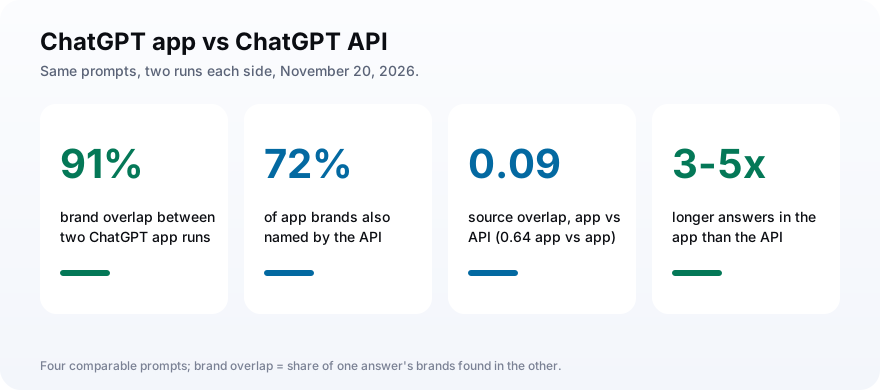
I ran the test on November 20, 2026 with six buyer prompts, each sent twice to the ChatGPT API with web search on and twice to the ChatGPT web app, 24 answers in total. Both sides ran through DataForSEO, which sells access to each, so the comparison did not depend on our own product.
Disclosure: MentionsAPI sells AI visibility data, including a live ChatGPT mode, so we have a stake in this question. I have reported what the numbers showed, including where the API holds up.
One note on terms. "ChatGPT scraper" sometimes means using ChatGPT to scrape websites. This post is about the other meaning: capturing ChatGPT's own answers.
What is a ChatGPT scraper?
A ChatGPT scraper sends a prompt to the ChatGPT web app the way a person would and records what comes back: the answer, its cited sources, and sometimes the search queries ChatGPT ran behind the scenes. Commercial versions are sold as APIs by vendors such as Bright Data, ScrapingBee, Scrapingdog, Scrape.do, and DataForSEO, so you send a prompt and get structured JSON back without running browsers yourself.
The point is to see the consumer product. Brand and marketing teams want to know what ChatGPT tells real buyers, and that is the app, not the API.
You can build one yourself with a headless browser, but logins, rate limits, and frequent interface changes turn it into a maintenance job. That upkeep is the main reason scraper APIs exist as a product.
The richer scrapers return more than text. The ChatGPT scraper we used for the test returned the model name, the answer in markdown, the sources, the search queries ChatGPT ran, and the brands it detected in the answer.
Why does the ChatGPT API answer differently from ChatGPT?
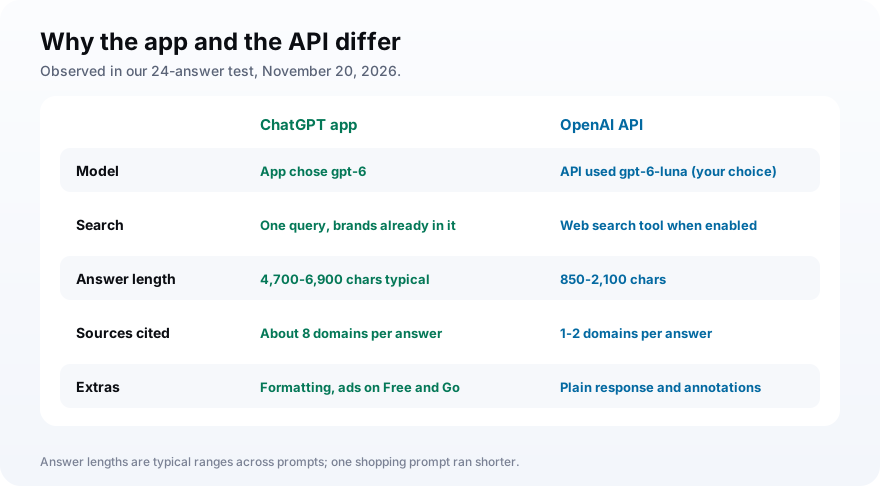
The ChatGPT API answers differently because it is a different setup. The app picks its own model and settings, decides when and how to search, formats a long answer, and can draw on memory and personalization. The API returns what the model you chose produces with the tools you turned on. In our test, the app reported running gpt-6, while our API calls used gpt-6-luna with web search.
Search behaves differently too. OpenAI's web search documentation says the API returns citations as url_citation annotations, and that "the number of sources is often greater than the number of citations."
In practice, the app wrote far longer answers. Its answers ran about 4,700 to 6,900 characters on most prompts, against roughly 850 to 2,100 for the API, and longer answers have room for more brands and more sources.
We also saw how the app searches. On every prompt, ChatGPT ran one search query, and that query often already listed brand names. For the CRM prompt, it searched for HubSpot, Zoho, Pipedrive, Freshsales, and monday CRM by name.
What our API vs ChatGPT app test found
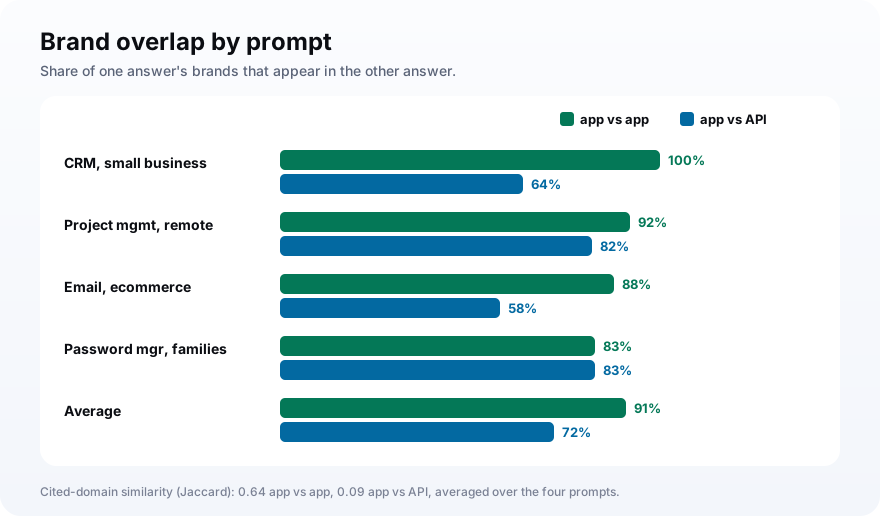
Across four prompts where brands could be compared cleanly, two runs of the ChatGPT app agreed on 91% of the brands they named, but the API named only 72% of the app's brands. Sources split far more. Cited domains overlapped at 0.64 between two app runs and only 0.09 between the app and the API, on a 0 to 1 scale. The difference was larger than normal run-to-run noise.
| Prompt | App vs app (brands) | App vs API (brands) | Sources, app vs API |
|---|---|---|---|
| Best CRM for a small business | 100% | 64% | 0.03 |
| Project management for remote teams | 92% | 82% | 0.13 |
| Email marketing for ecommerce | 88% | 58% | 0.08 |
| Password manager for families | 83% | 83% | 0.10 |
| Average of the four | 91% | 72% | 0.09 |
Brand overlap is the share of brands named in one answer that also appeared in the other. Source overlap is the Jaccard similarity of cited domains, where 1 means identical.
The CRM prompt shows the gap clearly. The app named seven tools in both runs, including Less Annoying CRM and monday CRM. The API named four or five and dropped both.
On the AI brand-tracking prompt, the app named Scrunch in both runs and AthenaHQ in one, while the API never named either. MentionsAPI was not named by either side.
This fits our earlier 1,000-query teardown, which found at least one meaningful gap between the ChatGPT API and app on 96% of queries. That study counted how often a gap appears. This one measures how big the gap is on each prompt.
Two prompts were excluded from the brand numbers because the scraper's brand labels were unusable: one returned category descriptions and the other returned full product listing titles. Their source results pointed the same way.
ChatGPT scraper options and pricing
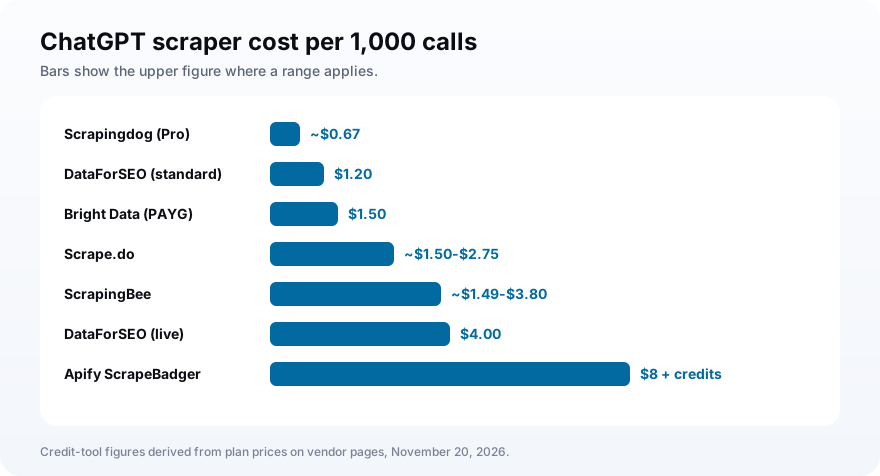
Most ChatGPT scraper APIs cost between about $0.70 and $4 per 1,000 calls at volume, and they differ mainly in what they return. Bright Data and DataForSEO publish per-1,000 prices. ScrapingBee, Scrapingdog, and Scrape.do charge credits per call, so the real price depends on your plan. Check which ones return citations and search queries, since plain answer text is the least useful part for brand tracking.
| Scraper | Price | Per 1,000 calls | Returns |
|---|---|---|---|
| Bright Data | $1.50/1K records, 5K free monthly | $1.50 | Answer, citations, links |
| DataForSEO LLM Scraper | $0.0012 to $0.004 per result | $1.20 to $4 | Answer, sources, search queries, brands |
| ScrapingBee | 15 credits per call | About $1.49 to $3.80 | Text, markdown, JSON |
| Scrapingdog | 10 credits per call | About $0.67 on Pro | Structured conversation |
| Scrape.do | 25 credits per call | About $1.50 to $2.75 | Text, content references |
| Apify (ScrapeBadger) | $0.008 per premium call | $8 plus credits | Answer, citation count |
Prices were read on each vendor's page on November 20, 2026. Per-1,000 figures for credit-based tools are our arithmetic from their plan prices, such as ScrapingBee's $99 plan with 1,000,000 credits and Bright Data's pay-as-you-go rate.
Most charge only for successful calls. Scraping a live web app also fails more often than calling an API, and interfaces change, so expect occasional gaps.
The app view is not always the expensive option. Through the same data provider in our test, each app-view capture cost $0.004, while each API call with web search cost about $0.017, because the API side pays for model tokens and search.
What should a ChatGPT scraper return?
A useful ChatGPT scraper returns more than the answer text. For brand tracking you want the cited sources with their positions, the search queries ChatGPT ran, the brands it named, the model it used, any ads shown beside the answer, and the location and time of the capture. Without sources and queries, you can see that a competitor won the answer but not why.
- Answer text or markdown, so you can parse lists and rankings.
- Cited sources with URLs, to see which pages shape the answer.
- Search queries ChatGPT ran, which show how it framed your category.
- Brand or entity detection, to save you writing a brand matcher.
- Model name and timestamp, so you can explain changes over time.
- Ads or sponsored units, now that ChatGPT shows ads on Free and Go plans.
Our post on ads in AI answers covers why the sponsored slot matters for brands. Only the app view can show it.
Is it allowed to scrape ChatGPT?
OpenAI's terms of use, effective January 1, 2026, list "automatically or programmatically extract data or Output" among the things users may not do. Scraper vendors run the ChatGPT accounts and carry that risk directly. If you buy scraped answers, you depend on a service that OpenAI's terms do not allow and that can break or be blocked. This is not legal advice.
The clause sits in the "you may not" list of OpenAI's terms of use, alongside reverse engineering and representing output as human-generated.
This applies to us too. Our live ChatGPT mode captures the ChatGPT interface, so it carries the same platform risk as every scraper on the list above.
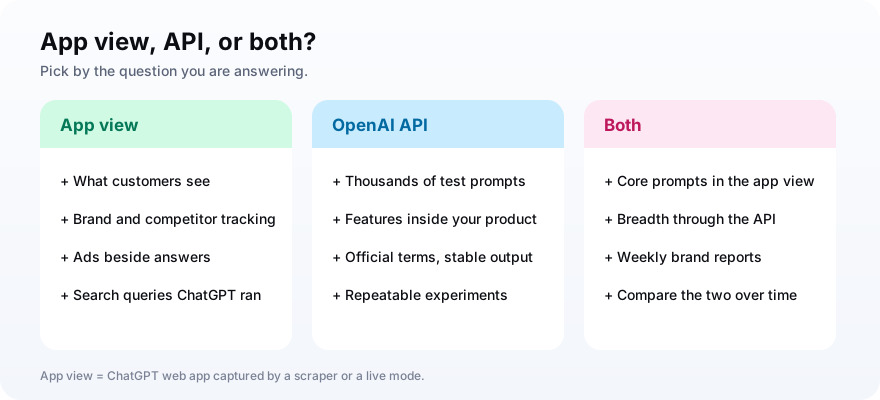
The practical answer most teams reach is a mix. Use the official API for volume and anything in your product, and use app-view data for a core set of prompts where you need to see what customers see.
When to use the API, a scraper, or both
Use the OpenAI API when you need volume, repeatability, a clean contract, or answers inside your own product. Use app-view data when you need to know what real ChatGPT users see, such as brand tracking, competitor reporting, or checking ads beside answers. Use both when you track a core prompt set in the app and run larger experiments through the API.
| Need | Use | Why |
|---|---|---|
| What customers see in ChatGPT | App view (scraper) | Brands and sources differed from the API |
| Thousands of test prompts | OpenAI API | Cheaper per call, official, repeatable |
| AI features in your product | OpenAI API | Clear terms and stable responses |
| Ads shown beside answers | App view | Ads appear in the app, not the API |
| Weekly brand report | Both | App view for core prompts, API for breadth |
The API agreed with the app less than the app agreed with itself. That gap is the reason scrapers exist.What our test showed
How to compare app and API answers yourself
To compare the ChatGPT app and API for your own brand, pick five to ten buyer prompts, run each at least twice through both, and measure two things: the share of brands that match, and the overlap of cited domains. Running each side twice lets you separate real differences from normal variation, which is the step most comparisons skip.
- Write prompts the way buyers ask, as full questions in your category.
- Send each prompt twice through the OpenAI API with web search on.
- Capture each prompt twice from the ChatGPT app through a scraper or a live mode.
- Fix a list of brands you care about, and record which appear in each answer.
- Compare app versus app first, then app versus API, for brands and for cited domains.
Our test cost $0.25 for 24 calls. For a broader method, our AI visibility audit guide covers prompt sets and scoring, and our API vs UI gap teardown looks at the same split across other engines.
Our own API has both views. Quick mode asks ChatGPT, Claude, Gemini, and Perplexity through their APIs for 150 credits, and the chatgpt_live mode captures the ChatGPT app with its search queries and citations for 35 credits, about $0.11 to $0.18 depending on plan. It also returns any ads shown with the answer.
Frequently asked questions
What is a ChatGPT scraper?
Why does the ChatGPT API give different answers than ChatGPT?
Is it legal to scrape ChatGPT?
How much does a ChatGPT scraper cost?
Can I get ChatGPT citations from the OpenAI API?
Should I use a ChatGPT scraper or the API for brand tracking?
Measure the app before you trust the API
Before you build ChatGPT tracking on the API alone, run your top five prompts through both the API and the ChatGPT app, twice each, and compare brands and sources. If the API agrees with the app as closely as the app agrees with itself, use the API. If it does not, as in our test, keep an app view for the prompts that matter most.
It costs less than a dollar to find out, and it changes what your reports mean.