SerpApi is the default name in SERP data, and its free tier makes it easy to start. Once you track AI Overviews and AI Mode at any volume, the bill and the gaps start to show.
The best SerpApi alternatives for AI Overview and AI Mode data are DataForSEO, Scrapingdog, SearchApi, and cloro. Each returns the AI answer text plus the cited sources as JSON, usually for far less per call than SerpApi, and they differ in capture rate, latency, and billing. Google rank alone is a different job, covered in our rank tracking API comparison.
I checked every price here on the vendor's own pricing page in November 2026. I also ran Google AI Mode queries live through DataForSEO while writing, and the results changed between runs.
Disclosure: MentionsAPI publishes this blog and sells an AI answer API that includes AI Overview and AI Mode checks. It is in the comparison with its real pricing, and for raw Google data at volume a SERP API is cheaper.
What AI Overview and AI Mode data should a SERP API return?
A useful AI Overview or AI Mode API returns four things: whether an AI answer appeared, the answer text, the list of cited sources with domain and URL, and the position of each source. Without the sources, you can read what Google said but not who it credited. Citations are the part you track, because they decide which sites get the visit.
Here is what to look for in the response before you compare prices:
- A presence flag, so a missing AI Overview reads as absent instead of failed.
- The answer as text or markdown, so you can search it for brand names.
- References with domain, URL, title, and a source index you can tie back to each sentence.
- Location and language controls, because AI answers differ by market.
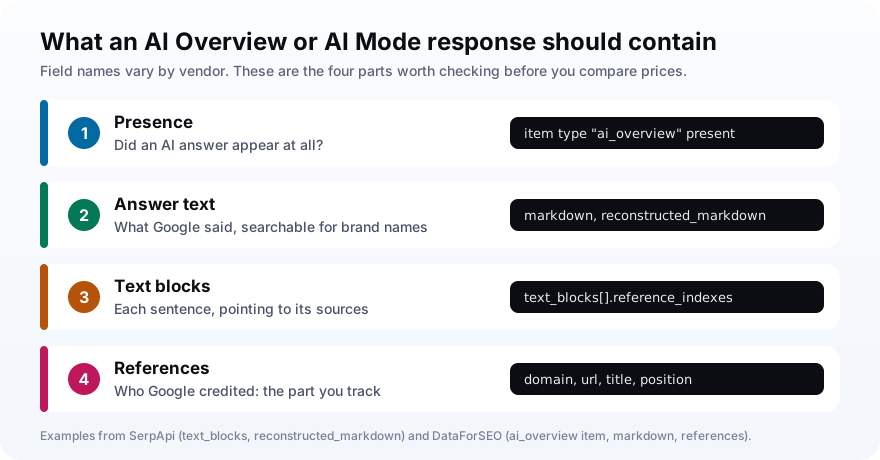
The field names differ by vendor. SerpApi's AI Mode API returns text_blocks that point into a references list by index. DataForSEO returns markdown and a references array with domain, URL, and title on each item.
SerpApi alternatives compared for AI data
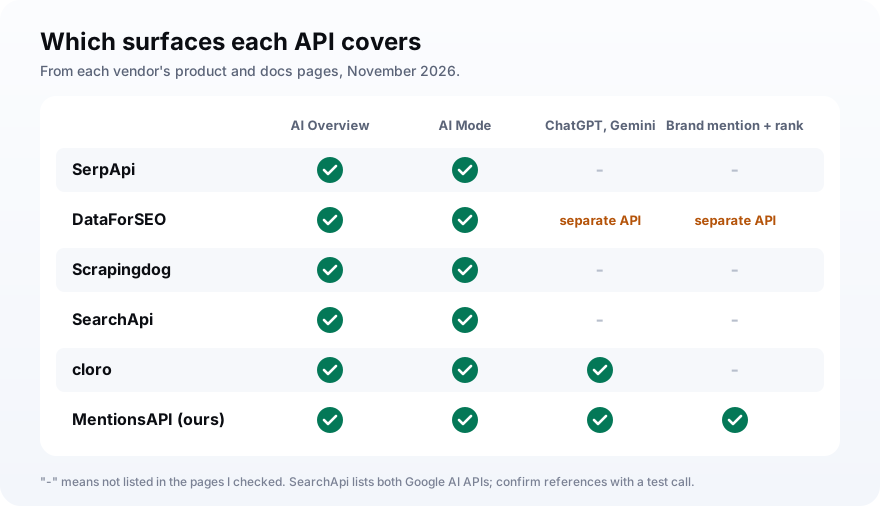
DataForSEO, Scrapingdog, SearchApi, cloro, and Apify scrapers all return Google AI answer data, and SerpApi is the baseline they get measured against. The table compares them on published pricing and what each lists for AI Overviews and AI Mode. MentionsAPI is a different kind of product, an AI answer API, included so you can see where the line falls.
| API | AI Overview | AI Mode | Published price |
|---|---|---|---|
| SerpApi | Yes, may need a 2nd request | Yes, with references | Free 250/mo; $75 for 5,000 searches |
| DataForSEO | Yes, at 2x base SERP price | Yes, with references | $1.20 per 1,000 AI Mode (standard) |
| Scrapingdog | Yes, dedicated API | Yes, with references | From $40 for 200,000 credits |
| SearchApi | Listed | Listed | $40 for 10,000 searches |
| cloro | Yes | Yes, plus ChatGPT and Gemini | From $30/mo for 37,500 credits |
| Apify scrapers | Varies by actor | Yes, third-party actors | From about $10 per 1,000 |
| MentionsAPI (ours) | Yes, 15 credits | Yes, 35 credits | 300 free credits; $5 for 1,000 |
SerpApi is still the easiest place to start. Its pricing page lists 250 free searches a month, then $25 for 1,000, $75 for 5,000, $150 for 15,000, and $275 for 30,000.
Only successful searches count, and cached ones are free. The catch for AI Overviews is the AI Overview engine: when the block loads late, you fetch it with a page token that expires within a minute, which can mean two searches per keyword.
DataForSEO is the value pick. Its AI Mode pricing is $0.0012 per task in the standard queue, $0.0024 in priority, and $0.004 live, which returned results within seconds in my tests.
For AI Overviews, you call the regular Google SERP endpoint with the async AI Overview flag on. That doubles its $0.0006 base price to $0.0012 per SERP, still cheap, and you get the organic results in the same call.
Scrapingdog is the cheapest at volume. Its Google AI Mode API works out to about $1 per 1,000 calls on the $40 Lite plan and $0.45 per 1,000 on the $90 Standard plan.
It returns text blocks and references, and it has a separate AI Overview API. Plans are credit-based, so price AI calls by their credit cost per request before you compare them with a flat per-search price.
SearchApi sits between the two on price. Its pricing page lists $40 for 10,000 searches, $100 for 35,000, and $250 for 100,000, and only successful searches are charged.
It lists both Google AI Mode and AI Overview APIs. I could not load its AI Mode docs page when I checked, so run a test call to confirm the response includes references before you build on it.
cloro is built for AI answers specifically. Its own comparison page puts AI Overview results at $1.25 to $2.00 per 1,000, with 500 free credits a month, and it covers ChatGPT and Gemini as well as Google AI Mode.
That page is self-published and based on ten AI Overview queries, so treat the figures as a starting point to verify. Apify actors fill in the rest, from about $10 per 1,000, with quality that depends on who maintains each one.
How much do AI Overview and AI Mode checks cost?
Per 1,000 Google AI Mode checks, published prices run from about $0.45 on Scrapingdog's Standard plan to around $15 on SerpApi's Developer plan. DataForSEO lands at $1.20 queued and $4 live, SearchApi near $4 on its entry plan, and Apify actors near $10. That is a 30x spread for the same kind of data.
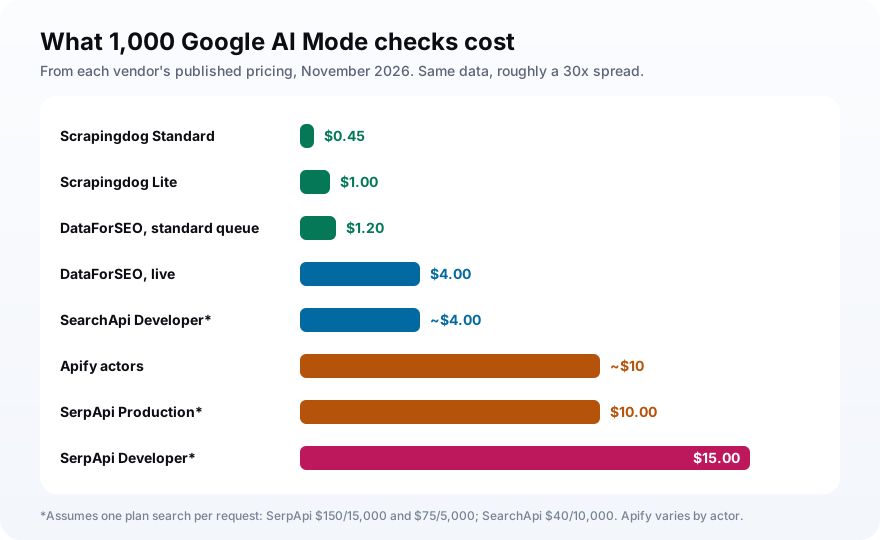
The SerpApi and SearchApi numbers assume one plan search per AI Mode request: $75 for 5,000 searches is $15 per 1,000, and $150 for 15,000 is $10. If an AI Overview needs the extra page-token request, double the SerpApi figure for that keyword.
Put it in project terms. Tracking 300 queries in AI Mode every day is about 9,000 calls a month, which is roughly $11 on DataForSEO's standard queue and a $150 SerpApi Production plan.
MentionsAPI costs more per call, 35 credits for AI Mode, or about $0.10 to $0.18 per check depending on plan. You pay for brand mention and rank parsing and the same call shape across chat engines, so it fits tracking a set of buyer prompts. For collecting raw Google data at volume, use a SERP API.
How reliably do SERP APIs capture AI Overviews?
Not as reliably as their feature pages suggest. In a 25-query benchmark published by Scrape.do, SerpApi detected AI Overviews 68% of the time, Scrape.do 60%, Scrapingdog 48%, and two well-known scrapers 0%. Google loads the block late and only for some queries, so test capture rate on your own query set before you buy.
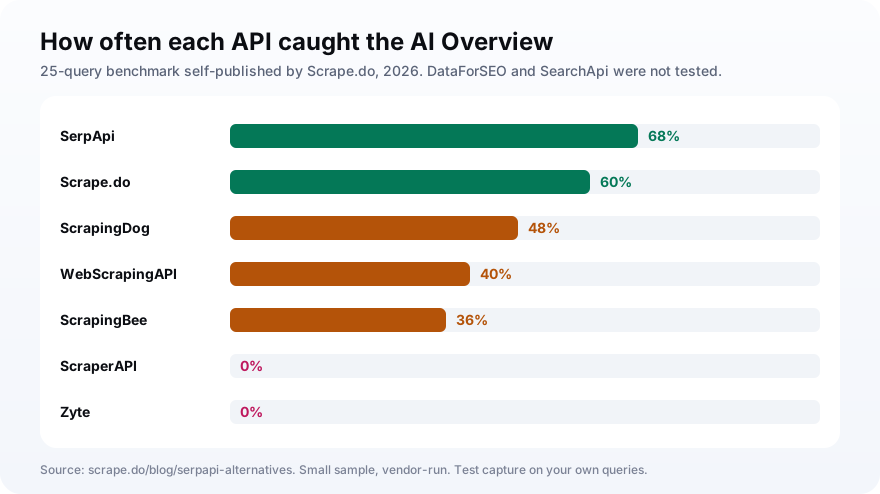
Read that benchmark with care. It is self-published by Scrape.do, which placed itself second, and 25 queries is a small sample. DataForSEO and SearchApi were not in it.
The direction still holds. A scraper that never waits for the AI Overview will log "no AI Overview" on queries that clearly have one, and that error looks exactly like a real absence in your data.
Sources churn too. A Semrush study of 3,000 keywords through October 2024 found that no keyword kept the same AI Overview URLs all month, and only 6.7% of desktop URLs cited in week one were still cited in week four.
Being cited is most of the visibility these answers give you. Pew found that Google users clicked a cited source in just 1% of visits with an AI summary, and clicked a regular result in 8% of those visits versus 15% without one, per its July 2025 analysis.
What I saw running AI Mode through an API
I ran "best serp api for ai overviews" through DataForSEO's live AI Mode endpoint four times in about five minutes, and no two runs cited the same sources. Each run cited three or five sources, six different domains in total. Only serpapi.com was cited every time, while the answer named SerpApi and DataForSEO in every run where I logged the brands.
Here is the function I used. It returns whether AI Mode answered, the cited domains, and whether yours is among them:
import os

import requests

LOGIN, PASSWORD = os.environ["DFS_LOGIN"], os.environ["DFS_PASSWORD"]


def ai_mode_sources(query, domain):
    """Google AI Mode answer for one query: cited domains, and whether yours is one of them."""
    r = requests.post(
        "https://api.dataforseo.com/v3/serp/google/ai_mode/live/advanced",
        auth=(LOGIN, PASSWORD),
        json=[{"keyword": query, "location_code": 2840, "language_code": "en"}],
        timeout=120,
    )
    r.raise_for_status()
    items = r.json()["tasks"][0]["result"][0]["items"] or []
    # AI Mode answers come back typed "ai_overview", not "ai_mode".
    answer = next((i for i in items if i["type"] == "ai_overview"), None)
    if answer is None:
        return {"answered": False, "sources": [], "cited": False}
    sources = [ref.get("domain") for ref in answer.get("references") or []]
    return {
        "answered": True,
        "sources": sources,
        "cited": any(domain in (s or "") for s in sources),
        "text": answer.get("markdown") or "",
    }
One quirk cost me a few minutes. DataForSEO's AI Mode endpoint returns the answer as an item typed "ai_overview", not "ai_mode", so a filter on the obvious name finds nothing.
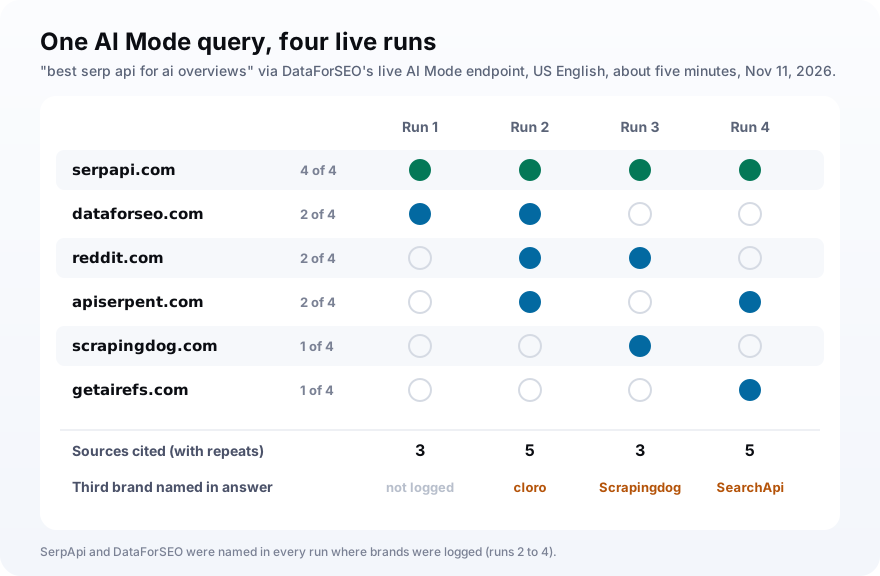
dataforseo.com was cited in only two of the four runs, though the answer recommended DataForSEO each time I logged it. The other slots rotated through reddit.com, apiserpent.com, scrapingdog.com, and getairefs.com.
The third brand the answer named changed on every logged run too: cloro, then Scrapingdog, then SearchApi. Whoever holds that slot today may not hold it an hour later.
A second query, "serpapi alternatives for ai mode", was stranger. The answer named SerpApi, DataForSEO, SearchApi, and Serper, yet cited you.com, icypeas.com, and octen.ai, none of which it recommended.
So the brands an answer names and the sources it cites are two separate measurements. Track both, or you will miss the case where Google recommends you while crediting someone else's page.
AI Mode named four SERP APIs and cited three sites it never mentioned. Mentions and citations are different numbers.From the live test
When you need an AI answer API instead of a SERP API
Use an AI answer API when you care whether a brand is mentioned and ranked across ChatGPT, Claude, Gemini, Perplexity, and Google's AI surfaces together. SERP APIs only read Google and Bing pages. An AI answer API sends one prompt to each engine and parses mention, rank, and citations, so you skip writing a parser for every engine.
Search behavior is spreading across those engines. A SparkToro and Gumshoe study found less than a 1-in-100 chance that an AI tool repeats the same brand list for the same prompt, Search Engine Journal reported, so one engine and one run tells you little.
On MentionsAPI, an AI Overview check is 15 credits, an AI Mode check 35, and a Copilot check 15. A quick check across ChatGPT, Claude, Gemini, and Perplexity is 150 credits fresh and 5 when the same query was asked recently.
Each mode takes the same request with a mode field set to ai_mode, ai_overview, or quick. The response shape stays the same across engines, which matters once you track 50 prompts in seven places.
How to choose a SerpApi alternative
Choose on capture rate first, then price, then latency. Run the same 25 queries through two or three finalists on the same day and location, count how many AI Overviews each catches, and compare the cited domains. Then price the winner at your real monthly volume, including any second request the vendor needs to load the AI block.
- Choose DataForSEO if you want AI Mode and AI Overview data with organic results at the lowest queued price.
- Choose Scrapingdog if you run hundreds of thousands of calls a month and price per call wins.
- Choose SerpApi if you want the most mature docs and a free tier, and the per-search price fits.
- Choose cloro if you want Google AI Mode plus ChatGPT and Gemini from one scraping vendor.
- Choose an AI answer API such as MentionsAPI if you need brand mention rate and rank across chat engines.
Serper is fast and has 2,500 free queries, but it does not list AI Overview data, so it is a poor fit here. If you also need Google positions, our rank tracking API guide prices that side.
Mistakes that corrupt AI Overview data
Most bad AI Overview data comes from the request, not the vendor. The API returns exactly what you asked for, and a missing flag or the wrong location quietly turns real AI Overviews into empty rows. These are the mistakes I see most often, in rough order of how much they skew a report.
- Skipping the async AI Overview option, then logging empty reference lists as real absences.
- Filtering DataForSEO AI Mode results for type ai_mode instead of ai_overview.
- Letting a SerpApi page token expire before the follow-up request fires.
- Leaving location unset, so you track a market you do not sell in.
- Treating one run as the answer instead of sampling the same query several times.
- Counting brand mentions in the text but ignoring which domains were cited.
Frequently asked questions
What is the best SerpApi alternative for AI Overview data?
Does SerpApi support Google AI Mode?
How much does Google AI Mode data cost per 1,000 queries?
What is the difference between AI Overview and AI Mode data?
Can a SERP API tell me if ChatGPT mentions my brand?
Why does my SERP API return an empty AI Overview?
Test on your own queries before you switch
The right SerpApi alternative is the one that catches the most AI Overviews on your queries at a price you can scale. For most teams that means DataForSEO or Scrapingdog for Google AI data, tested side by side on 25 queries. Add an AI answer API when the question becomes whether ChatGPT and Perplexity mention you too.
Whichever you pick, store the cited domains with a date. Those lists shift so often that a single snapshot only tells you about one day.