You checked ChatGPT once, saw your brand, and relaxed. Run the same prompt next week and there is a 70% chance you are gone.
That is the trap with AI brand mention monitoring. AI answers are not fixed, so a single screenshot is a single sample from a slot machine. To actually know how AI talks about your brand, you monitor it the way you would poll anything that moves: the same prompts, every week, across every engine your buyers use.
I run this loop for my own brand. So this guide is the practical version: what monitoring actually is, what to track, how to set it up across all four engines, and how often, without drowning in a $99-a-month dashboard if you do not want one.
What is AI brand mention monitoring?
AI brand mention monitoring is the practice of tracking how AI models mention, cite, and recommend your brand across ChatGPT, Claude, Gemini, and Perplexity over time. It is not social listening, which tracks what humans post, and it is not a one-time check. You run a fixed set of buyer prompts on a schedule, then measure how often and how well each engine names you against your competitors.
The reason it needs its own name is that it answers a question social tools cannot. Social listening catches human conversation. AI monitoring catches machine recommendations, the answer a buyer hears the moment they ask an AI which product to pick.
That answer now reaches enormous audiences, so being misdescribed or absent there is a real cost, not a vanity metric.
Why a single check is not monitoring
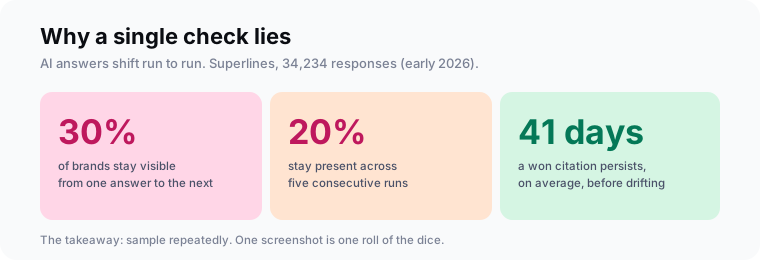
Because AI answers change constantly, one check is a coin flip. In a Superlines study of 34,234 AI responses in early 2026, only 30% of brands stayed visible from one AI answer to the next, and just 20% stayed present across five consecutive runs. Once a brand did win a citation, it held for about 41 days on average before drifting. So monitoring means repeated sampling, not a screenshot.
The variance is not small either. A separate 750-response study by Vismore found three identical prompt runs produced 38% different brand sets. Sample once and you might catch a good day or a bad one, with no way to tell which.
One AI check is a data point. Monitoring is a trend line. Only the trend line tells you whether you are winning or losing the answer.The core rule
What should you track?
Track four kinds of mention, then sentiment and share of voice on top. A plain brand mention is your name in the answer text. A citation is when the AI links your domain. An unlinked mention is when it names you with no link to click. A competitor-comparison mention is when you appear alongside rivals. Score each for sentiment, and roll it all into share of voice against your competitor set.
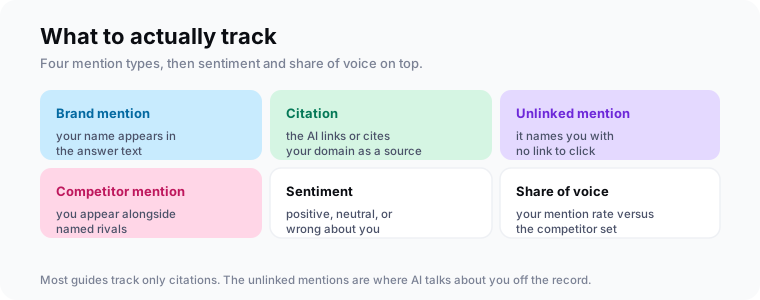
The unlinked mention is the one people miss. AI names brands far more often than it links them, so if you only watch for citations you undercount how often AI actually talks about you. We dug into that gap in how to check if ChatGPT mentions your brand.
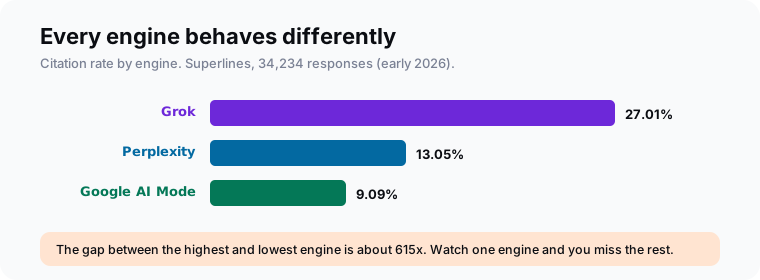
Segment every metric by engine. Citation rates swing wildly: per the same Superlines data, Grok cites sources in 27.01% of responses, Perplexity in 13.05%, and Google AI Mode in 9.09%. Watch one engine and you miss the rest.
How to set up AI brand mention monitoring
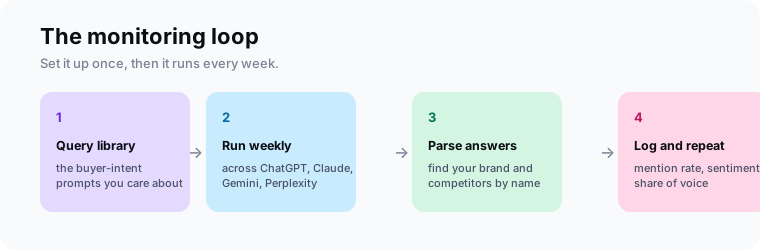
Four steps. Build a query library of the buyer-intent prompts your customers actually ask, like "best CRM for startups," not just your brand name. Run every prompt weekly across ChatGPT, Claude, Gemini, and Perplexity. Parse each answer for your brand and competitors. Then log mention rate, sentiment, and share of voice, and repeat next week.
Start with 20 to 50 prompts. Vanity queries like "what is [your brand]" waste runs, since AI already knows your name there. The prompts that matter are the category and comparison ones where a buyer is deciding, and where you might not show up.
AI brand monitoring vs social listening
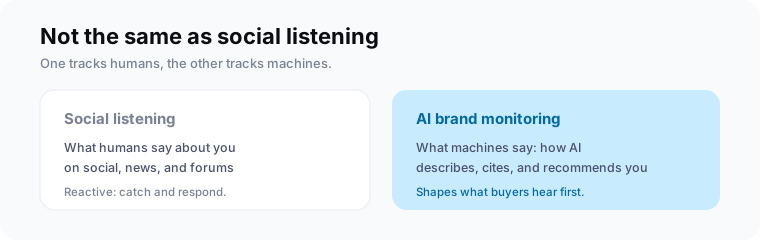
They track different things and you need both. Social listening tracks what humans say about you on social platforms, news, and forums, and fires alerts so you can respond. AI brand monitoring tracks what machines say: how AI describes, cites, and recommends you when a buyer asks about your category. One is human conversation, the other is machine recommendation, and your social tool does not see the second.
How often should you monitor, and with what?
Weekly is the right cadence, and you have three ways to run it. By hand is free but caps out at a few prompts. A dashboard automates the runs for a monthly fee, often $99 and up per domain. An API lets you script the whole loop and pay per call, which scales cheapest and keeps the data in your own tools. Match the method to whether a person or a script will own the monitoring.
One honest caveat if you go the API route. A raw model API can return answers that differ from the live chat a user sees, which is a fair knock on API-only monitoring. The fix is to check both: MentionsAPI runs fast model checks and live UI-surface scrapes of ChatGPT, Gemini, and Perplexity, so you capture what users actually get. We weigh the full trade-off in API or dashboard.
Frequently asked questions
How do I monitor brand mentions in AI search?
What is the difference between AI brand monitoring and social listening?
How often should I monitor my brand in AI?
What should I track when monitoring AI brand mentions?
Can I monitor AI brand mentions for free?
Do AI monitoring tools show what real users see, or just the API?
Set the query library, then run it every week
The move that matters most: stop treating AI visibility as a screenshot. Write 20 buyer-intent prompts, add your competitors, and run the set across all four engines once a week. That single habit turns a lucky check into a trend you can actually manage.
Then act on the trend. Pull this week's baseline across every engine, watch your share of voice against rivals, and feed the gaps into the GEO playbook so next month's numbers move.