Rankscale gives you more AI engines for less money than almost anything else in the category. That alone makes it worth a look.
It also comes with a credit model and a subscription, and whether those fit depends on how you plan to use the data. So this is a straight review: what Rankscale does, what it costs, where it wins, and when something simpler is the better buy.
No affiliate angle. Just where it fits and where it does not.
What is Rankscale?
Rankscale is a generative engine optimization platform that measures how your brand appears in AI answers and helps you improve it. It calls itself an integrated AI SEO suite, and that is a fair description: monitoring, competitor analysis, citation tracking, sentiment, page audits, and prompt research in one place. The headline output is a single Visibility Score that rolls up mentions, citations, position, and sentiment.
Reviewers tend to call it the most approachable tool in the category, and that fits. The dashboard is clean, the Visibility Score is easy to explain to a client or a boss, and the options make sense without a training call.
What sets it apart, though, is breadth and access.
Most platforms track a handful of engines and lock you into their dashboard. Rankscale tracks 17 or more, exposes the data through a REST API and a Looker Studio connector, and lets agencies fold AI visibility into the client reports they already build. It is a platform that does not trap the data inside itself.
That openness is rarer than it sounds. A lot of AI visibility tools want to be the place you live, so they make it awkward to get your numbers out.
Rankscale takes the opposite stance, which is a point in its favor whether you are an agency piping data into client dashboards or a team that wants AI visibility sitting next to the rest of its analytics. You are buying a tracker, not a walled garden.
Rankscale is the broad, affordable, data-friendly pick. You still pay a subscription for it.The one-line verdict
What does it track, and which AI engines?
Rankscale tracks mentions, citations, sentiment, position, detection rate, and top-three visibility, then combines them into one score you can trend over time. It also runs page audits against 200-plus factors and does LLM-native prompt research, so it covers both measurement and the on-page work behind it.
The engine list is the real standout.
It covers 17 or more, including ChatGPT, Perplexity, Gemini, Google AI Overviews, Google AI Mode, Claude, Copilot, Grok, DeepSeek, and Mistral. The DeepSeek and Mistral coverage is rare, and it matters if your audience is in the EU or outside the usual US model set. Better still, every engine is available on every plan, so coverage is not something you buy up tiers to unlock.
That last point is a real contrast with pricier platforms. Some gate their best engines behind higher tiers, so the model you actually care about sits above the plan you can afford.
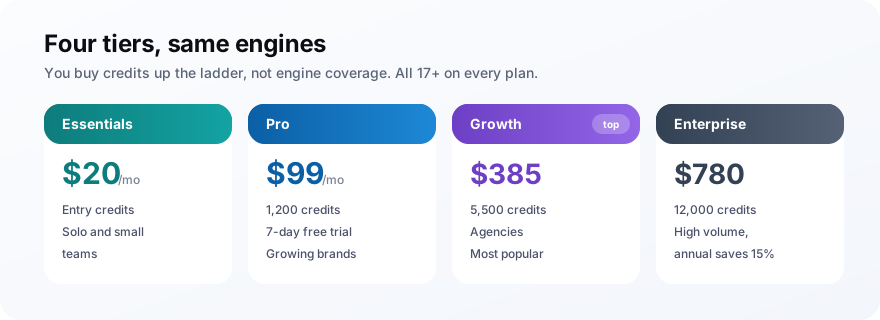
Rankscale does not play that game. A $20 Essentials plan sees the same engine list as a $780 Enterprise one, and you scale credits, not access. For a small team that specifically needs to track Claude or DeepSeek, that alone can make Rankscale the cheapest way in.
How much does Rankscale cost?
Rankscale is credit-based across four tiers: Essentials from $20 a month, Pro at $99, Growth at $385, and Enterprise at $780. Pro includes 1,200 credits a month, Growth 5,500, and Enterprise 12,000. Annual billing takes off 15%, and unused credits roll over, which is friendlier than most credit systems.
The credit model has one wrinkle worth knowing before you buy.
A typical query costs about 0.25 credits per engine, but the premium models cost more: DeepSeek runs 1 credit and Claude runs 2 or more per query. So a prompt checked across all engines is not a flat cost, and tracking many prompts against Claude specifically will drain credits faster than the 0.25 headline suggests.
It is worth doing the math on your own setup, as independent pricing breakdowns stress. A mid-size tracking plan can look cheap and then run out of credits mid-month.
Say you track 40 prompts across 10 engines, daily. If a few of those engines are Claude at 2 credits, your per-run cost is not 40 times 0.25; it is meaningfully higher, and Pro's 1,200 credits can vanish in a couple of weeks. The rollover helps, but the lesson holds: price the plan against your real engine mix, not the headline rate.
Rankscale pros and cons
The honest summary: Rankscale is the best-value broad tracker in its class, with unusually good data access, held back mainly by a credit model that punishes premium-model tracking and the lack of a free tier. Here is the balance.
| Strengths | Weaknesses |
|---|---|
| 17+ engines, all on every tier | No permanent free plan, only a trial |
| Low $20 entry price | Premium models cost more credits |
| REST API and Looker connector | Credit math needs forecasting |
| Credits roll over, annual saves 15% | Still a monthly subscription for data |
| Rare DeepSeek and Mistral coverage | Content action is lighter than agentic tools |
The pattern in that table is familiar for the category. The product is good; the friction is the pricing model.
Rankscale tracks well, covers more engines than most, and hands you the data through an API and Looker. What you weigh against that is a credit meter that treats premium models as expensive, no free tier to sit on, and a subscription you keep paying whether you log in daily or once a month. None of that is a defect; it is a fit question.
Who is Rankscale for, and who should skip it?
Rankscale fits brands and agencies that want broad, affordable AI visibility tracking and will use the dashboard and reports. The wide engine coverage, the low entry price, and the Looker connector make it especially strong for agencies reporting to clients. If you only need the underlying data, or you never open a dashboard, the subscription is harder to justify.
A few profiles make the call clearer.
- Agencies reporting AI visibility to clients get real value from the Looker connector and broad coverage.
- Brands with EU or global audiences benefit from the rare DeepSeek and Mistral tracking.
- Cost-conscious teams that still want a dashboard will prefer the $20 entry to pricier platforms.
- Developers and data teams who just want the numbers can skip the dashboard and use a pay-as-you-go API instead.
That last group is worth calling out, because Rankscale does have an API, and it is easy to assume that settles it.
It does not, quite. Having an API and being an API are different things.
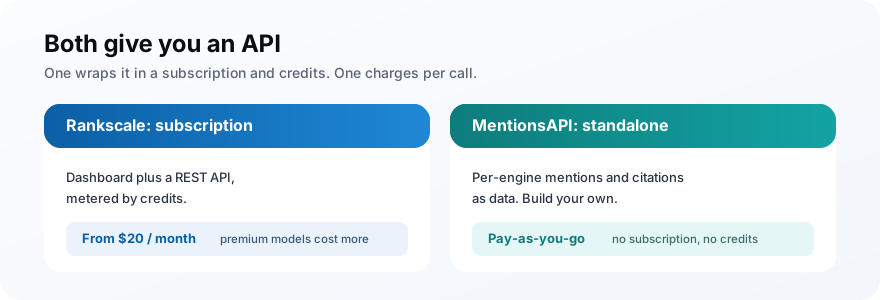
Rankscale's API sits inside a credit subscription, so you are still paying a monthly plan and spending metered credits to reach it. If the data feed is all you want, that is a lot of platform wrapped around a call you could make more cheaply somewhere else.
The best Rankscale alternatives
The alternatives split into three groups: other GEO platforms, SEO suites that bolted on AI tracking, and standalone AI visibility APIs. Which one fits depends on whether you want a managed dashboard, an add-on to a suite you already pay for, or just the data.
- GEO platforms: AthenaHQ, Profound, and Peec AI offer similar dashboards, with AthenaHQ leaning more premium and agentic.
- SEO suites: Semrush and SE Ranking add AI tracking if you already pay for the suite.
- Standalone API: MentionsAPI returns per-engine mentions and citations pay-as-you-go, with no subscription or credit model, for teams that want to build rather than buy a dashboard.
Our roundup of the best AI visibility tools lays out the whole field and where each one fits.
Rankscale vs a standalone AI visibility API
This is the comparison Rankscale makes trickier than most, because it has its own REST API. The difference is not API versus no API; it is a subscription with a bundled API versus a standalone pay-as-you-go one. With Rankscale you buy a plan and spend credits, and the API is part of that. With a standalone API you pay only for the calls you make, with no monthly floor.
For a team that wants the dashboard and the API together, Rankscale is a tidy package.
For a team that only wants the data feed, the standalone route is cheaper and simpler. You are not paying a subscription to reach an API, you are not translating usage into credits that cost more for premium models, and you can scale calls up or down without changing plans. The trade is that you build your own reporting instead of getting Rankscale's dashboard.
The right answer depends on one honest question: will your team use a dashboard?
If someone will open it, read the recommendations, and act, the dashboard is worth paying for, and Rankscale is a good one at a fair price. If the data is really destined for a spreadsheet, a BI tool, or an automation you already run, the dashboard is a cost you carry and never use, and a per-call API delivers the same signal for less.
Frequently asked questions
What is Rankscale?
How much does Rankscale cost?
Does Rankscale have a free plan?
What AI engines does Rankscale track?
Is Rankscale worth it?
What are the best Rankscale alternatives?
Broad and cheap, if you will use the dashboard
Do this before you buy: list the engines you care about, the number of prompts you want to track, and how often. Weight Claude and DeepSeek heavily, since they cost more credits, and run that against Rankscale's 7-day Pro trial to see how fast the credits actually move on your own prompt set.
If you want a broad, affordable dashboard and will actually use it, Rankscale is one of the best values in the category. If you mostly need the citation data to power your own reporting, pull a per-engine baseline with MentionsAPI first and decide whether you need the subscription at all.
Compared head to head with a pricier platform, Rankscale wins on coverage and cost, and gives up some of the done-for-you polish. Set beside a bare API, it wins on the dashboard and loses on price and flexibility.
That middle position is exactly its appeal. Rankscale is the sensible default for a team that wants real breadth without a big platform bill, and is honest enough about its trade-offs that you can decide in an afternoon whether it or a lighter API is the better fit.