SaaS marketers spent a decade optimizing the site. The decision now happens one step earlier, inside an answer you do not control.
For SaaS, the AI chatbot has quietly become the shortlisting step.
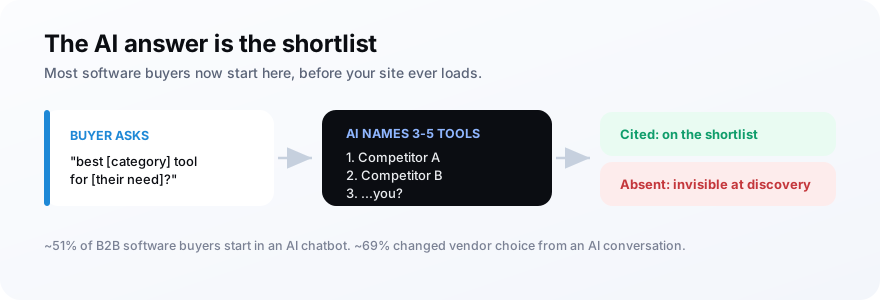
More than half of software buyers now start their research in ChatGPT or Perplexity instead of Google, the AI names three to five tools, and that list is the shortlist.
If your product is not one of the names, you are out of the deal before the buyer ever sees your site. AI visibility for SaaS is the work of being one of those names. Here is the playbook.
Why does AI visibility matter for SaaS?
Because the AI answer now decides your shortlist. In 2026, roughly 51% of B2B software buyers start vendor research in an AI chatbot rather than Google, and about 69% say an AI conversation changed which vendor they chose, per 2026 B2B SaaS research. The model names a handful of tools for any category question, and buyers treat that as the candidate list. Not being named is not a small miss. It is being invisible at the moment of discovery.
SaaS feels this harder than most categories.
Software buying starts with a research question, not a brand, so the buyer is practically asking the AI to pick for them. A consumer might still wander to a store; a B2B buyer evaluating tools takes the AI's shortlist and runs with it, because it saves hours of comparison work.
And the deal is often half-decided before you know it exists.
By the time a buyer books a demo, the AI has already told them who the main options are and where you sit among them. You are not opening the conversation. You are responding to one the AI already had with your prospect.
The adoption numbers make this hard to wave off.
Forrester found 94% of business buyers used AI somewhere in their buying process, and other 2026 surveys put the share who have asked an AI which vendors to consider around 82%. This is not an early-adopter edge case anymore. It is how the median software buyer now starts.
Picture the moment concretely.
A RevOps lead opens ChatGPT and asks for the best CRM for a 30-person sales team. It returns four names with a line each and a note on pricing.
She demos three of them and never opens Google. If your product was the name the model left out, you were never in that evaluation at all.
In SaaS, the AI answer is the shortlist. Not being named is not a ranking problem, it is not being in the room.The one line to remember
How do SaaS buyers use AI to pick software?
They ask the category question, not your brand name. A buyer types something like the best project management tool for remote teams, the AI returns a short ranked list with a sentence on each, and they shortlist from that. Then they dig in, often by asking follow-ups or checking the sources the AI cited. By the time they reach your site, the AI has already framed where you sit.
The follow-up questions are where deals shift.
Buyers ask the AI to compare two tools, to list alternatives, or to say which fits a 50-person team. Each answer either keeps you in or quietly drops you, and most of it happens with no analytics footprint on your side at all.
What does AI cite when recommending SaaS?
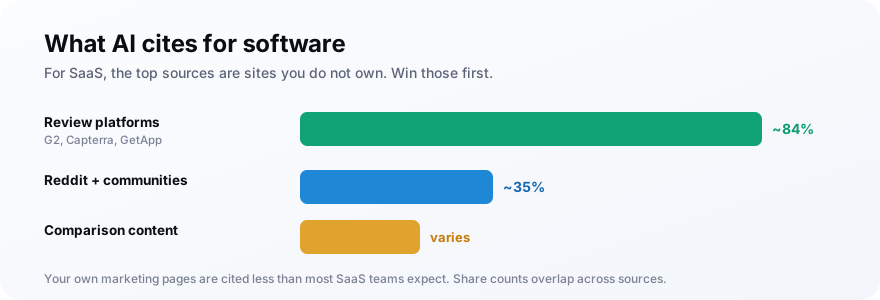
Mostly third-party sources, not your marketing site. In the software category, review platforms like G2, Capterra, Software Advice, and GetApp account for about 84% of the sources AI cites, and Reddit is cited by ChatGPT around 35% of the time. Your AI visibility depends heavily on how you show up on sites you do not own, which changes the whole playbook for SaaS.
| Source AI reaches for | Roughly | Your move |
|---|---|---|
| Review platforms (G2, Capterra, GetApp) | 84% of software citations | Keep profiles current, win fresh reviews |
| Reddit and communities | ~35% of ChatGPT citations | Earn genuine mentions where buyers ask |
| Comparison and alternatives content | Varies | Own pages for vs and alternatives queries |
| Your product and docs pages | Lower than you expect | Clear, answer-first, AI-crawler accessible |
The pattern holds across studies.
A 2026 G2 AI search report put review platforms at the top of software citations, and separate research found about 32% of vendors are now discovered through AI citations, where being cited means making the shortlist and being absent means not existing at the discovery stage.
This is the part most SaaS teams get wrong.
They pour effort into their own blog and expect the AI to cite it, while the model is actually pulling from G2 and a Reddit thread. For SaaS, your off-site presence is not a supporting act. It is the main source the AI reads.
How is this different from regular SaaS SEO?
Traditional SaaS SEO optimizes pages you own to rank in Google. AI visibility optimizes how you appear across sources you mostly do not own, so an AI names you when a buyer asks. The skills overlap, but the center of gravity moves off your site: to review platforms, community threads, and the comparison content AI engines actually quote.
The metric changes too.
SaaS SEO counts rankings and sign-up traffic from your pages. AI visibility counts whether the model names you in the shortlist, which can happen with zero clicks to your site. A team that only watches organic traffic will miss the deals the AI is already shaping.
The vertical also makes the stakes uneven.
AI citation rates vary widely by category, from around 61% in developer tools down to roughly 22% on average, per 2026 B2B SaaS benchmarks. Some SaaS categories are already AI-decided while others are just starting, so knowing where yours sits tells you how urgent this is.
Either way, the old playbook is no longer enough on its own.
Ranking your pages still matters, but if the review sites and threads the AI trusts do not carry you, the best-optimized site in your category still loses the shortlist. The on-site work and the off-site work now have to move together.
The SaaS AI visibility playbook
Win the sources AI trusts for software, then back them with your own comparison content. That means a strong, current presence on the big review platforms, real traction in the communities your buyers read, comparison and alternatives pages on your own site, and clean technical access so AI crawlers can read all of it. The work is less about blog volume and more about third-party proof.
The moves that actually move SaaS citations:
- Own your review profiles: keep G2, Capterra, and GetApp current and win fresh reviews, since these carry most software citations.
- Show up on Reddit honestly: be genuinely useful in the subreddits your buyers read, because ChatGPT leans on Reddit heavily for software.
- Publish comparison and alternatives pages: you-vs-competitor and alternatives-to-competitor content AI can lift directly.
- Structure for extraction: clear category definitions, feature tables, and FAQ and HowTo schema on your key pages.
- Open the doors: make sure AI crawlers can reach your site and docs, or none of the above gets read.
Two of these deserve more weight than SaaS teams give them.
Reviews are not a one-time setup. AI engines favor recent, active review profiles, so a steady trickle of fresh G2 and Capterra reviews keeps you in the answer, while a profile that peaked two years ago fades out of it. Treat review generation as an ongoing motion that never really finishes.
Reddit rewards being useful, not promotional.
A genuinely helpful answer in the subreddit your buyers read can become the exact passage an AI quotes, while an obvious plug gets downvoted and ignored. Show up as a practitioner the thread respects. Our guide on improving your AI visibility score covers the on-site mechanics; the SaaS difference is how much weight these off-site sources carry.
Which prompts should a SaaS brand monitor?
Track the category questions a buyer asks before they know your name. The highest-value SaaS prompts are category discovery, best tool for a job, comparisons against a named competitor, alternatives to a rival, and use-case fit for a team size or industry. Skip your own brand name, since you already win there. Monitor the prompts where the AI picks a winner and it might not be you.
Build the list from your real sales motion.
Pull the categories you compete in, the competitors you lose to, and the use cases your best customers cite, then phrase each the way a buyer would ask an AI. Our guide on prompt monitoring covers how to turn that into an ongoing watch rather than a one-time check.
How do you measure AI visibility for SaaS?
Measure your citation rate on category prompts, broken down against each competitor. For SaaS the number that matters is how often the AI names you for the questions your buyers ask, versus how often it names each rival, across ChatGPT, Perplexity, Gemini, and Claude. It is worth measuring well, because AI-referred visitors convert at roughly 2.4 times the rate of regular organic traffic, arriving pre-shortlisted.
Think of it as share of the shortlist.
Your share of model in your category, the slice of AI answers that name you against competitors, is the SaaS metric that maps most directly to pipeline. A rising share means the AI is handing more buyers your name at the shortlist stage.
Set a baseline before you act.
Record how often you are named for your core category prompts today, then watch it move as you work the review platforms and comparison content. Our guide on checking whether ChatGPT mentions your brand covers the manual version, and an API makes it repeatable across engines.
Report it as a trend against competitors.
A single citation-rate number is useful, but the SaaS version worth putting in front of a revenue team is your share of the shortlist over time, next to your top two or three rivals. That chart answers the only question that matters: is AI feeding pipeline to you, or to them?
Frequently asked questions
Why does AI visibility matter for SaaS?
How do B2B buyers use AI to choose software?
What sources does AI cite when recommending SaaS?
How do I get my SaaS cited by ChatGPT?
Which prompts should a SaaS company track?
Does AI traffic convert for SaaS?
Be a name, not a footnote
Do this next: open ChatGPT, ask the category question your best buyers ask, and see whether your product is named and who is named instead. That answer is your current standing in the SaaS deals starting today.
Then go win the shortlist. Strengthen your review-platform and community presence, publish the comparison pages, and track your share of model with MentionsAPI so you know the work is landing.
In SaaS, the demo is no longer the first impression. The AI answer is.