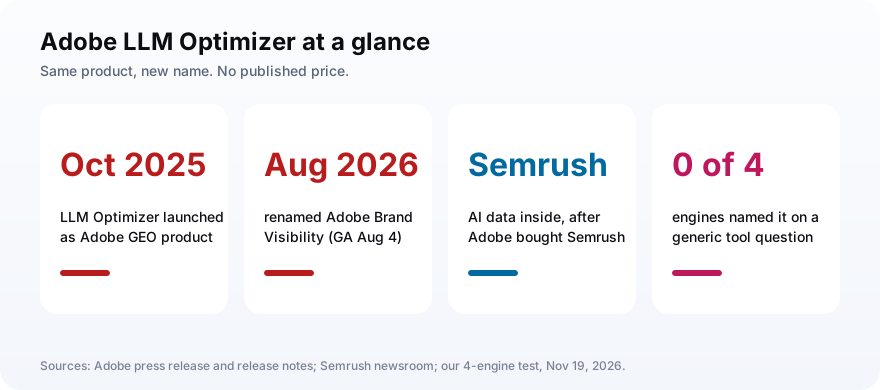
Searches for Adobe LLM Optimizer are down about 80% this year. The product did not go away. It changed its name.
Adobe LLM Optimizer is Adobe's generative engine optimization product, renamed Adobe Brand Visibility in August 2026. It measures how AI engines mention your brand, recommends content and technical fixes, and can deploy some fixes to AI agents directly at the CDN. In this Adobe LLM Optimizer review, I cover what changed, what it does now, who can buy it, and the best alternatives.
I built this review from Adobe's press release, its Experience League documentation, and its release notes, all read on November 19, 2026. I also asked ChatGPT, Claude, Gemini, and Perplexity three buyer questions through their APIs with web search on, 12 answers in total.
Disclosure: MentionsAPI sells an AI visibility API, so we compete with the tracking part of Adobe's product. We do not offer anything like its edge deployment. We were named in none of the 12 answers.
What happened to Adobe LLM Optimizer?
Adobe LLM Optimizer became Adobe Brand Visibility in August 2026. Adobe's release notes say on August 1, 2026 that "LLM Optimizer is becoming Adobe Brand Visibility," and the renamed product became generally available on August 4. The product now uses Semrush's AI visibility data, after Adobe completed its acquisition of Semrush on April 28, 2026. The old name still appears in many reviews and searches.
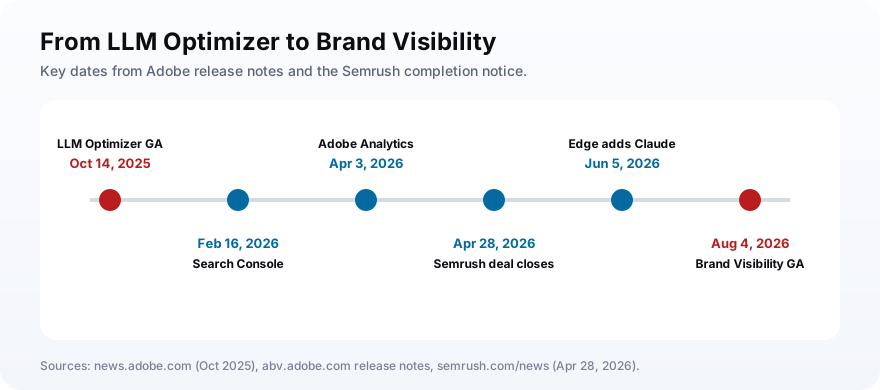
The timeline, from Adobe's own sources:
- October 14, 2025: LLM Optimizer becomes generally available as a standalone app and inside AEM Sites.
- February 16, 2026: Google Search Console integration becomes generally available.
- April 3, 2026: Adobe Analytics integration becomes generally available for paying customers.
- April 28, 2026: Adobe completes its acquisition of Semrush.
- April 25 and June 5, 2026: Optimize at Edge adds Adobe Managed CDN, then Claude support.
- August 4, 2026: Adobe Brand Visibility becomes generally available.
The launch is documented in Adobe's October 2025 press release, the later dates in its release notes, and the acquisition in the completion announcement.
What does Adobe Brand Visibility do?
Adobe Brand Visibility measures how often AI engines mention and cite your brand, compares you with competitors, and turns gaps into fixes. Its documentation says AI Visibility supports analysis across ChatGPT, Google AI Overviews, Google AI Mode, and Gemini, powered by Semrush data. It adds prompt research, content opportunities, agentic traffic dashboards, and Optimize at Edge for deploying fixes.
The main modules, per Adobe's documentation:
- Brand Visibility: a visibility score and benchmarks against competitors.
- AI Visibility: a Semrush-powered overview, prompt research, and market comparison.
- Prompts Management: your own topics and prompts to track.
- Opportunities: fixes such as FAQs, LLM-friendly summaries, and tables of contents.
- Agentic Traffic and Referral Traffic: dashboards built from CDN logs.
- Optimize at Edge: serving improved pages to AI agents without touching your CMS.
The engine list is shorter than some rivals advertise. Perplexity and Claude appear in Optimize at Edge, which serves pages to their crawlers, but not in the AI Visibility tracking list, per the Experience League docs.
The October 2025 launch also mentioned support for A2A and MCP, and a free Chrome extension called "Is Your Webpage Citable?" for checking single pages.
How do Optimize at Edge and agentic traffic work?
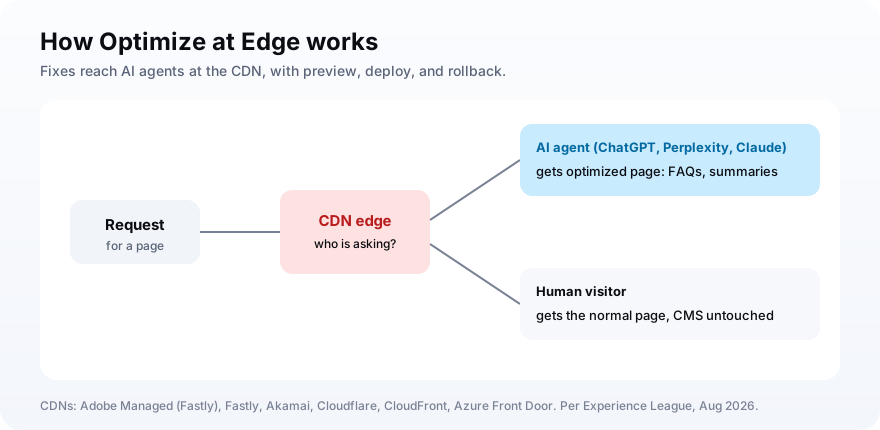
Optimize at Edge serves an improved version of a page only to AI agents, such as those from ChatGPT, Perplexity, and Claude, at the CDN layer. Human visitors still see the normal page, and your CMS stays untouched. Agentic traffic dashboards read your CDN logs to show which AI bots visit, which pages they fetch, and which AI referrals turn into visits. Few AI visibility tools offer either feature.
Optimize at Edge works on the Adobe Managed CDN, which runs on Fastly, or on your own Fastly, Akamai, Cloudflare, CloudFront, or Azure Front Door setup. Each change has preview, deploy, and rollback.
Agentic traffic needs CDN log forwarding from Akamai, Cloudflare, CloudFront, Fastly, or Imperva, or a manual upload. Setup also asks you to allowlist Adobe's Spacecat/1.0 crawler.
Adobe LLM Optimizer pricing and trial
Adobe does not publish a price for LLM Optimizer or Adobe Brand Visibility. Paid use runs through a license agreement with Adobe sales. A trial is open to Adobe Experience Manager Cloud customers and Adobe Analytics or Customer Journey Analytics customers, covering up to 100 prompts, one domain, and up to 50 URLs per opportunity type. Companies outside those products are onboarded after a business agreement.
| Option | Who can get it | Limits |
|---|---|---|
| Trial (from April 1, 2026) | AEM Cloud, Adobe Analytics, or CJA customers | 100 prompts, 1 domain, 50 URLs per opportunity type |
| Optimize at Edge trial | Same | 1 opportunity, up to 10 pages |
| Paid license | Through Adobe sales | Agreed per contract |
| Non-Adobe customers | After a business agreement | Agreed per contract |
Trial details are from Adobe's quick start documentation, updated November 3, 2026. Adobe states that use beyond the included limits requires a separate license agreement.
In practice, that makes Adobe Brand Visibility a sales-led enterprise purchase, usually bundled into a wider Adobe Experience Cloud contract. If you need a number for a budget, you will need a quote, so ask for one that names the prompt and domain limits.
Adobe Brand Visibility pros and cons
Adobe Brand Visibility's strengths are edge deployment of fixes, agentic traffic analytics from CDN logs, Semrush prompt data, and attribution through Adobe Analytics. Its weaknesses are unpublished pricing, trial access limited mainly to existing Adobe customers, a tracking list of four engines in the documentation, and a setup that assumes an enterprise web stack.
What it does well:
- Optimize at Edge, which can fix how AI agents see a page in days instead of a CMS release cycle.
- Agentic traffic dashboards that show AI crawler activity many analytics tools miss.
- Semrush prompt research and market comparison built in.
- Attribution through Adobe Analytics and Customer Journey Analytics.
Where it falls short:
- No public price, and paid use needs a license agreement.
- Trials favor existing AEM, Analytics, and CJA customers.
- AI Visibility documentation lists ChatGPT, Gemini, AI Overviews, and AI Mode only.
- Adobe's headline results come from its own sites, such as a 41% rise in LLM-referred traffic to Adobe.com.
Adobe's market data is still useful context. Its launch release reported a 1,100% year-over-year increase in AI traffic to US retail sites in September 2025, with that traffic 12% more engaged and 5% more likely to convert.
Is Adobe LLM Optimizer worth it? What four AI engines said
Adobe LLM Optimizer is worth it for large enterprises already on Adobe Experience Manager and Adobe Analytics, and too much for teams that only want to know whether AI engines mention them. When we asked ChatGPT, Claude, Gemini, and Perplexity "Is Adobe LLM Optimizer worth it?" on November 19, 2026, all four gave that verdict, and all four already knew about the rename to Adobe Brand Visibility.
ChatGPT and Perplexity leaned on Adobe's own pages. Claude cited review sites and noted that Optimize at Edge is unusual among these tools.
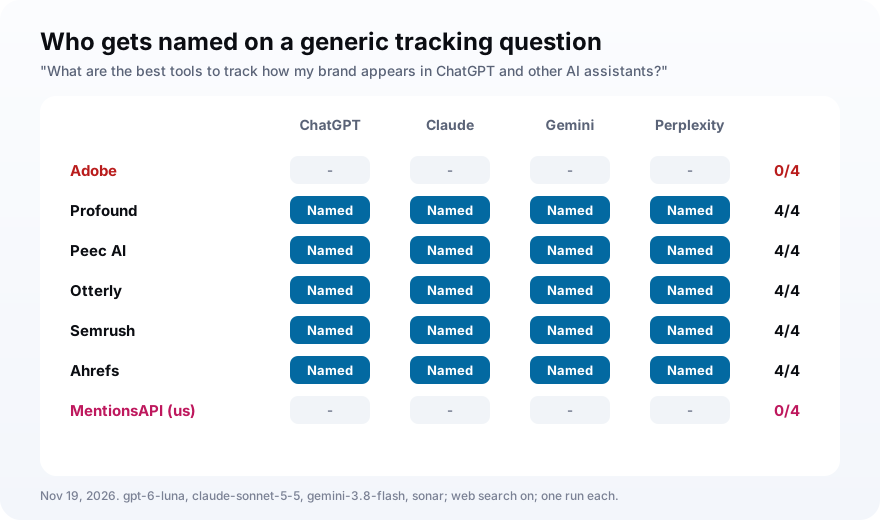
The generic question told a different story. Asked "What are the best tools to track how my brand appears in ChatGPT and other AI assistants?", none of the four engines named Adobe.
Profound, Peec AI, Otterly, Semrush, and Ahrefs were named by all four. Adobe now owns one of those five, but AI engines still list Semrush under its own name.
Adobe Brand Visibility vs Profound
Choose Adobe Brand Visibility if you run Adobe Experience Manager and want fixes deployed at the CDN with attribution in Adobe Analytics. Choose Profound if you want deeper monitoring across more engines without committing to the Adobe stack. Both are enterprise, sales-led products with free trials and no published paid price, so the deciding factor is usually your existing stack.
| Point | Adobe Brand Visibility | Profound |
|---|---|---|
| Engines tracked | ChatGPT, Gemini, AI Overviews, AI Mode (docs) | Up to 10 on Enterprise |
| Deploying fixes | Optimize at Edge at the CDN | Edge deployment not listed on its pricing page |
| Data source | Semrush Enterprise AIO data | Its own tracking |
| Trial | 100 prompts, mainly Adobe customers | 7 days, 50 fixed prompts a day |
| Price | License via Adobe sales | Custom Enterprise |
| Best for | Adobe Experience Cloud customers | Enterprises on any stack |
Profound's details are covered in our Profound alternatives and pricing guide, including its September 2026 move to Enterprise-only pricing.
Best Adobe LLM Optimizer alternatives
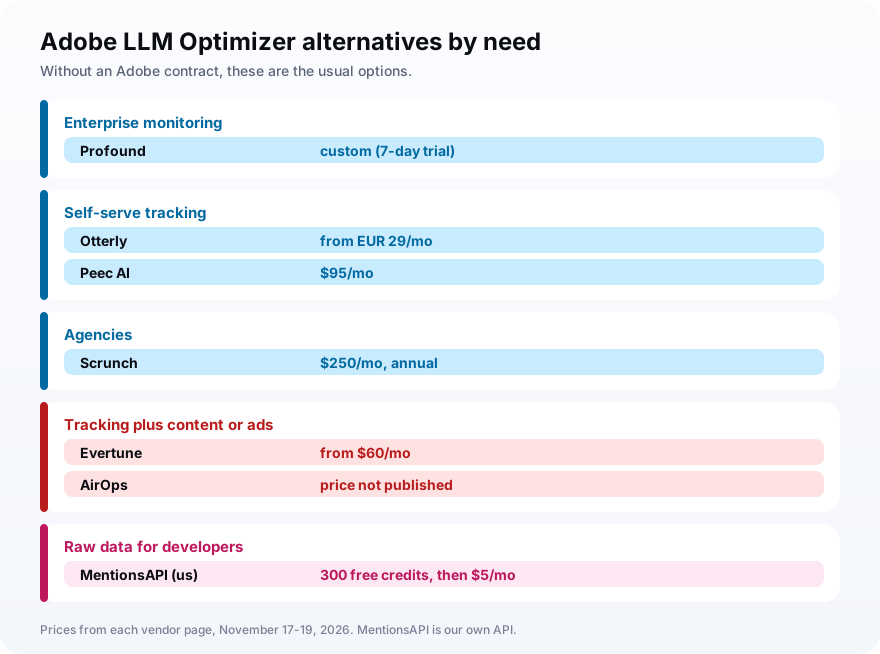
The best Adobe LLM Optimizer alternatives are Profound for enterprise monitoring, Peec AI and Otterly for self-serve tracking, Scrunch for agencies, AirOps and Evertune for tracking paired with content or ads, and an AI visibility API for developers. When we asked four engines for Adobe LLM Optimizer alternatives, Profound, Peec AI, Otterly, and Scrunch appeared in all four answers.
| Tool | Entry price | Choose it over Adobe if |
|---|---|---|
| Profound | Custom (7-day trial) | You want enterprise monitoring on any stack |
| Peec AI | $95/mo | You want self-serve daily tracking with unlimited seats |
| Otterly | EUR 29/mo | You track only a few prompts |
| Scrunch | $250/mo, annual | You are an agency with many prompts |
| AirOps | Not published (14-day trial) | You want tracking tied to content production |
| Evertune | $60/mo | You want heavy sampling and buy media |
| MentionsAPI (ours) | 300 free credits, then $5/mo | You build tracking into your own tools |
Prices were read on each vendor's own page between November 17 and 19, 2026.
Our reviews go deeper on each: Peec AI, AirOps, and Evertune. Semrush's own toolkit, now part of Adobe, is covered in our Semrush AI Visibility Toolkit review.
Our own product is an API with no edge deployment. It returns whether ChatGPT, Claude, Gemini, Perplexity, and Google's AI surfaces mention, rank, and cite a brand, so developers can build tracking into their own dashboards. A quick check costs 150 credits fresh or 5 cached.
Who should use Adobe Brand Visibility?
Adobe Brand Visibility fits large companies already running Adobe Experience Manager, Adobe Analytics, or Customer Journey Analytics, with a web team that can deploy at the CDN and a budget for an Adobe license. It does not fit small teams, companies outside the Adobe stack that want a quick start, or developers who want raw AI answer data to build with.
| If you are | Pick |
|---|---|
| An enterprise on AEM and Adobe Analytics | Adobe Brand Visibility |
| An enterprise on another stack | Profound |
| A small team tracking a few dozen prompts | Peec AI or Otterly |
| An agency tracking many clients | Scrunch or Peec AI |
| A developer building AI visibility features | An AI visibility API |
Every engine knew the new name. None of them put Adobe on a tracking shortlist.What our test showed
Whatever you choose, start with a baseline of your own. Our AI visibility audit guide shows how to build a prompt set and score it across engines before you talk to any vendor.
Frequently asked questions
What happened to Adobe LLM Optimizer?
How much does Adobe LLM Optimizer cost?
Which AI engines does Adobe Brand Visibility track?
What is Optimize at Edge in Adobe LLM Optimizer?
Is Adobe LLM Optimizer worth it?
What are the best Adobe LLM Optimizer alternatives?
Ask Adobe three questions before you trial it
If you are an Adobe customer, the trial is worth running, but ask three things first. Which engines will the AI Visibility reports track for your market? How is the paid license priced after the trial? And can your web team support Optimize at Edge on your CDN? The answers decide whether Brand Visibility fits or a lighter tool is enough.
If you are not on Adobe's stack, start with one of the alternatives and a two-week test of your own prompts.