Most AI visibility tools tell you where you are missing. AirOps wants to write the page that fixes it.
AirOps is an AI search platform that measures how AI engines mention and cite your brand, then helps your team create and refresh content to close the gaps. In this AirOps review, I cover what AirOps does, how AirOps pricing works, where it falls short, how it compares with Profound, and the best AirOps alternatives for teams that only need tracking.
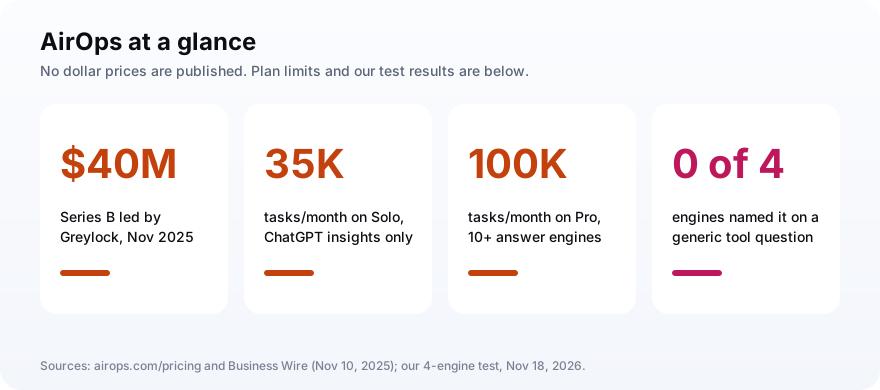
I read AirOps' site and pricing page on November 18, 2026, and ran a small test the same day: three buyer questions sent to ChatGPT, Claude, Gemini, and Perplexity through their APIs with web search on, 12 answers in total.
Disclosure: MentionsAPI sells an AI visibility API, so we compete with the tracking half of AirOps. We do not make content tools. Our product was named in none of the 12 answers.
What is AirOps?
AirOps is a company founded in 2022 that sells software and services for winning visibility in AI search. Its homepage promises to help you "run the strategy that wins AI discovery." The product has three parts: Insights, which measures AI visibility; Actions, which creates and refreshes content; and measurement of the results. It positions itself for marketing and content teams at growing companies.
AirOps started as a general AI workflow builder and moved toward AI search. CEO Alex Halliday founded it in early 2022 after leading product at Teespring and MasterClass, and Matt Hammel is co-founder and COO.
In November 2025, AirOps raised a $40 million Series B led by Greylock, bringing total funding to $55.5 million, according to its Business Wire announcement. Fortune reported the round at a $225 million valuation.
The customer list is strong. AirOps shows logos including Webflow, Ramp, Chime, HubSpot, Carta, Brex, and KAYAK, and it opened a London office in October 2026 to serve Europe.
How does AirOps work?
AirOps works as a loop. Insights tracks how AI engines answer your buyers' questions, reporting visibility, citations, sentiment, and position by model, topic, competitor, and source. Workflows and Grids then generate or refresh content in bulk using your Brand Kit and knowledge bases, a human reviews it, and it publishes to your CMS. Then you measure again.
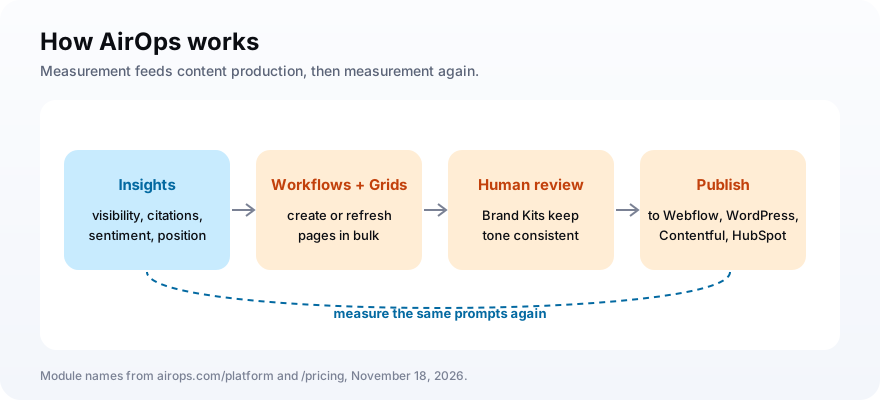
The content side is where AirOps differs from most trackers. Grids run a workflow across hundreds of rows, such as refreshing every product comparison page, and Brand Kits keep the tone consistent.
It connects to the CMS tools content teams use, including Webflow, WordPress, Contentful, Sanity, and HubSpot, and to SEO data from Semrush, Ahrefs, Moz, and DataForSEO.
AirOps also publishes big numbers about its own data, including 6 billion citations and 70 million high-value prompts. It does not explain how it samples AI answers or how often it runs each prompt, which matters for how much to trust any single score.
AirOps pricing in 2026
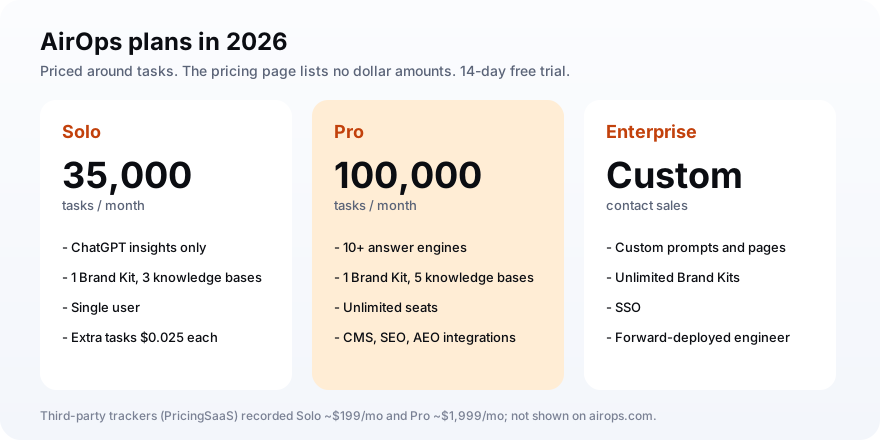
AirOps pricing has three plans, Solo, Pro, and Enterprise, but the pricing page shows no dollar figures. Solo includes 35,000 tasks a month and AI visibility insights for ChatGPT only. Pro includes 100,000 tasks, insights across 10 or more answer engines, and unlimited seats. Enterprise is custom. A 14-day free trial is available, and extra tasks on Solo cost $0.025 each.
| Plan | Tasks per month | AI engines tracked | Seats |
|---|---|---|---|
| Solo | 35,000 | ChatGPT only | 1 user |
| Pro | 100,000 | 10+ answer engines | Unlimited |
| Enterprise | Custom | Custom prompts and pages | Unlimited, plus SSO |
Plan details are from the AirOps pricing page on November 18, 2026. Tasks are AirOps' unit of usage. A task is spent when certain workflow steps, such as generating content or extracting data, complete successfully.
Third-party trackers have recorded Solo at about $199 a month and Pro at about $1,999, per PricingSaaS. Those figures are no longer on AirOps' page, so ask for a quote.
The ChatGPT-only limit on Solo is the detail most buyers miss. If your customers use Perplexity, Gemini, or Google's AI answers, Solo will not show you those engines at all.
AirOps pros and cons
AirOps' strengths are that it turns AI visibility gaps into published content, runs workflows across hundreds of pages, keeps a consistent brand voice, and connects to the CMS and SEO tools teams already use. Its weaknesses are unpublished prices, ChatGPT-only insights on Solo, no published sampling method, and a setup that takes real time before the numbers mean much.
What AirOps does well:
- Connects measurement to action, so a gap can become a refreshed page the same week.
- Grids for bulk work, such as refreshing every comparison page at once.
- Brand Kits and a human review inbox, so generated content stays on brand.
- An MCP server and API, so teams can run AirOps workflows from Claude Code or Cursor.
Where it falls short:
- No dollar prices on the pricing page, so budgeting needs a sales call.
- Solo tracks ChatGPT only.
- No public methodology for how prompts are sampled or how often they run.
- Its own customer results, like a mention rate rising from 17.2% to 31.7%, are vendor case studies.
Is AirOps worth it? What four AI engines said
AirOps is worth it for established content teams that will refresh and publish pages based on what they find, and less so for small teams that want a lightweight tracker. When we asked ChatGPT, Claude, Gemini, and Perplexity "Is AirOps worth it for improving brand visibility in AI search?" on November 18, 2026, all four reached that same verdict.
ChatGPT noted that pricing is not published, and Perplexity warned that setup takes real effort. Claude cited a comparison by Profound arguing AirOps falls short on monitoring, and flagged that it comes from a competitor.
The sharper finding came from a generic question. Asked "What are the best tools to track how my brand appears in ChatGPT and other AI assistants?", none of the four engines named AirOps.
Profound, Peec AI, Otterly, Semrush, and Ahrefs were named by all four. For a company with $55.5 million in funding and 6,600 monthly brand searches, AirOps is still missing from the shortlists AI builds when buyers ask about tracking.
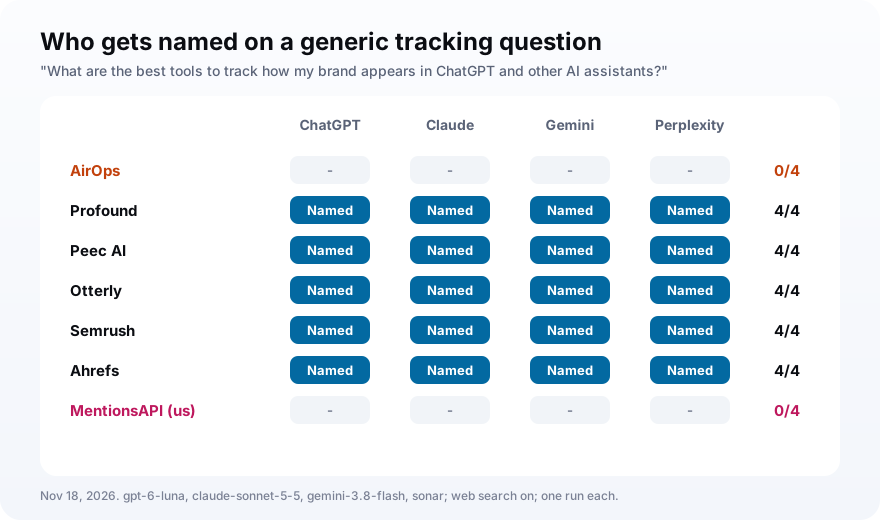
That fits how AirOps sells itself. It pitches content and action more than tracking, so AI engines file it under content tools, not monitoring tools.
AirOps vs Profound: which should you choose?
Choose AirOps if your main goal is producing and refreshing content to win AI answers, and you have a team to run it. Choose Profound if your main goal is the deepest monitoring across up to 10 answer engines with enterprise security. Both sell mainly to larger teams, and neither publishes a paid price. Searches for "airops vs profound" rose about 325% this year.
| Point | AirOps | Profound |
|---|---|---|
| Main strength | Content creation and refresh at scale | Depth of AI visibility monitoring |
| Engines | ChatGPT on Solo, 10+ on Pro | Up to 10 on Enterprise |
| Public paid price | None listed | None listed |
| Entry option | 14-day free trial | 7-day free trial |
| API | MCP server and API | Enterprise |
| Best for | Content and SEO teams that publish often | Enterprise teams that report on visibility |
Profound retired its $399 and $499 plans in September 2026, as covered in our Profound alternatives guide, so both are now sales-led for real use. A larger team could also pair them: Profound to measure, AirOps to produce.
Best AirOps alternatives in 2026
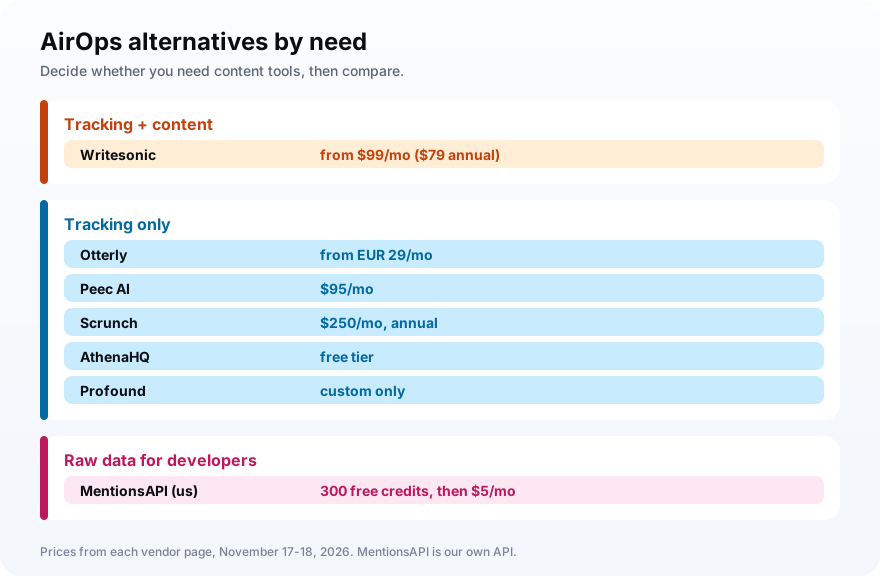
The best AirOps alternatives depend on which half you need. For tracking alone, Profound, Peec AI, and Otterly are the most-named options. For tracking plus content, Writesonic is the closest match. Scrunch and AthenaHQ suit agencies and free starts, and an AI visibility API suits developers. When we asked four engines for AirOps alternatives, Profound, Peec AI, and Writesonic appeared in all four answers.
| Tool | Entry price | Tracking or content? | Choose it if |
|---|---|---|---|
| Writesonic | $99/mo ($79 annual) | Both | You want AirOps-style content plus tracking with public prices |
| Profound | Custom | Tracking | You need 10 engines and enterprise security |
| Peec AI | $95/mo | Tracking | You want 50 daily prompts and unlimited seats |
| Otterly | EUR 29/mo | Tracking | You track a handful of prompts |
| Scrunch | $250/mo, annual | Tracking | You are an agency with many prompts |
| AthenaHQ | Free tier | Tracking | You want to start without paying |
| MentionsAPI (ours) | 300 free credits, then $5/mo | Raw data | You build tracking into your own tools |
Prices were read on each vendor's own page on November 17 and 18, 2026.
Writesonic, the closest match
Writesonic combines AI articles and SEO with AI visibility tracking across ChatGPT, Gemini, and Google AI Overviews. Its pricing page shows Starter tracking 50 prompts daily with 15 AI articles a month, and higher plans tracking 100 and 200 prompts.
Starter costs $99 a month or $79 billed annually. Unlike AirOps, the prices are public.
Profound
Profound is the monitoring-first enterprise option, with up to 10 answer engines, an API, and SOC 2 on Enterprise. It now offers only a free trial and custom pricing.
Peec AI
Peec AI is the self-serve tracker most teams shortlist: $95 a month for 50 prompts run daily on three engines you choose, with the API from $245. Our Peec AI review has the details.
Otterly, Scrunch, and AthenaHQ
Otterly starts at EUR 29 a month for 16 prompts. Scrunch includes 350 prompts from $250 a month on an annual plan, which suits agencies. AthenaHQ has a free tier, then $295 a month; our AthenaHQ review covers it.
MentionsAPI
Ours is an API with no content tools. It returns whether ChatGPT, Claude, Gemini, Perplexity, and Google's AI surfaces mention, rank, and cite a brand, so developers can build tracking into their own products or feed results into a content tool they already use.
Who should use AirOps, and who should not
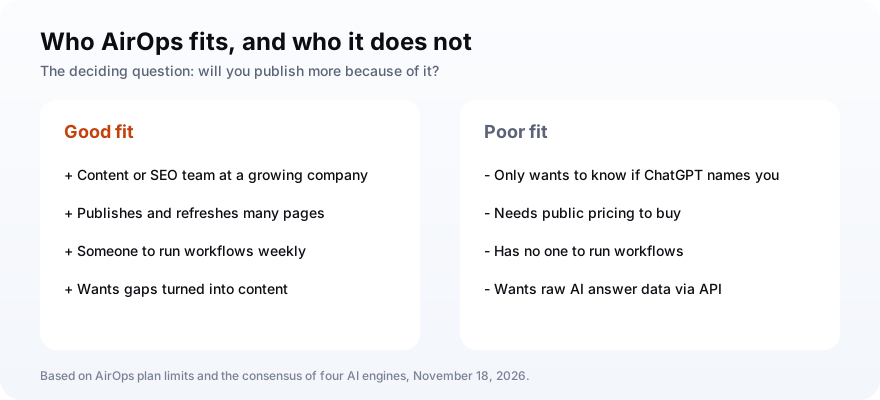
AirOps suits content and SEO teams at growing companies that publish and refresh many pages, have someone to run workflows, and want AI visibility gaps turned into content. It does not suit solo founders who only want to see whether ChatGPT names them, teams that need public pricing to buy, or developers who want raw AI answer data for their own product.
| If you are | Pick |
|---|---|
| A content team publishing dozens of pages a month | AirOps Pro |
| A small team that wants tracking plus some content | Writesonic |
| A team that only needs to track mentions | Peec AI or Otterly |
| An enterprise reporting on visibility to leadership | Profound |
| A developer building AI visibility into a product | An AI visibility API |
AI engines know AirOps as a content platform. None of them put it on a tracking shortlist.What our test showed
Before you buy any tool, measure where you stand. Our AI visibility audit guide shows how to build a prompt set and score it, and our Evertune review covers another platform that pairs measurement with action.
Frequently asked questions
What is AirOps?
How much does AirOps cost?
Is AirOps worth it?
What are the best AirOps alternatives?
What is the difference between AirOps and Profound?
Does AirOps have an API?
Use the trial on one real content project
AirOps only proves its value when it changes what you publish. Use the 14-day trial on one real project, such as refreshing ten comparison pages for the buyer prompts where you are missing. Measure those prompts before and after with the same engines, then ask AirOps for a written quote before you plan a budget around it.
If you only need the measuring half, start with a tracker or an API and add content tools later.