SE Ranking did not build an AI visibility tool. It added AI visibility to an SEO tool, and the difference shows.
The SE Ranking AI Visibility Tracker is worth a look if you want AI-answer tracking without buying a separate platform. It sits inside SE Ranking, a mature SEO suite, and watches whether your brand shows up in AI answers for the prompts you choose. That integration is the whole pitch, and mostly it delivers.
This review covers what it tracks, which engines it quietly skips, what it costs, its honest pros and cons, who it fits, and the strongest alternatives, including the case for using an API instead of a dashboard.
First, why any of this matters. Pew Research Center found that 18% of Google searches produced an AI summary in March 2025, and users clicked a result just 8% of the time when one appeared, versus 15% without. When the answer replaces the click, tracking whether you are inside the answer stops being optional.
The channel is growing, too. Semrush measured AI referral traffic rising 66% in 2025, which is why tools like SE Ranking rushed an AI layer into products built for classic search. The question is how well that bolt-on actually works.
What is the SE Ranking AI Visibility Tracker?
It is the AI-answer tracking module inside SE Ranking, an established SEO platform used by agencies and in-house teams. Rather than a standalone product, AI visibility lives alongside SE Ranking's rank tracking, audits, and keyword tools, so you monitor AI answers in the same place you already do SEO. There is also a standalone version marketed as SE Visible.
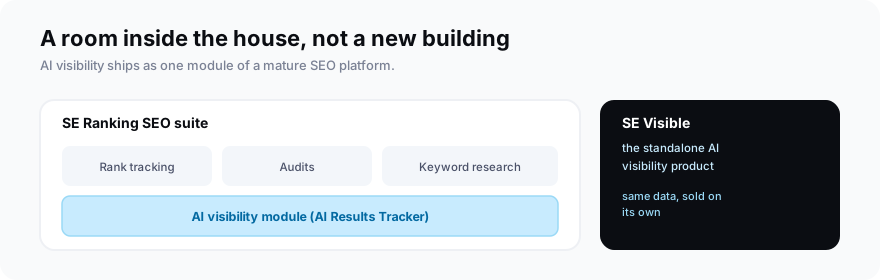
SE Ranking itself is not new. It has been a mainstream SEO platform for years, popular with agencies for rank tracking and client reporting, which is the install base the AI module is built to serve. The AI features arrived as the market shifted; it was never the founding idea.
That framing matters because it sets expectations. You are getting a competent AI feature attached to a strong SEO product, not a purpose-built AI visibility engine. For many teams that is exactly the right trade, and for some it is the wrong one, which the rest of this review works through.
What does it track, and which AI engines?
SE Ranking tracks five AI surfaces: ChatGPT, Perplexity, Google AI Overviews, Google AI Mode, and Gemini. For each, it records whether your brand is mentioned or cited, which sources the engine pulled, your position in the answer, and how competitors fare, refreshed daily. The coverage is solid on the mainstream engines.
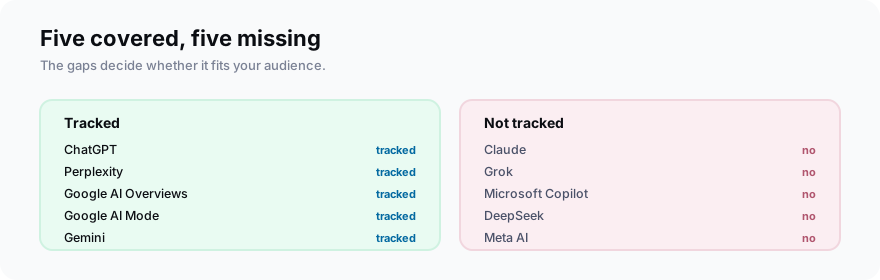
The gap is what it does not track, per its own reviewers: Claude, Grok, Microsoft Copilot, DeepSeek, and Meta AI are all absent. If your buyers ask Claude or Grok, SE Ranking simply cannot see it, and no setting fixes that. Whether that matters depends entirely on where your audience actually is.
On features it is generous. You get brand-mention monitoring with and without a link, source ranking that shows the most-cited third-party domains, sentiment, and a "No cited" view that surfaces prompts where competitors are named and you are not, which reviewers call the most useful part for content planning.
That "No cited" view is the sleeper feature. Seeing the exact prompts where rivals get named and you do not turns AI visibility from a vanity score into a content backlog: each gap is a page or an update waiting to be written. It is the part most likely to change what your team does next week.
The tracking also carries SE Ranking's strength in local search. Reviewers single out its consistency at the city and ZIP level, so if you care how AI answers differ by location, that granularity is a genuine edge over pure-play tools that treat the country as one market.
It estimates traffic and your position within each answer as well, so you see not just whether you appear but how prominently. That prominence is the point, because being named in the first line of an AI answer is worth far more than a passing mention buried at the end of one.
How much does SE Ranking AI visibility cost?
SE Ranking Core is $129 a month and Growth is $279 a month, falling to roughly $103 and $223 on annual billing, with Enterprise priced on request. AI visibility is bundled into the paid plans rather than sold as a separate add-on, and a 14-day free trial with no card lets you test it before committing.
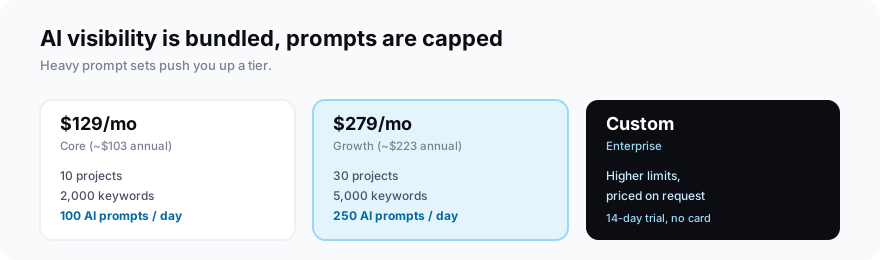
The plans also cap usage in ways worth checking. Core covers 10 projects, 2,000 tracked keywords, and 100 AI prompts a day; Growth raises that to 30 projects, 5,000 keywords, and 250 daily prompts. A large prompt set, the kind serious AI tracking needs, can push you up a tier faster than the headline price suggests.
The value read depends on what else you use. If you want the SEO suite anyway, the AI layer is nearly free upside. If you only want AI visibility, paying $129 and up for a bundle you will half use is the wrong math, and a pure-play tool or an API will serve you better.
SE Ranking AI tracker: pros and cons
The honest scorecard is that SE Ranking trades depth for breadth of workflow. It is a strong, well-supported SEO platform with a competent AI feature, not a specialist AI visibility engine. The table below is the short version of what that means in practice.
| Pros | Cons |
|---|---|
| AI tracking inside a full SEO suite | Misses Claude, Grok, Copilot, DeepSeek, Meta AI |
| Strong local and ZIP-level tracking | AI data is directional, needs manual checks |
| "No cited" competitor-gap view | Bundled pricing is steep for AI-only buyers |
| 4.8/5 on G2, support rated 9.4/10 | No panel-derived prompt-volume data |
| 14-day free trial, no card | Daily prompt caps limit large prompt sets |
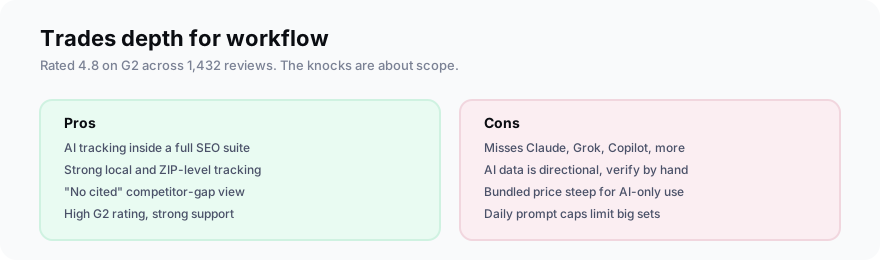
One caveat deserves emphasis, and it applies to every AI visibility tool, not just this one. Reviewers warn that AI tracking is directional, because model answers shift run to run, so treat the numbers as a trend and verify anything you are about to act on.
Who is SE Ranking's AI tracker for, and who should skip it?
It fits teams that already want an SEO suite and see AI visibility as one more panel in it. Agencies managing many clients, SMB teams that value one consolidated tool, and content teams mining the "No cited" gaps for ideas get real value. For them the bundle is a feature, not a tax.
The integration is the reason to stay in the bundle. Because AI tracking sits beside rank tracking, audits, and keyword data, and pipes into GSC, GA, and Looker Studio, one report can show classic and AI visibility together. For an agency presenting to clients, that single pane of glass is worth real money on its own.
Picture the fit: a five-client agency already reporting rankings in SE Ranking adds AI visibility to the same weekly deck with almost no new tooling and no new login for the team to learn. That team gets more from deepening one platform than from bolting on a separate tool nobody else opens. Consolidation is the whole return.
Skip it if AI visibility is your main job. Enterprises needing governance and automation lean to Scrunch, teams wanting dedicated AI depth prefer specialists, and builders who want the underlying data are better served by an API. The mismatch is about scope rather than quality: it is buying a suite when you wanted an instrument.
Buy SE Ranking if you want an SEO suite with AI visibility attached. If you only want AI visibility, you are paying for rooms you will not enter.The one-line verdict
The best SE Ranking alternatives for AI visibility
The alternatives split into three shapes: pure-play AI visibility tools, rival SEO suites with an AI layer, and the API route. Which one fits depends on whether you want depth, consolidation, or raw data. The table maps the main options against SE Ranking.
| Alternative | Shape | Best for |
|---|---|---|
| Profound | Pure-play, enterprise | Governance and depth |
| Peec AI | Pure-play | Focused AI visibility |
| Scrunch AI | Pure-play, enterprise | Automation and scale |
| Ahrefs Brand Radar | Suite add-on | Ahrefs users |
| Semrush | Suite add-on | Semrush users |
| MentionsAPI | API / data layer | Builders, broad engine data |
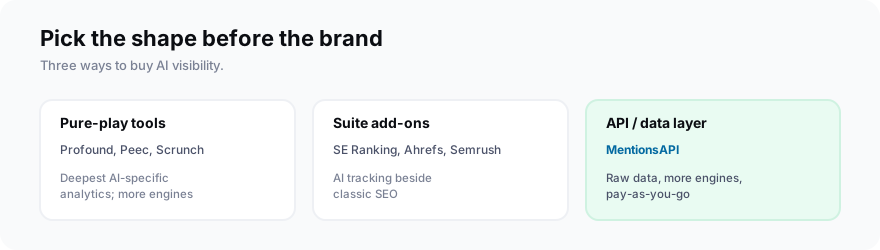
A quick read on each. Profound is the enterprise pure-play, strong on governance and depth, while Scrunch AI leans into automation and scale for larger teams. Peec AI is a focused, lighter-weight option for teams that want AI visibility without a suite around it.
Ahrefs Brand Radar and Semrush, like SE Ranking, add AI tracking to a suite you may already pay for, so the calculus there is the same bundle-versus-focus question. If you are already committed to one of those platforms, its AI layer is usually the cheapest place to start.
The pure-play tools generally track more engines and go deeper on AI-specific analytics than a suite module does, which is the trade for giving up the consolidated SEO workflow. If AI visibility is a side quest, a suite wins; if it is the main quest, a specialist or an API usually does.
We review the closest pure-play options in depth elsewhere, including Peec AI, Scrunch AI, and the suite add-ons Ahrefs Brand Radar and Semrush. Our full best AI visibility tools guide compares the field.
SE Ranking vs an AI visibility API
The real fork is dashboard versus data layer. SE Ranking gives you a ready-made UI, reports, and SEO tooling around the AI data; an API gives you the raw citations to pipe wherever you want. If you are a builder, an agency automating reports, or a team feeding a warehouse, the API shape wins on flexibility and engine coverage.
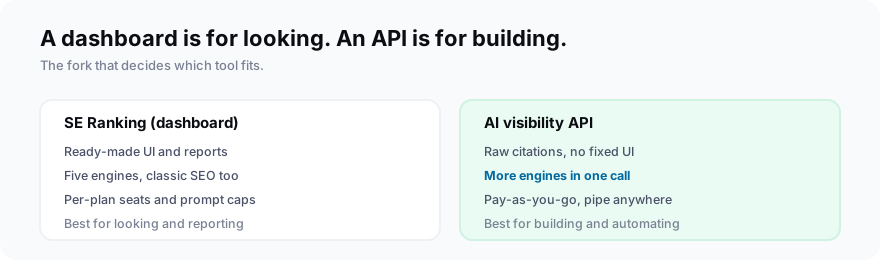
The concrete cases make it obvious. An agency automating client reports, a data team feeding a warehouse, or a product wiring AI visibility into its own dashboard all want an endpoint rather than a login. For those, per-seat suite pricing and a fixed UI are the wrong shape, however good the UI is.
This is where the engine gap bites hardest. MentionsAPI covers the surfaces SE Ranking misses, Claude, Grok, DeepSeek, and Meta AI, alongside ChatGPT, Perplexity, and Gemini, in one call, and bills per check rather than per seat. For a dashboard you want to look at, SE Ranking is fine; for data you want to build on, the API is the fit.
Frequently asked questions
What is the SE Ranking AI Visibility Tracker?
Which AI engines does SE Ranking track?
How much does SE Ranking AI visibility cost?
Is SE Ranking good for AI visibility?
What are the best SE Ranking alternatives for AI visibility?
SE Ranking vs an API: which is better for AI visibility?
Match the tool to the job
Do this next: if you already live in an SEO suite and want AI visibility as one more panel, start SE Ranking's free trial and see whether its five engines cover where your buyers actually are. If they do not, that is your answer.
The 14-day trial makes this low-risk to settle yourself. Load your ten most important buyer prompts, run them across the five surfaces it covers, and check whether that is where your audience actually asks. The trial answers the only question that matters faster than any review can.
If you want broad engine coverage or the raw data to build on, sample an API against the same prompts before you commit to any dashboard. Pull your citations with MentionsAPI, keep your AI visibility fundamentals in view, and buy the shape that matches the job, not the brand with the loudest homepage.