Comparison · July 24, 2026

Google AI Mode vs ChatGPT: which one names your brand?

They recommend the same brands and cite almost nothing in common. Here is why, and how to get named in both.

TL;DR
Google AI Mode and ChatGPT are two search engines reading two different indexes: AI Mode uses Google's, ChatGPT uses Bing's. They recommend similar brands (26.9% overlap) but their cited sources overlap just 6.2%. AI Mode cites 14 sources per answer to ChatGPT's 3.7. So you cannot optimize once: win Google for AI Mode, win Bing plus Reddit and authority for ChatGPT, then measure both.

They agree on which brands to recommend, then cite almost nothing in common.

That paradox is the whole story of Google AI Mode versus ChatGPT. In a study of 18,206 identical prompts, the two engines recommended similar brands but their cited sources overlapped only 6.2%. The reason is simple and practical: they read two different indexes. AI Mode pulls from Google's, ChatGPT pulls from Bing's. Same question, two separate worlds of evidence, and you have to win both.

Google AI Mode vs ChatGPT: what is the real difference?

The real difference is where each one gets its facts. Google AI Mode is built on Google's search index and answers inside Google Search. ChatGPT Search combines its model with real-time retrieval through Bing and data partnerships. They do the same job, synthesizing an answer with citations, but from different source pools, which is why what gets you cited in one does little for the other.
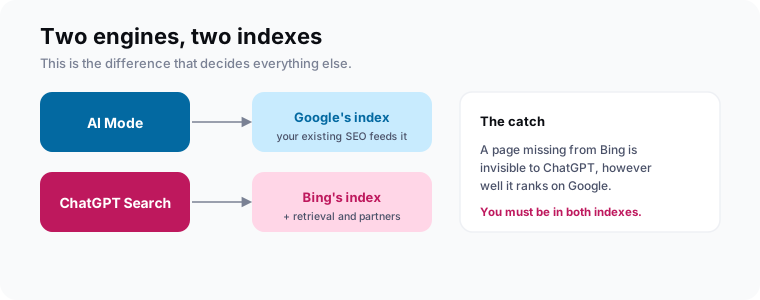
Google AI Mode draws sources from Google's index while ChatGPT Search draws from Bing's index plus retrieval; a page missing from Bing is invisible to ChatGPT no matter how well it ranks on Google.
The index is the whole difference. Everything downstream follows from it.

This is also the difference from AI Mode versus Gemini, where both surfaces share Google's stack. Against ChatGPT, AI Mode is a genuinely separate engine reading a separate index.

Do they cite the same sources?

Almost never. Per a Parse study of 18,206 identical buyer-intent prompts in mid-2026, AI Mode and ChatGPT shared only 6.2% of their cited sources and just 6 of their top 25. Yet they recommended the same brands 26.9% of the time. The researchers summed it up well: they agree on the answer and disagree on the evidence.
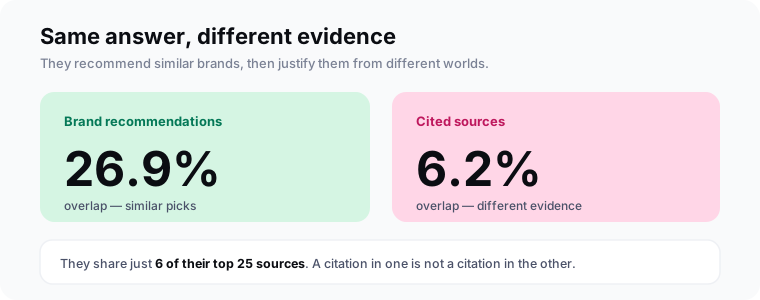
AI Mode and ChatGPT recommend similar brands with 26.9 percent overlap, but their cited sources overlap only 6.2 percent, and they share just 6 of their top 25 sources.
Same picks, different proof. That gap is where per-engine work lives.
A citation in ChatGPT is not a citation in AI Mode. Treating AI search as one channel is the most expensive assumption in the category.The one-line takeaway

How differently do they cite?

AI Mode cites far more, and far wider. It attached 14.0 sources to the average answer versus ChatGPT Search's 3.7, a 3.8x gap that held every week. More slots means more chances to be cited, but also more competition per answer. ChatGPT, by contrast, commits to a small, concentrated set, so getting in is harder but worth more when you do.
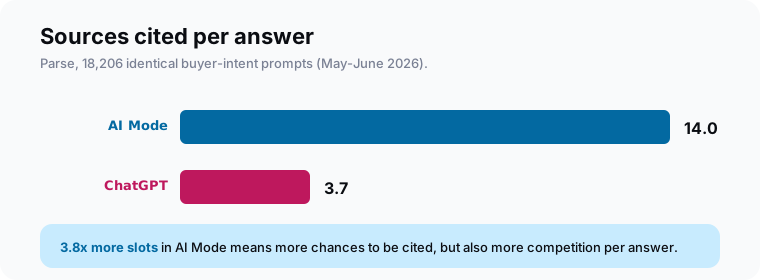
Google AI Mode attached 14.0 sources to the average answer while ChatGPT Search attached 3.7, a 3.8 times gap, per a Parse study of 18,206 prompts.
Wide and shallow versus narrow and deep. Two different games.
6.2%cited-source overlap between the two
14 vs 3.7sources per answer (AI Mode vs ChatGPT)
26.9%brand-recommendation overlap

What does each one cite?

They lean opposite ways. AI Mode spreads across many sources and leans on Google's own surfaces, including YouTube, which made up 5.05% of its citations. ChatGPT leans on high-authority publications, Wikipedia, and Reddit, and cited YouTube just 0.11% of the time, a roughly 48x gap. If your strategy is built for one engine's taste, it will underperform in the other.
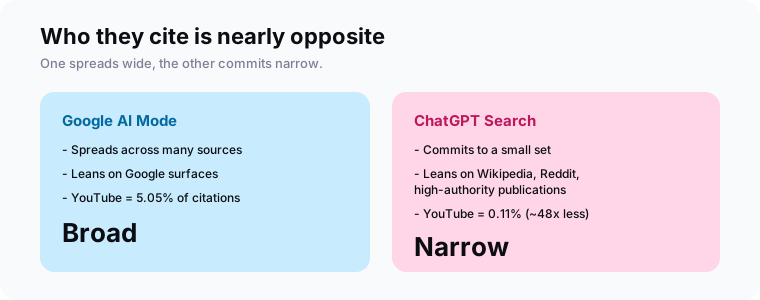
Google AI Mode spreads citations broadly and leans on Google surfaces and YouTube at 5.05 percent; ChatGPT commits to a small set of high-authority sources like Wikipedia and Reddit and cites YouTube only 0.11 percent.
A YouTube-heavy strategy wins AI Mode and barely registers in ChatGPT.

Which reaches more people?

They reach differently, and both are too big to skip. ChatGPT drives roughly 78% of AI referral traffic, so it sends more clicks to your site. Google AI Mode passed 1 billion monthly active users inside Search, so it reaches more people at the exact moment they are searching. One is better for traffic; the other is better for reach at the point of intent.

How do you get cited in each?

Run two playbooks, because there are two indexes. For AI Mode, win Google Search organic, lead each section with a clear answer, and add structured data; your existing SEO does most of the work. For ChatGPT, make sure you are indexed in Bing, using IndexNow to speed it up, then build presence on Reddit, Wikipedia, and authority publications. Most brands optimize for Google and forget Bing entirely, which is exactly why the ChatGPT slot is winnable.
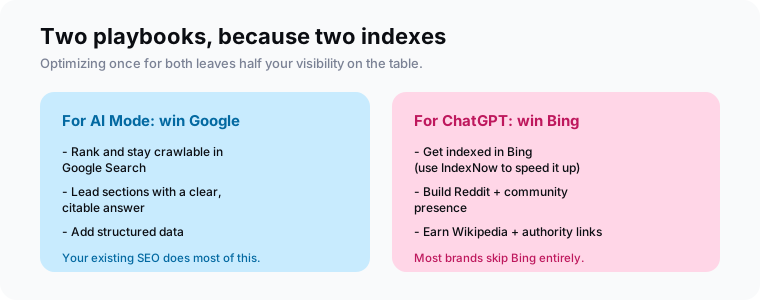
For AI Mode, win Google Search organic and structure content; for ChatGPT, get indexed in Bing with IndexNow and build Reddit, Wikipedia, and authority presence. You cannot optimize once for both.
Win Google for AI Mode, win Bing for ChatGPT. Same content, two distribution jobs.
The Bing gap is the practical headline. Bing feeds both ChatGPT Search and Microsoft Copilot, so a page missing from Bing is dark to two of the largest AI answer engines at once. The deeper Bing angle is in our Copilot vs ChatGPT breakdown.

How do you track your brand across both?

You track it by running your buyer prompts through both engines and recording whether you are named and cited, then watching each on its own. Because their sources barely overlap, a single blended AI visibility number hides which engine is working and which is not. An API that queries AI Mode and ChatGPT and parses the citations gives you a per-engine baseline you can act on.

Two engines, two indexes, two numbers. Measuring them together tells you nothing; measuring them apart tells you where to spend.

See which engine names your brand
Run the same prompts through Google AI Mode, ChatGPT, Gemini, and Perplexity and get back who was mentioned and cited, per engine, in one call. MentionsAPI turns this comparison into a metric you can track. Pay-as-you-go, $1 free signup credit.

Frequently asked questions

What is the difference between Google AI Mode and ChatGPT?
They are two different AI search engines reading two different indexes. Google AI Mode synthesizes answers from Google's search index inside Search. ChatGPT Search combines its model with real-time retrieval through Bing and data partnerships. Same job, different source of truth, which is why they cite almost nothing in common.
Do Google AI Mode and ChatGPT cite the same sources?
Almost never. In a Parse study of 18,206 identical prompts, their cited sources overlapped just 6.2%, and they shared only 6 of their top 25 sources. They recommend similar brands (26.9% overlap) but justify them from entirely different source pools. A citation in one is not a citation in the other.
Which cites more sources, AI Mode or ChatGPT?
Google AI Mode, by a wide margin. It attached 14.0 sources to the average answer versus ChatGPT Search's 3.7, a 3.8x gap that held every week in Parse's data. AI Mode gives you more citation slots but more competition; ChatGPT commits to a small, concentrated set.
Why does Bing matter for ChatGPT visibility?
Because ChatGPT Search retrieves through Bing's index. A page missing from Bing is invisible to ChatGPT no matter how well it ranks on Google. AI Mode reads Google's index; ChatGPT reads Bing's. To be cited in both, you have to be present and crawlable in both.
How do I get cited in both AI Mode and ChatGPT?
Run two playbooks. For AI Mode, win Google Search organic, lead sections with a clear answer, and add structured data. For ChatGPT, get indexed in Bing (IndexNow speeds it up) and build presence on Reddit, Wikipedia, and high-authority publications. You cannot optimize once and cover both.
Which reaches more people, AI Mode or ChatGPT?
They reach differently. ChatGPT drives roughly 78% of AI referral traffic, so it sends more clicks. Google AI Mode passed 1 billion monthly active users inside Search, so it reaches more people at the moment they are searching. For most brands, both are too large to ignore.

Win two indexes, then measure two numbers

Do this next: keep winning Google Search for AI Mode, then check whether your pages are even in Bing for ChatGPT. That one gap decides half your AI visibility, and most brands never look.

Then measure them apart. Pull a per-engine baseline with MentionsAPI, keep your Gemini vs ChatGPT and AI Mode vs Gemini playbooks running, and watch which engine starts citing you.

Nikhil Kumar
Founder, MentionsAPI

Growth marketer at the intersection of marketing, product, and technology. 8+ years across startups and scale-ups in India, Switzerland, and the Netherlands. Founder of Landkit (landkit.pro).

Stop guessing whether AI can see you.

Check whether ChatGPT, Claude, Gemini, and Perplexity mention and cite your brand in one API call. $1 free signup credit, pay-as-you-go.