Comparison · July 23, 2026

Google AI Mode vs Gemini: what's the difference, and which to optimize for?

They run on the same model, so people assume they are the same product. They are not. Here is the difference, and the one surface worth your effort.

TL;DR
Google AI Mode and the Gemini app run on the same Gemini model but are different surfaces. AI Mode is AI-powered search inside Google Search; the Gemini app is a standalone assistant for writing and tasks. AI Mode reaches 1 billion users, cites sources inline mid-answer, and draws on Google's index, so your existing SEO feeds it. For brand visibility, optimize for AI Mode first, then measure whether it names you.

People keep asking if Google AI Mode is just Gemini with a new name. It is not.

Google AI Mode and the Gemini app run on the same Gemini model family, but they are different products doing different jobs. AI Mode is an AI-powered search experience inside Google Search. The Gemini app is a standalone assistant for writing, analysis, and tasks. Same brain, two surfaces. That distinction decides where your brand can show up, how it gets cited, and which one is actually worth optimizing for.

What is the difference between Google AI Mode and Gemini?

The difference is the surface, not the model. AI Mode lives inside Google Search and answers queries with AI synthesis on top of web results; it is still fundamentally a search product. The Gemini app lives at gemini.google.com and in its own app, and it is built for writing drafts, analyzing files, and multi-step tasks with persistent memory. One helps you search; the other helps you work.
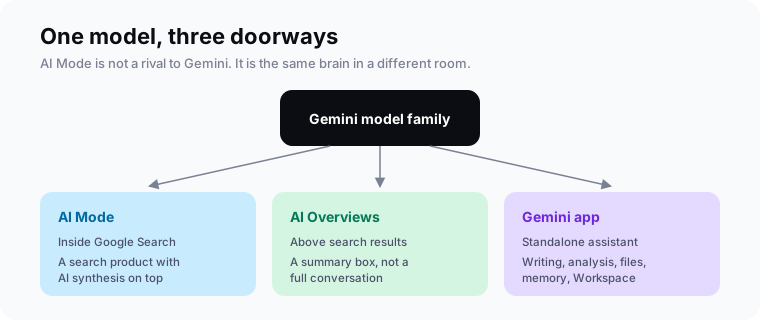
Google's Gemini model family powers three surfaces: AI Mode inside Google Search, AI Overviews above search results, and the standalone Gemini app for writing and analysis.
Same model, three doorways. AI Mode is the one that sits in Search.

AI Mode runs on a fast, agent-tuned Gemini model that Google made the AI Mode default at its 2026 I/O event, built to reason across multiple sources for longer, more complex search queries.

Is Google AI Mode the same as Gemini? A closer look

No. The clearest way to see it is behavior. AI Mode keeps context only within a single search session and resets when you leave the results page. The Gemini app keeps persistent memory across sessions, reads your uploaded files, and plugs into Google Workspace. If you need to search and refine, that is AI Mode. If you need to draft, analyze, or build something, that is the Gemini app.
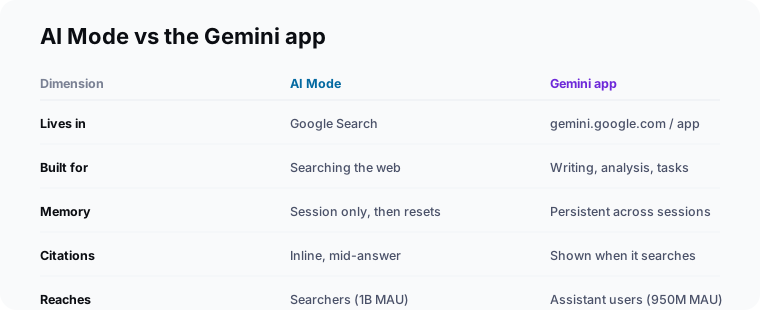
AI Mode lives in Google Search, is built for searching, keeps session-only context, shows inline citations, and reaches searchers; the Gemini app is a standalone assistant with persistent memory that reaches assistant users.
Same model, but memory, purpose, and audience all diverge.

There is a third thing people lump in: AI Overviews. That is the AI summary box above your normal results for some queries, covered in our guide to Google AI Overviews. AI Mode is the fully conversational search you switch into, not the summary box.

Which one reaches more people?

The search surfaces reach far more people than the app. AI Mode passed 1 billion monthly active users by mid-2026, roughly a year after launch, and AI Overviews reaches about 2 billion, while the standalone Gemini app is around 950 million. All three run the same model, but the ones inside Search touch the most users, because that is where people already are.
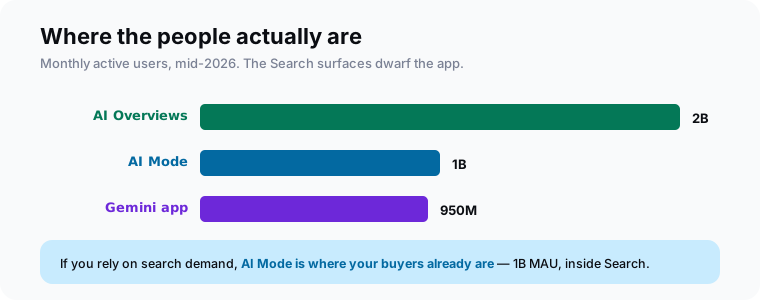
AI Overviews reach about 2 billion monthly users, AI Mode about 1 billion, and the standalone Gemini app about 950 million; the search surfaces reach more people than the app.
The app is huge. The Search surfaces are bigger, and full of buying intent.
1BAI Mode monthly active users (mid-2026)
950MGemini app monthly active users
2BAI Overviews monthly users (largest surface)

How does AI Mode cite sources?

AI Mode embeds inline citations inside the answer text, often mid-paragraph, next to follow-up question suggestions. Being cited in the middle of an answer, not just listed at the bottom, is the new visibility goal. It pulls those sources from Google's search index in real time, so the pages it cites are the pages that already earn trust in Search.
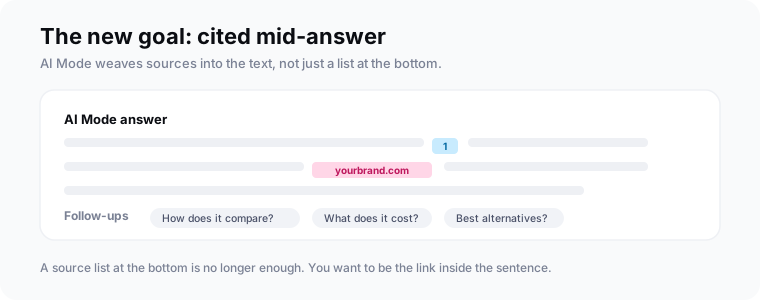
AI Mode synthesizes an answer and embeds inline citations mid-paragraph, plus follow-up question suggestions; being cited inside the answer is the new visibility goal.
The link inside the sentence beats the link in a source list nobody scrolls to.
Ranking used to mean owning a blue link. In AI Mode it means being the sentence the answer is built from, with your name on the citation.The shift AI Mode forces

Which should you optimize for?

Optimize for AI Mode first. It lives inside Google Search, reaches 1 billion people, and draws on the same index your SEO already targets, so clear, structured, citable content feeds it directly. The Gemini app is a task assistant you cannot rank in the same way, and chasing it separately is wasted effort. Win Google Search organic and you feed AI Mode as a byproduct.
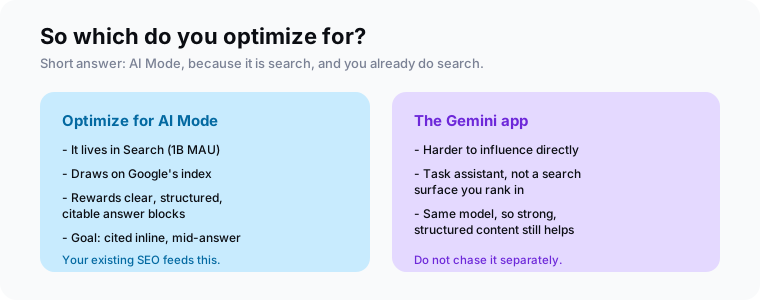
For brand visibility, optimize for AI Mode first because it sits in Search and draws on Google's index that your SEO already targets; the Gemini app is harder to influence directly.
One surface to optimize, and it runs on the SEO you are probably already doing.

In practice that means the AI-search playbook: be crawlable and authoritative in Google Search, then lead each section with a clear, self-contained answer the model can lift and cite. The full method is in our guide to ranking in Google AI Overviews, which applies to AI Mode too, and the cross-engine version is in AI search optimization.

One caution worth pricing in: studies from 2024 to 2026 found a 20 to 40 percent drop in organic click-through for queries now served by AI answers. Being cited inside AI Mode is not a nice-to-have; it is replacing the click you used to get.

How do you track your brand across both?

You track it by running your buyer prompts through each surface and recording whether you are named and cited, then watching that over time. AI Mode and the Gemini app cite different things, and neither hands you clean analytics, so a single blended number hides what is happening. An API that queries these surfaces and parses the citations gives you a per-surface baseline you can act on.

Optimize the one surface that matters, then measure the result. That is the whole loop.

See if Google's AI names your brand
Run your prompts through Google AI Mode, Gemini, ChatGPT, and Perplexity and get back who was mentioned and cited, per surface, in one call. MentionsAPI turns this comparison into a metric you can track. Pay-as-you-go, $1 free signup credit.

Frequently asked questions

Is Google AI Mode the same as Gemini?
No, but they share a brain. AI Mode and the Gemini app both run on Google's Gemini model family, yet they are different products. AI Mode is an AI-powered search experience inside Google Search. The Gemini app is a standalone assistant at gemini.google.com for writing, analysis, and tasks. Same model, two surfaces, two jobs.
What is the difference between AI Mode and AI Overviews?
AI Overviews is the AI summary box that appears above your normal search results for some queries. AI Mode is a separate, fully conversational search experience you switch into, with follow-up questions and inline citations. Overviews is a summary on the results page; AI Mode replaces the results page with a chat.
Which reaches more people, AI Mode or the Gemini app?
The search surfaces reach more. AI Mode passed 1 billion monthly active users by mid-2026, and AI Overviews reaches about 2 billion, while the standalone Gemini app is around 950 million. If you rely on search demand, AI Mode is where more of your buyers already are.
How does AI Mode cite sources?
AI Mode embeds inline citations inside the answer text, often mid-paragraph, alongside follow-up question suggestions. Being cited in the middle of an answer, not just listed at the bottom, is the visibility goal. It draws those sources from Google's search index in real time.
Should I optimize for AI Mode or the Gemini app?
Optimize for AI Mode first. It lives inside Google Search, reaches 1 billion users, and draws on the same index your SEO already targets, so clear, structured, citable content feeds it directly. The Gemini app is a task assistant you cannot rank in the same way, though strong content still helps there.
Does traditional SEO still matter for AI Mode?
Yes, more than ever. AI Mode synthesizes answers from Google's search index, so being crawlable, well-structured, and authoritative in Google Search is the foundation. AI Mode adds a layer on top: lead sections with a clear answer so the model can lift and cite a clean sentence from your page.

Optimize the surface, then measure the citation

Do this next: treat AI Mode as search, not as a separate channel. Keep your pages crawlable and authoritative in Google, lead sections with a clear answer, and do not burn time chasing the Gemini app on its own.

Then measure it. Pull a baseline of whether Google's AI names you with MentionsAPI, keep your Gemini vs ChatGPT playbook running, and watch whether AI Mode starts citing you inside its answers.

Nikhil Kumar
Founder, MentionsAPI

Growth marketer at the intersection of marketing, product, and technology. 8+ years across startups and scale-ups in India, Switzerland, and the Netherlands. Founder of Landkit (landkit.pro).

Stop guessing whether AI can see you.

Check whether ChatGPT, Claude, Gemini, and Perplexity mention and cite your brand in one API call. $1 free signup credit, pay-as-you-go.