Every list of the best MCP servers names the same ten tools. None of them measures anything.
The best MCP servers in 2026 are the ones that do one job well, come from the vendor that owns the data, and cost little context. For coding that means Context7, GitHub, and Playwright. For data work it means a read-only database server and one search server. Marketing teams can now add GA4, DataForSEO, and AI visibility servers to the same agent.
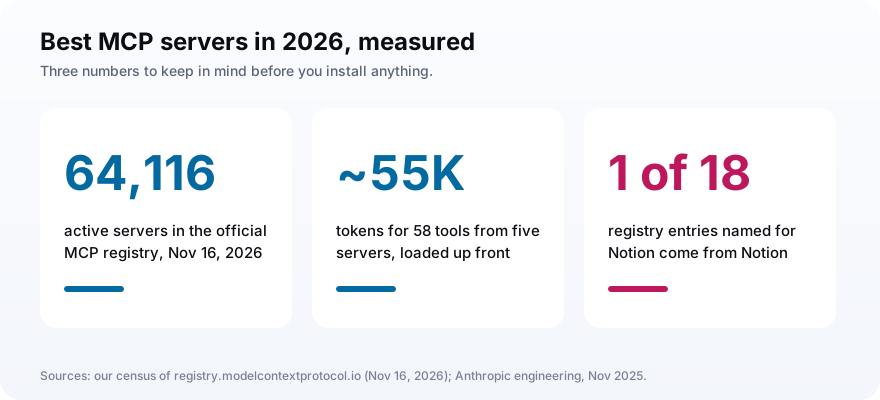
I did two things the other lists skip. On November 16, 2026, I pulled every entry in the official MCP registry through its public API, 652 pages of it. I also measured the tool definitions of one server end to end, so the context numbers below come from data I collected.
Disclosure: we build MentionsAPI, and its MCP server is one of the 14 picks. It sits in the marketing section, where it belongs, and I describe it the same way as the others.
How I picked the best MCP servers
I picked each MCP server on four tests: it does one clear job, the company that owns the data publishes it, it has a safety switch such as read-only mode or OAuth scopes, and its tool definitions are small enough to keep loaded. Popularity alone did not count, because the registry is full of near-identical names, and a popular wrapper from an unknown publisher fails the second test.
I checked every install path, URL, and price against the vendor's own repo or docs on November 16, 2026. Where a vendor publishes no price, I say so.
I also left things out on purpose. Several famous servers from the original reference repo, including GitHub, Slack, Postgres, and Sentry, are now archived there, according to the MCP servers repository. The vendors now publish their own versions, and those are what I list.
What are the best MCP servers right now?
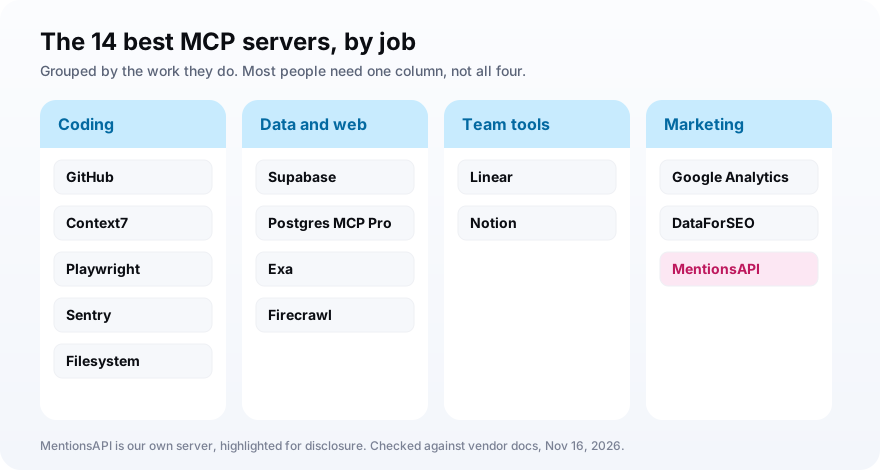
The best MCP servers right now are GitHub, Context7, Playwright, Sentry, and Filesystem for coding, Supabase and Postgres MCP Pro for databases, Exa and Firecrawl for the web, Linear and Notion for team tools, and Google Analytics, DataForSEO, and MentionsAPI for marketing data. The table below shows who publishes each one, how it connects, and the setting to turn on first.
| Server | Job | Connects via | Turn on first |
|---|---|---|---|
| GitHub | Repos, issues, PRs | Remote or local | Read-only, fewer toolsets |
| Context7 | Current library docs | Remote or local | Free API key for limits |
| Playwright | Browser testing | Local (npx) | Separate browser profile |
| Sentry | Production errors | Remote, OAuth | Scope to one project |
| Filesystem | Local files | Local | Allow only named folders |
| Supabase | Postgres + backend | Remote, OAuth | read_only and project_ref |
| Postgres MCP Pro | Any Postgres | Local | Restricted access mode |
| Exa | Web search | Remote | Default tools only |
| Firecrawl | Scraping pages | Remote or local | Allowed hosts list |
| Linear | Issues | Remote, OAuth | Read-only endpoint |
| Notion | Docs and wikis | Remote, OAuth | Share fewer pages |
| Google Analytics | GA4 reports | Local or HTTP | Read-only is default |
| DataForSEO | SEO data | Remote, OAuth | Daily spend limit |
| MentionsAPI | Brand visibility in AI answers | Remote, OAuth | Cached checks first |
Best MCP servers for coding agents
GitHub, Context7, and Playwright are the best MCP servers for coding agents in Claude Code, Cursor, or Codex. GitHub handles repository work, Context7 supplies current documentation, and Playwright checks the UI in a real browser. Add Sentry when you debug production errors, and the reference Filesystem server when your client has no file access of its own.
GitHub MCP server
The official GitHub server reads and writes issues, pull requests, and code. Connect remotely at api.githubcopilot.com/mcp/ or run it locally.
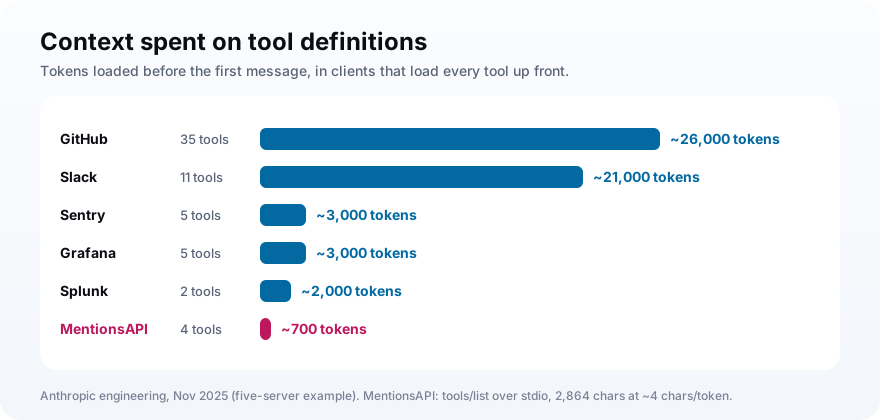
It is also the heaviest server here. In Anthropic's example setup, its 35 tools took about 26,000 tokens. Load only the toolsets you need with --toolsets, and add --read-only until you trust the agent.
Context7
Context7, from Upstash, fetches current, version-specific docs for the library you are using. It cuts the most common coding-agent failure: confident code written against an API that changed last year.
It exposes two tools, resolve-library-id and query-docs, so its context cost is small. A free API key from the Context7 dashboard raises its rate limits. If you install only one server, make it this one.
Playwright MCP
Microsoft's Playwright MCP drives a browser through accessibility snapshots instead of screenshots, which keeps it fast and works with any model. Install it with claude mcp add playwright npx @playwright/mcp@latest.
One catch: Microsoft's server is not in the official registry, while 15 other entries use the Playwright name. Install it from Microsoft's repo or npm, not from a search result.
Sentry MCP
Sentry's server lets the agent read real stack traces and issues before it guesses at a fix. Connect to mcp.sentry.dev/mcp with OAuth, and scope it to one organization and project.
Filesystem
The Filesystem server is one of seven reference servers still maintained by the MCP steering group. Use it in clients without built-in file access, and pass only the folders the agent should touch.
Best MCP servers for databases and web data
Use Supabase's hosted server or Postgres MCP Pro when the agent needs your database, and Exa or Firecrawl when it needs the web. Run database servers read-only by default, because an agent with write access to production is one bad prompt from a deleted table. Pick one web server: Exa for finding pages, Firecrawl for reading them in full.
Supabase MCP
Supabase hosts its server at mcp.supabase.com/mcp with OAuth sign-in. Add read_only=true and project_ref to the URL, and the agent can query one project's schema and data without changing it.
Postgres MCP Pro
For any other Postgres, Crystal DBA's Postgres MCP Pro adds health checks and index tuning to plain queries. Run it with --access-mode=restricted for read-only transactions with a time limit.
Exa
Exa is a search engine built for agents. Its remote server at mcp.exa.ai/mcp exposes web search and page fetch by default, and the free tier gives $10 in credits each month with no card.
Firecrawl
Firecrawl turns pages into clean markdown. Its pricing page lists 1,000 free credits a month, then $19 a month for 5,000, at one credit per scraped page.
Best MCP servers for team tools
Linear and Notion are the best MCP servers for team tools. Both now host official remote servers with OAuth, so there is no key to paste and no local process to run. They let an agent read the ticket or spec behind a task before it writes code. Start both read-only and widen access later.
Linear runs at mcp.linear.app/mcp and offers a separate read-only endpoint, according to Linear's MCP docs. Notion runs at mcp.notion.com/mcp, and Notion says its older open-source server is no longer maintained.
That second point matters in the registry. Searching for Notion returns 18 active entries, and only one, com.notion/mcp, comes from Notion.
Best MCP servers for marketing, SEO, and AI visibility
The best MCP servers for marketing work are the Google Analytics server for GA4 reports, DataForSEO's server for keyword, SERP, and backlink data, and MentionsAPI for checking whether AI engines mention and cite a brand. Few lists cover this category. In our census, only 584 of 64,116 active registry entries mention SEO at all.
Google Analytics MCP
The Google Analytics MCP server is read-only by default and signs in with your Google Cloud credentials. Writes need an explicit --allow-write flag. Google has no official Search Console server yet, so treat the community ones with care.
DataForSEO MCP
DataForSEO's official server connects at mcp.dataforseo.com/v3/mcp. It exposes a docs search and one general api_request tool, so the agent can call any DataForSEO endpoint.
Accounts need a $50 minimum top-up after a $1 trial credit, per DataForSEO's pricing page. Set a daily spending limit before you hand it to an agent.
MentionsAPI MCP
Our server checks whether ChatGPT, Claude, Gemini, Perplexity, and Google's AI surfaces mention, rank, and cite a brand for a prompt. It has four tools: mentions_check, mentions_watch, mentions_discover, and mentions_compare.
Add the remote server at api.mentionsapi.com/mcp as a custom connector with OAuth, or run the npm package locally. A quick check costs 150 credits fresh or 5 when cached, and signup includes 300 free credits.
If you are not sure which prompts to check, our AI visibility audit guide shows how to build the prompt set first.
How many MCP servers should you install?
Install three to five MCP servers for daily use. In clients that load tools up front, each server puts its tool names, descriptions, and input schemas into the model's context before you type a word, and Anthropic measured 58 tools from five servers at about 55,000 tokens. Past that point you pay for unused tools on every request, and the model picks the wrong tool more often.
Tool counts vary more than server counts. In Anthropic's measurement, GitHub's 35 tools took about 26,000 tokens and Slack's 11 tools about 21,000. Sentry's five took about 3,000.
I measured our own server the same way, by listing its tools over stdio. The four tool definitions came to 2,864 characters, roughly 700 tokens at four characters per token.
Clients are starting to load tools on demand instead of all at once. With Anthropic's tool search enabled, Claude Opus 4.5 picked the right tool 88.1% of the time on a large tool library, up from 79.5% without it.
Claude Code already works this way. Its MCP docs say tool search is on by default, so MCP tool definitions are deferred and discovered when needed.
Other clients may still load every definition up front, so trim by hand there. Keep a short default list, enable project-specific servers in that project's config, and switch off toolsets you never call.
Deferred loading fixes the context bill. The other costs stay: every extra server is another publisher to trust and another set of tools the model can pick by mistake.
For heavy data work, Anthropic suggests a different pattern: let the agent write code that calls MCP tools and filters results before they reach the model. In its example, that cut one workflow from 150,000 tokens to 2,000.
Are MCP servers safe? How to vet one before you install it
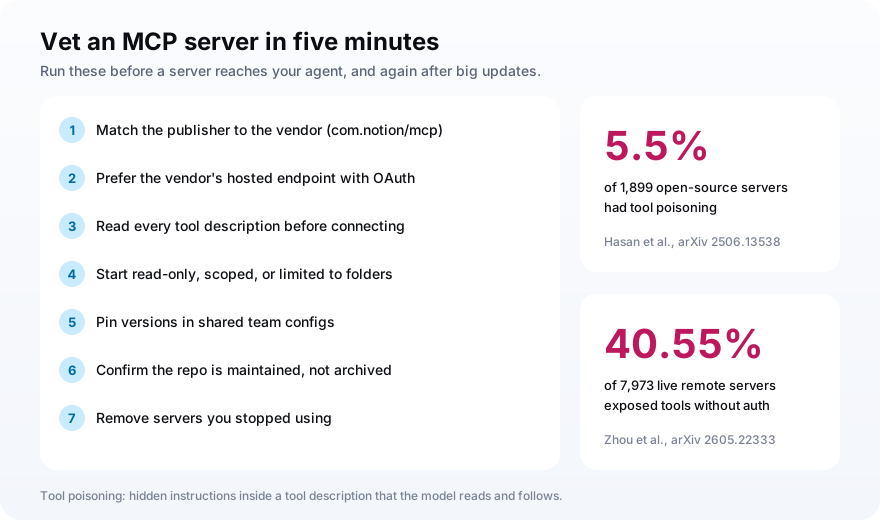
MCP servers are as safe as their publisher and the permissions you grant them. A study of 1,899 open-source servers found 5.5% with MCP-specific tool poisoning, where hidden instructions sit inside a tool description. A 2026 scan of 7,973 live remote servers found 40.55% exposed tools without any authentication. Vet every server before it reaches your agent.
The first figure comes from Hasan and colleagues, who also found general vulnerabilities in 7.2% of servers. The second comes from Zhou and colleagues, published in May 2026.
Clients do not catch much either. A March 2026 study of seven MCP clients found that five ran no static validation on tool descriptions.
Here is the five-minute check I run before adding any server:
- Match the publisher to the vendor. In the registry, com.notion/mcp is Notion; com.mcparmory/notion is not.
- Prefer the vendor's hosted endpoint with OAuth over a third-party package holding your key.
- Read every tool description before connecting, since that is where poisoned instructions hide.
- Turn on read-only mode, scopes, or allowed folders first, then widen them.
- Pin the package version in shared team configs, so an update cannot change tools silently.
- Check that the repo is still maintained and not one of the archived reference servers.
- Remove servers you stopped using, since each one is attack surface and context cost.
What our census of the official MCP registry found
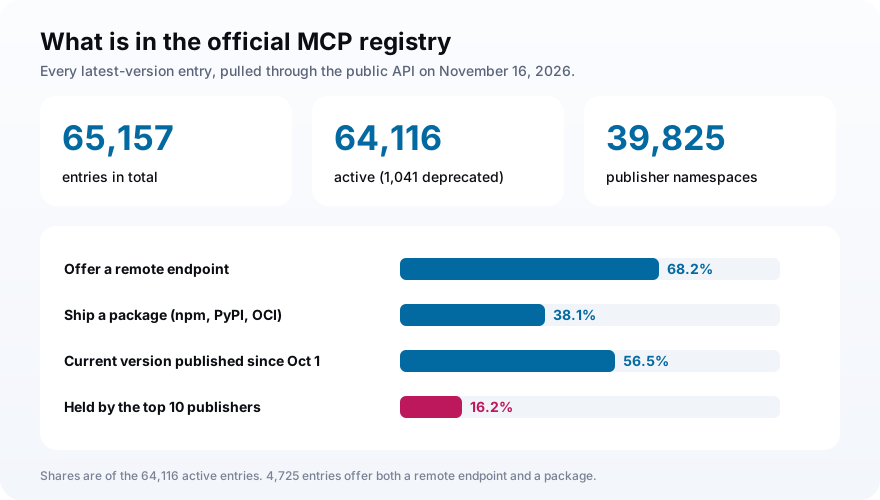
The official MCP registry held 65,157 server entries on November 16, 2026, of which 64,116 were active. Most are new: 56.5% of active entries had their current version published after October 1. The registry proves a server exists and who published it. It does not rank, review, or security-check anything, so it is a phone book, not a buyer's guide.
Remote servers now dominate. 68.2% of active entries offer a hosted endpoint, against 38.1% that ship a package, mostly on npm (16,935) and PyPI (5,261).
A few publishers produce a large share. The registry has 39,825 publisher namespaces, yet the top 10 account for 16.2% of all active entries, and the largest single publisher lists 2,366 servers.
Interest is still running ahead of use. Postman's 2025 State of the API report found 70% of developers aware of MCP but only 10% using it regularly.
The registry tells you a server exists. It never tells you the server is the real one.What the census taught me
Which MCP servers to start with, by role
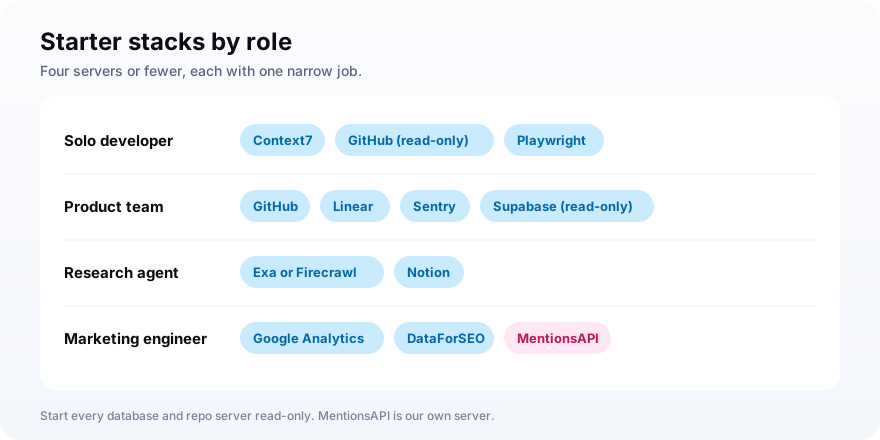
Pick a starter stack by the work you do. A solo developer needs docs, repos, and a browser. A product team adds tickets and errors. A marketing engineer swaps the browser for analytics, SEO, and AI visibility data. Each stack below stays at four servers or fewer, and each server has one narrow job, so you always know which tool the agent should reach for.
| Role | Starter stack | Why |
|---|---|---|
| Solo developer | Context7, GitHub (read-only), Playwright | Current docs, repo context, and a way to check the UI |
| Product team | GitHub, Linear, Sentry, Supabase (read-only) | Ticket to fix with real errors and schema |
| Research agent | Exa or Firecrawl, Notion | Find sources, read them, and save notes |
| Marketing engineer | Google Analytics, DataForSEO, MentionsAPI | Traffic, search data, and AI answer visibility |
How to add a server in Claude Code or Cursor
In Claude Code, add a hosted server with one command, for example claude mcp add --transport http notion https://mcp.notion.com/mcp. Add --scope project to write it to a .mcp.json file you can commit for your team.
Run claude mcp list to see what is connected, and /mcp inside a session to check status and sign in to OAuth servers.
In Cursor, put the same server in .cursor/mcp.json for one project or ~/.cursor/mcp.json for every project, with the endpoint under a url key. Use the project file for anything a teammate should inherit.
For a worked example of the marketing stack, our guide to building an AI brand-visibility agent in Claude Code wires the MentionsAPI server into a standing agent step by step.
Frequently asked questions
What are the best MCP servers for Claude Code?
How many MCP servers should I install?
Are MCP servers safe to install?
What is the difference between an MCP server and an API?
Do MCP servers cost money?
Is there an MCP server for SEO or tracking brand mentions in ChatGPT?
Install three servers this week, then measure
Start with the three MCP servers that match your daily work, in read-only mode, from the vendor's own namespace. Run the five-minute vetting check on each one before you connect it. After a day, open /mcp or your client's equivalent and look at what each server costs you. Add a fourth server only when a real task fails without it.
The registry will keep growing faster than anyone can review it. A short, vetted list will serve you better than any count.