Half of AI SEO software tells you whether AI cites your brand. The other half helps you get cited. Buy the wrong half and you have spent your budget answering a question you did not ask.
That split is the thing to understand before you compare a single tool. "AI SEO software" is a category with two jobs inside it, and the tools that do one rarely do the other well. So this guide organizes the market by job, tracking and optimization, then helps you pick the type you actually need first.
What is AI SEO software?
AI SEO software is any tool that helps your brand win AI search, and it comes in two kinds. Tracking software measures whether ChatGPT, Gemini, Perplexity, and Claude cite you. Optimization software improves your content and schema so they do. A few suites attempt both; most specialize. Knowing which job you are buying for is the difference between a tool that helps and a subscription that sits unused.
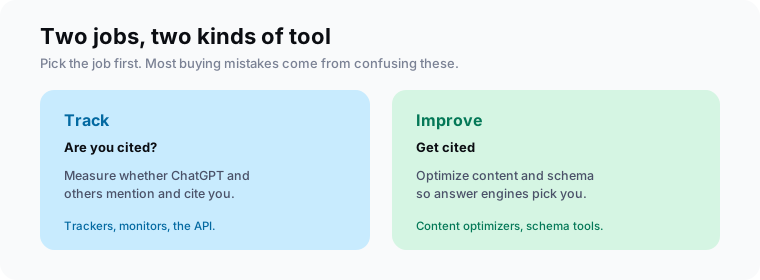
Trackers answer "does AI cite me?" Optimizers answer "how do I get cited?" You need both, but you need them in that order.The category in one line
AI SEO software that tracks (are you cited?)
Tracking software measures your presence in AI answers, and it comes as dashboards or as an API. Dashboards give a UI, seats, and alerts: Otterly starts around $29/month, with Peec (~$89), Rank Prompt, Ahrefs Brand Radar, Profound (~$399), and Goodie (~$199+) above it. The API option is MentionsAPI, at about $0.52 per check across all four engines, with no prompt cap and data you own.
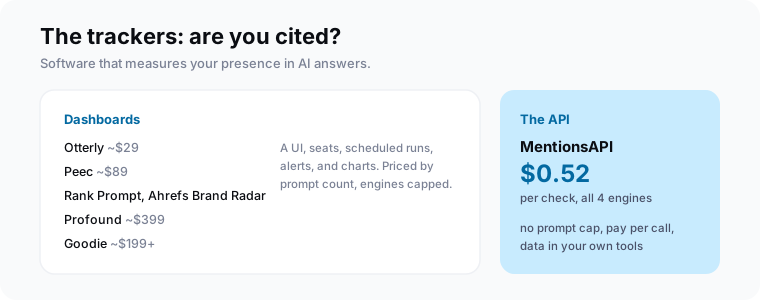
We compare the dashboards in depth in the best AI monitoring tools, and make the build-versus-buy case in API or dashboard. Whichever you pick, this is the half of AI SEO software that gives you a number to improve.
AI SEO software that improves (get cited)
Optimization software improves what AI reads about you. Content optimizers like Clearscope, Surfer, Frase, MarketMuse, and AirOps help you write and structure pages answer engines can lift, through briefs, on-page scoring, and drafts. Schema tools like Schema App and Yoast add the structured data that helps AI parse your pages. These change what you publish; they do not tell you whether it worked.
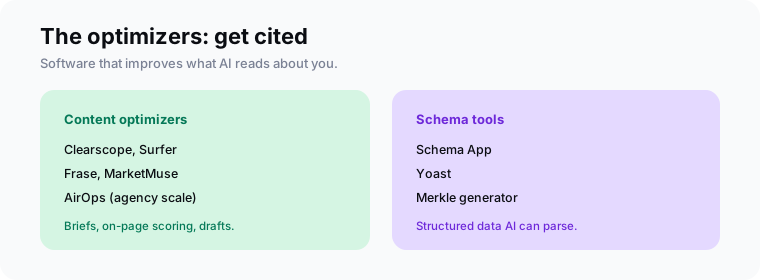
This is where most teams start, and it is the wrong end to start from. Optimizing before you measure means guessing at which queries and which pages need work. Our GEO playbook walks through the optimization work once you know where the gaps are.
The schema layer
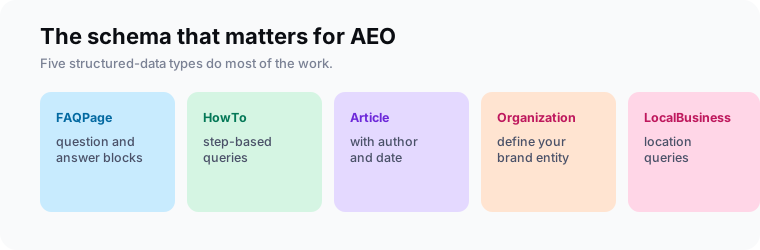
Schema is the quiet half of optimization. Structured data helps answer engines parse and trust your pages, and five types do most of the work: FAQPage for question answers, HowTo for step queries, Article with author and date, Organization to define your brand entity, and LocalBusiness for location queries. Schema tools automate this so you are not hand-writing JSON-LD on every page.
All-in-one suite, or best-of-breed?
All-in-one suites like Semrush cover both jobs adequately in one login, which is convenient if AI visibility is one priority among many. Best-of-breed tools do one job better: a dedicated tracker sees more engines and detail, and a dedicated optimizer writes better briefs. If AI search is a real priority, a specialized tracker plus a specialized optimizer usually beats the bundle. If it is a side concern, the suite is fine.
| Job | Tools | What it answers |
|---|---|---|
| Track | Otterly, Peec, Profound, Goodie, MentionsAPI | Does AI cite me? |
| Optimize content | Clearscope, Surfer, Frase, MarketMuse, AirOps | How do I get cited? |
| Schema | Schema App, Yoast, Merkle | Can AI parse my pages? |
| All-in-one | Semrush | A bit of all three |
How to choose, and where to start
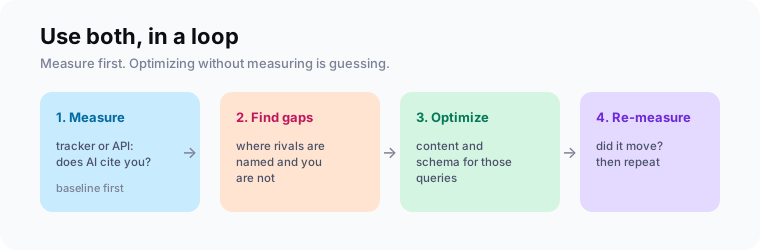
Start by measuring, always. Pull a baseline of whether AI cites you with a tracker or the API, find the queries where rivals are named and you are not, optimize content and schema for those, then re-measure to see if it moved. AI SEO software works as a loop, and the loop starts with measurement, not with a content tool.
Frequently asked questions
What is AI SEO software?
What is the difference between tracking and optimization tools?
What is the best AI SEO software for tracking visibility?
What AI SEO software improves content for AI search?
Does schema markup help with AI SEO?
Do I need an all-in-one AI SEO platform or separate tools?
Buy for the job, not the label
The choice gets easy once you name the job. Decide whether you need to know if AI cites you, need to get cited, or both. A tracker handles the first, an optimizer the second, and when the answer is both, buy the tracker first so the optimizer has a target. The label "AI SEO software" covers two jobs; your budget should follow the one you actually have.
Then run the loop. Baseline your visibility with a single API call, optimize for the gaps with the GEO playbook, and re-measure until AI names you where it counts.