The fastest way to vet an AI SEO service is to ask for one thing most of them cannot produce: a citation.
AI SEO services help your brand show up and get cited inside AI answers from ChatGPT, Google AI Overviews, Perplexity, and Gemini, rather than only in blue links.
The catch is that AI SEO means two different things, and a wave of agencies have rebranded old SEO as AI SEO without changing anything underneath.
So choosing a service is mostly about telling the real work from the relabel, and knowing how to check that it works. Here is what the services include, what they cost, and how to vet one.
What are AI SEO services?
AI SEO services are done-for-you work to make your brand visible, accurate, and cited inside AI-generated answers, beyond traditional search rankings. In practice that means structuring your content so engines like ChatGPT and Google AI Overviews pull it into their responses, fixing the technical access that lets AI crawlers read you, and tracking whether the citations actually appear. It is the service version of generative engine optimization.
The category exists because search itself changed.
Buyers now ask ChatGPT and Perplexity the questions they used to type into Google, and the answer names a few brands instead of listing ten links. AI SEO services are how companies try to be one of the named brands. Our guide on answer engine optimization covers the discipline these services sell.
Real AI SEO can show you a citation it earned. A relabel can only show you a slide that says "AI."The one line to remember
"AI SEO" means two different things
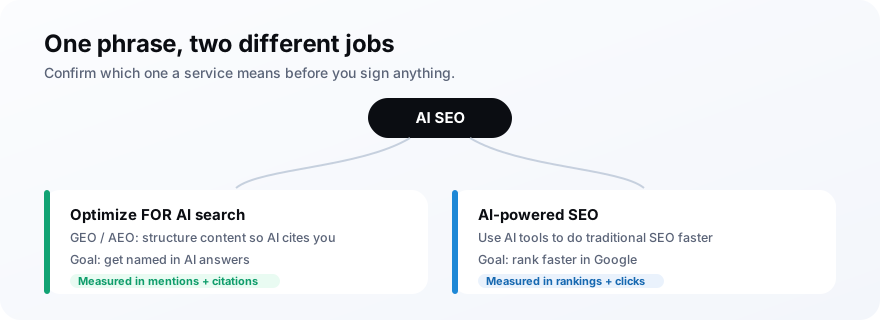
The phrase gets used for two different jobs, and buyers routinely confuse them. One is optimizing for AI search: structuring content so AI answers cite you, which is GEO or AEO. The other is AI-powered SEO: using AI tools to do traditional SEO faster, like generating content or analyzing keywords. Both are real, but they deliver different outcomes, so pin down which one a service actually means.
| Question | Optimize for AI search (GEO/AEO) | AI-powered SEO |
|---|---|---|
| Goal | Get cited in AI answers | Rank faster in Google |
| Method | Structure content for AI extraction | AI tools speed up SEO tasks |
| Target | ChatGPT, AI Overviews, Perplexity | Google blue links |
| Success metric | Mentions and citations | Rankings and clicks |
Most brands asking about AI SEO today want the first one.
They have noticed AI answers naming competitors and want in. That is the optimize-for-AI job, and it is the one this guide focuses on, because it is newer, harder to fake well, and the one most often rebranded. Industry writers draw the same line between AI SEO and traditional SEO.
A quick way to tell which a service sells: ask what they measure.
If the answer is rankings and traffic, you are buying AI-powered traditional SEO. If it is mentions and citations in AI answers, you are buying the optimize-for-AI job. The metric gives the game away faster than any pitch deck does.
What do AI SEO services actually include?
Legitimate AI SEO work is specific, not vague. It covers answer-first content structured for extraction, FAQ and HowTo schema, topic clusters and internal links, technical retrievability like clean HTML and AI-crawler access, and citation tracking to prove it worked. Services often bundle AI-assisted keyword research and content production on top.
The concrete deliverables a real scope names:
- Content built for extraction: answer-first pages, clear definitions, comparison tables an AI can lift cleanly.
- Schema and structure: FAQ and HowTo markup, semantic HTML, passage-level organization.
- Technical retrievability: AI-crawler access in robots.txt, server-side rendering, an llms.txt index, Bing crawlability.
- Authority and mentions: digital PR to earn the third-party mentions that move AI citations.
- Citation tracking: measuring whether AI engines actually name and cite you, per prompt, over time.
Notice the last item. It is the one relabeled SEO almost never includes, because it is the one that would expose whether the work is landing.
Use the deliverables list as a filter.
Hand a prospective service this list and watch which items they can speak to in detail. The ones who light up on schema, retrievability, and citation tracking are doing the real work. The ones who pivot back to blog volume and backlinks are selling you traditional SEO in a new suit.
How much do AI SEO services cost?
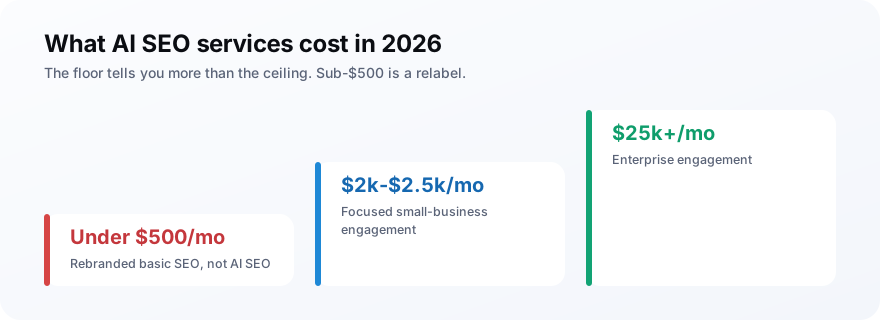
Expect roughly $2,000 to $2,500 a month for a focused small-business engagement, rising to $25,000 or more for enterprise work, based on 2026 pricing guides. The number that should stop you is a low one: anything under $500 a month is not AI SEO, it is rebranded basic SEO with new labels. Real citation work takes time and expertise, and credible pricing reflects it.
Price alone does not prove quality, though.
A high retainer can still buy rebranded SEO, and a lean one can buy sharp work. Price screens out the obvious fakes at the bottom, but the real test is what they can show you, which is the next section.
What the higher tiers actually buy is labor and reach.
AI SEO is content-heavy and relationship-heavy. Someone has to rewrite pages, build schema, and earn mentions across the web, and none of that scales for free. The jump from small-business to enterprise pricing mostly reflects content volume and depth of digital PR, not a secret algorithm you are paying to access.
How do you spot rebranded SEO?
The single best test is to ask the provider to show a verifiable AI citation for their own brand or a client. A provider that cannot point to a documented ChatGPT or AI Overview citation is speculating, not delivering. Add the usual tells and the relabels sort themselves out fast.
The red flags worth walking away from, many of which other AI SEO pricing teardowns flag too:
- No citations to show: cannot produce a single documented AI citation for themselves or any client.
- Guaranteed rankings: promises of a first-place ranking or a fixed AI Overview slot, neither of which anyone can guarantee.
- Suspiciously cheap: sub-$500 a month for full-service AI SEO, which is a relabel by arithmetic.
- Vague methods: proprietary black-box language with no explanation of your specific strategy.
- Old deliverables, new label: the scope is identical to a 2023 SEO proposal with the word AI pasted on.
Do you need an agency, or can you do it with tools?
You can do a lot of AI SEO yourself with the right tools, and some of it you should. The content and structure work rewards in-house knowledge of your buyers. An agency earns its fee on scale, technical depth, and digital PR for the third-party mentions that move citations. Many teams run a hybrid: tools and in-house content, an agency for the heavy lifting.
Start by separating the work that needs a vendor from the work that does not.
Rewriting your key pages answer-first, adding schema, and fixing crawler access are things a capable team can do in-house with guidance. Earning authoritative mentions across the web at scale is where an agency's relationships pay off. Our guide to GEO agencies and services goes deeper on the hire side, and our roundup of AI visibility tools covers the DIY stack.
Whichever way you go, keep one thing in-house.
Own the measurement. If your agency both does the work and grades its own homework, you have no independent read on whether it is working. Hold the citation tracking yourself, and the relationship stays honest.
The hybrid split that works for most teams is simple.
Keep content and measurement in-house, where your product knowledge lives, and outsource the scale work: large content volumes and the outreach that earns authoritative mentions. You get your voice on the pages and an independent read on results, with a vendor doing the parts that genuinely need extra hands.
How long do AI SEO services take to work?
Faster than traditional SEO for some things, slower for others. Content and structure changes can start showing up in AI answers within weeks, because engines re-crawl often and favor fresh pages. The authority side, the third-party mentions that make a model trust you, takes months. Expect early movement on specific prompts in four to eight weeks, with a transformed footprint taking a good deal longer than thirty days.
Be wary of anyone promising instant results.
AI answers are volatile, so a brand can pop into a few answers quickly and still take a quarter to hold a durable position across engines. A credible service sets that expectation up front and reports on the trend, rather than celebrating a single lucky answer in week one.
The timeline is also why the baseline matters so much.
Without a starting measurement, you cannot tell a real four-week gain from a service taking credit for citations you already had. Capture the baseline first, and the timeline becomes something you can hold a provider to instead of a story they tell you.
How do you know AI SEO services are working?
Measure citations, not promises. The whole point of AI SEO is getting named and cited in AI answers, so the proof is whether that happens for your buyer prompts, and whether it rose after the work started. Capture a baseline before you hire, then watch it move. A service that cannot move that number is not doing AI SEO, whatever the invoice says.
Set the baseline first, while you still can.
Before any engagement, record how often AI engines name and cite you for your core buyer prompts. Our guides on checking whether ChatGPT mentions you and improving your AI visibility score cover how. That baseline is what turns a vague service into an accountable one.
A concrete version makes it real.
Say you are cited in 2 of your 15 core prompts before you hire. Three months in, a working service has you in six or seven, with the new citations traceable to pages they built or mentions they earned. If the number is still 2, no reporting on impressions or rankings changes the verdict.
Frequently asked questions
What are AI SEO services?
What is the difference between AI SEO and traditional SEO?
How much do AI SEO services cost?
How do I know if an AI SEO agency is legit?
Can I do AI SEO myself?
How do I measure whether AI SEO is working?
Buy the citations, not the label
Do this next: before you talk to any AI SEO service, write down ten questions your buyers ask an AI and record who gets named today. That baseline is your edge in every sales conversation that follows.
Then make the citation the deal. Ask every provider to show you one they earned, hold the tracking yourself with MentionsAPI, and judge the work on whether your own number moves.
The label on the service does not matter. The citations do.