Half of these tools do one thing: tell you AI does not mention your brand. Then they hand you a chart and wish you luck.
I have tested a lot of them this year, and the useful ones are the minority. Most AI search optimization tools are visibility trackers wearing an optimizer's marketing. They measure the problem well and do nothing about it. The difference between a tool that reports and a tool that tells you what to change is the whole ballgame, and it is not the difference the pricing pages lead with.
So this is a comparison built around one question: which of these actually helps you win the answer, not just watch yourself lose it?
What are AI search optimization tools?
AI search optimization tools help your brand get named and cited inside AI answers on ChatGPT, Perplexity, Gemini, and Google AI Overviews. They come in two kinds: trackers that measure whether AI mentions you, and optimizers that improve your content and schema so it does. Some suites attempt both, and an API layer lets developers build their own. The category is young, crowded, and full of tools that blur which job they do.
The reason the category exists at all is that search is moving. Per Conductor's analysis of 21.9 million queries, Google AI Overviews now show on 25.11% of searches, up from 13.14% in March 2025. On the chat side, ChatGPT has crossed 900 million weekly users.
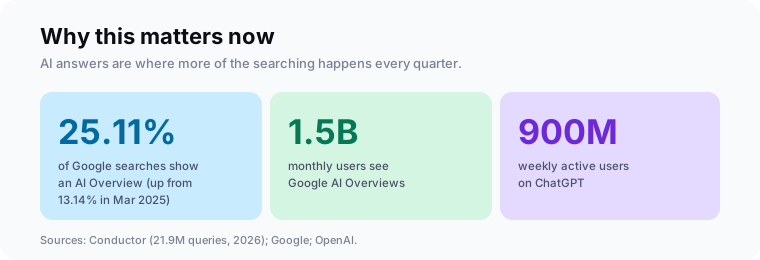
When a quarter of Google searches open with an AI answer, being absent from it is lost demand. That is what these tools are for. The hard part is telling the ones that help apart from the ones that only report.
How do you choose an AI search optimization tool?
Judge every tool on five things, in this order, and put price last. First, engine coverage: does it watch the engines your buyers actually use? Second, does it close the loop, meaning tell you how to fix a gap, not only that one exists? Third, can you own the data through an API? Fourth, is it a flat fee or pay per call? Fifth, does it fit your team's size and skills?
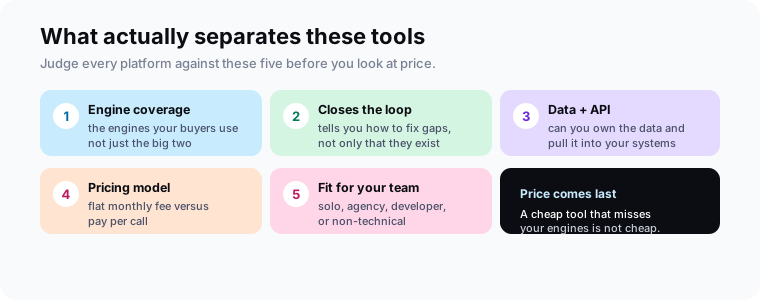
I put price last on purpose. A $29 tool that only tracks ChatGPT is expensive if your buyers live in Gemini and you still cannot see it. Coverage and closing the loop decide whether the money does anything.
One thing the pricing pages hide: accuracy. Some tools show the prompts people really type, and some reverse-engineer them from a keyword list. A weekly snapshot can also miss a fast-moving answer. Ask how fresh the data is, and where it comes from, before you trust the chart.
Do these tools optimize, or just track?
Most just track, and that is the trap. A tracker tells you ChatGPT does not name you for "best CRM for startups," which is worth knowing once and useless the tenth time. A tool that closes the loop tells you why: rivals are cited from a G2 listing and a comparison page you do not have. One of those insights you can act on. As one 2026 platform analysis put it, the most powerful feature is not tracking but showing you how to fill the gap.
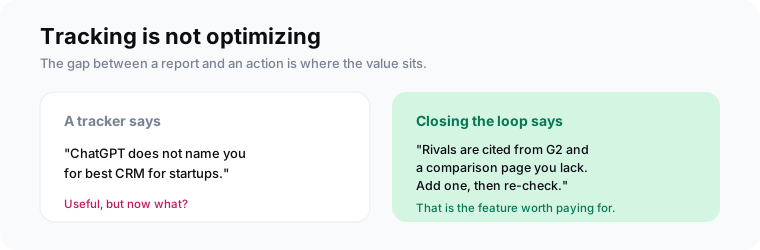
This matters because tracking is cheap to build and easy to sell, so the market is flooded with it. Real optimization, the part that reads citation sources and tells you what to publish, is rarer and worth more. We break the two jobs down further in AI SEO software.
Ask any tool one question: after it shows me a gap, does it tell me what to do about it? If the answer is "you figure that out," you are buying a thermometer, not a cure.The buying test
The best AI search optimization tools compared
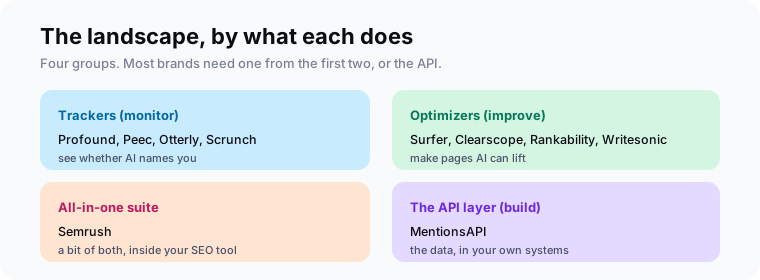
The market sorts into four groups: trackers that monitor AI visibility, optimizers that improve your pages, all-in-one suites, and the API layer for building your own. Most brands need one tool from the first two, or the API if they can code. The landscape first, then the numbers.
| Tool | Group | Entry price | Best for |
|---|---|---|---|
| MentionsAPI | API layer | ~$0.52/check | Developers, agencies, product teams |
| Otterly.AI | Tracker | ~$29/mo | Solo and small brands |
| Scalenut | Optimizer | ~$24/mo | Content + tracking in one |
| Peec AI | Tracker | ~$89/mo | Agencies, many brands |
| Surfer / Clearscope | Optimizer | ~$99+/mo | Content teams optimizing pages |
| Profound | Tracker | ~$399/mo | Enterprise, deep granularity |
| Ahrefs Brand Radar | Tracker (add-on) | ~$828+/mo all-in | Teams already in Ahrefs |
A note on the trackers: several are strong, and we cover them one by one in the best AI visibility tools and in the Profound alternatives breakdown. The point here is not to crown one, it is to place each in the group that matches your job.
How much do AI search optimization tools cost?
The spread is wider than the feature gap. Entry dashboards start near $24 to $29/month (Scalenut, Otterly), mid-tier tools run $89 to $399 (Peec, SE Ranking, Profound), and Ahrefs Brand Radar reaches roughly $828/month all-in once you add a base plan and the AI indexes. An API bills per call instead: MentionsAPI is about $0.52 a check across all four engines, with no monthly floor.
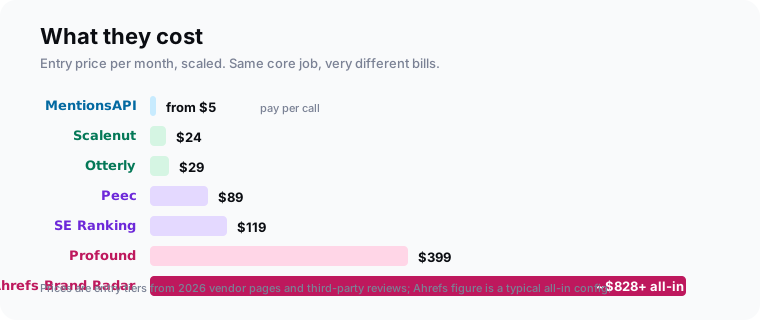
The lesson from that range: match spend to what you will use. If a solo brand needs a UI and a few prompts, the $29 tier is plenty. If you can code, the API undercuts almost everything and covers every engine per call. We make the full case in API or dashboard.
Which tool is right for you?
Pick by team and job, not by brand name. A non-technical solo brand should take the cheapest dashboard that covers its engines, usually Otterly. A content team should pair a tracker with an optimizer like Surfer or Clearscope. An agency running many brands wants Peec or Profound. And if anyone can write code, an API gives you every engine and the data in your own tools for the least money.
Frequently asked questions
What are AI search optimization tools?
How accurate is the data from AI search optimization tools?
Do I need a separate AI tool if I already use Semrush or Ahrefs?
Do AI search optimization tools improve visibility or just track it?
How much do AI search optimization tools cost?
Are AI search optimization tools worth it?
Buy the tool that tells you what to change
The one filter that saves you the most money: after a tool shows you a gap, does it tell you what to do about it? Trackers stop at the chart. Optimizers and the API turn the chart into a next step. Everything else, price included, is secondary to that.
Start with a real baseline on your own brand, choose the group that fits how your team works, and re-measure after every change so you know the money moved something. That loop, not any single tool, is what wins the answer.