For twenty years, SEO assumed a human would read the page.
Comet breaks that assumption. Perplexity Comet is an AI browser where an assistant sits in the page, reads what you are viewing, researches across your tabs, and can click and act on your behalf. The person asking the question may never see your site at all.
That is the whole story for anyone doing SEO. The reader is now sometimes a machine, and the machine has different taste than a human with ten blue links.
What is Perplexity Comet, and why does it matter now?
Comet is Perplexity's AI browser, built on Chromium with an assistant living inside every page. It launched on July 9, 2025 as a $200-a-month perk for Perplexity Max, then went free worldwide on October 2, 2025. It matters more now because OpenAI shut down its rival browser, ChatGPT Atlas, in August 2026, folding its browser agent into ChatGPT and leaving Comet as the leading AI-native browser.
The price drop is the part to sit with. A $200 product is a curiosity.
A free one on Mac, Windows, iOS, and Android is a distribution channel. Comet hit number 3 on the US App Store at its iOS launch, which almost never happens for a browser.
The assistant is the point, not the browser chrome. It can see the tab you are on, pull context from several open tabs at once, run Perplexity's Deep Research, and take actions like filling forms, comparing products across sites, and completing simple bookings or purchases. It answers with cited sources, the same way Perplexity search does.
Perplexity itself is not small either. It has more than 45 million monthly active users, and its revenue is projected to reach $656 million in 2026, several times what it was a year earlier. The audience reading through an agent is real and growing.
How does agentic browsing change SEO?
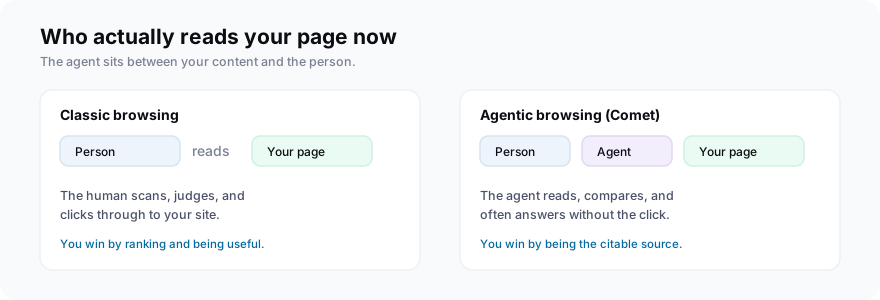
Agentic browsing moves the reader one step away from your page. In Comet, the assistant reads your content, compares you against competitors across open tabs, and often answers the question or completes the task in the sidebar. So the target shifts from ranking a page a person scans to being the source an agent can extract, trust, and choose. Clarity and structure beat clever copy.
Think about what the agent actually does. It does not skim your hero image or feel your brand.
It parses your text, pulls the facts it needs, and moves on. If your key answer is buried three scrolls down or trapped in an image, the agent misses it and picks a competitor whose page said it plainly in the first paragraph.
The comparison step is where this bites hardest. Ask Comet for the best option in a category and it opens several contenders, reads each one, and lines up price, features, and proof.
Whoever states those facts most clearly tends to win the slot. A vague page that makes the agent guess loses to a precise one, even if the vague page would have charmed a human reader.
You are no longer writing to be read. You are writing to be extracted.The whole shift in one line
This is not brand-new. It is the same citation-first pressure Perplexity search already put on content, now pushed harder because the browser can also act. Our Perplexity SEO guide covers the citation mechanics in depth, and this is that world with an agent's hands attached.
Does Comet still send traffic to your site?
Sometimes, but less per query. Comet can cite sources and link out, so a strong, clearly attributed page still earns clicks from people who want to verify or go deeper. But when the assistant summarizes the answer or finishes a task in the sidebar, the user often never loads your page. Expect fewer sessions per query and more weight on each citation you do win.
This is the zero-click story, turned up. Search already trained people to read the answer and not click. An agent can skip the click entirely and still act on your information.
So the metric that matters changes. A visit is no longer the only proof you showed up.
Being named as the cited source is its own win, even without the session, because that is what puts you in the answer and on the agent's shortlist. If you only count sessions, an agentic browser looks like pure loss when it is often quiet influence.
Where does Comet get its answers?
Comet answers from Perplexity's search stack, not a static model. It leans on Perplexity's index, discovered by PerplexityBot, and fetches live pages in the moment through Perplexity-User when the agent needs the current version. Then it writes a cited answer with links, so the sources are visible and checkable.
Two things follow from that. First, freshness counts. Perplexity indexes close to real time, so a page you update can enter or fall out of citations within days.
Second, your crawler rules decide whether you exist here at all. If you block Perplexity's bots, you are not in the index the agent reads from, and no amount of on-page work fixes that.
Comet vs Chrome vs traditional search
Here is the practical difference between browsing in Comet, browsing in Chrome, and searching on Google. Read it as three ways a buyer can reach the same decision, because increasingly they use all three.
| Comet | Chrome | Google Search | |
|---|---|---|---|
| Who reads your page | An AI agent, first | A person | A person |
| Main output | A cited answer or action | The page itself | Ranked links |
| Clicks to your site | Often skipped | Direct | Direct |
| You win by | Being the citable source | Being useful on-page | Ranking |
| What it rewards | Structure and clarity | Experience and speed | Authority and links |
The rightmost two columns are the familiar world, and most SEO teams are still built entirely for them. Comet is the column almost nobody has staffed for.
You do not get to pick which column your buyer uses. The same person might Google on Monday and let Comet do the legwork on Thursday, so your page has to satisfy the agent and the human at once.
How do you optimize your site for Comet?
You optimize for Comet by making your page trivial for an agent to read and quote. Put the answer first, keep the facts structured and current, mark up your data with schema, and let Perplexity's crawlers in. The agent rewards pages it can parse in one pass, not pages that hide the answer behind a story.
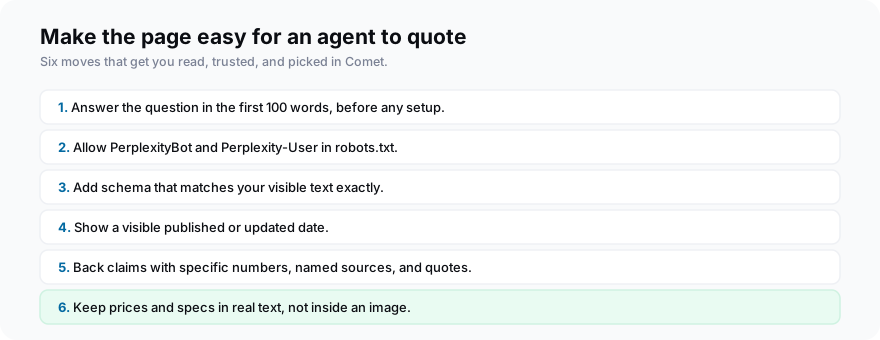
Here is the short list I would work through in order:
- Answer the question in the first 100 words, before any setup, so the agent finds it fast.
- Allow PerplexityBot and Perplexity-User in robots.txt, or you are invisible to Comet.
- Add Product, FAQPage, Article, or HowTo schema that matches your visible text exactly.
- Show a visible published or updated date, because Perplexity indexes near real time.
- Back claims with specific numbers, named sources, and quotes an agent can lift cleanly.
- Keep prices, specs, and availability in real text, not baked into an image the agent cannot read.
None of this is exotic. It is the citation discipline good AI-search content already uses, plus a hard rule about machine-readable data.
For the crawler decision specifically, including whether a block will even hold, see our guide on PerplexityBot.
What agentic browsers reward beyond ranking
Agentic browsers reward whether the agent can finish the task on your page, not just whether you rank. If the assistant is booking, comparing, or buying, it needs to complete steps without hitting a wall. A page that is easy to read but impossible to act on quietly loses to one the agent can drive end to end.
So conversion design becomes part of SEO now. That is new.
If your pricing needs a sales call to reveal, or your key spec lives in a PDF, or your form breaks without a human, the agent stalls and moves on. The brands that win agentic browsing make the whole path legible: clear text, clean structure, and actions a machine can take without guessing.
Picture a buyer telling Comet to find and start a trial of the best tool for their team. The agent shortlists a few, reads each pricing page, and tries to begin signup on the one it rates highest.
If your trial needs a demo call and a competitor offers instant signup, the agent completes the task on the competitor and never comes back. You lost the sale at the structure layer, before anyone compared the actual products.
One honest caveat. Agents are still clumsy today, and independent testing shows Comet botching multi-step tasks on the first try more often than you would like. That is a reason to prepare your pages now, not to wait, because the models behind the agent improve on a monthly cadence.
How do you track whether Comet cites you?
Track it by running your real buyer prompts through Perplexity and Comet on a schedule and recording whether you were named and which page was cited. Watch that line over weeks, because Perplexity indexes near real time and your citations can appear or disappear within days. One spot check tells you nothing useful.
A visit-only dashboard will mislead you here. It shows the lost clicks and hides the won citations.
Measure the citation directly instead. Query the engine with the questions your buyers ask, parse who gets named, and track your share over time so you can tell whether a page change actually moved the agent.
Two numbers are worth separating. Track how often you get mentioned at all, and how often your own page is the cited source, because they move for different reasons.
A rising mention rate with flat citations usually means others describe you well but your own pages are not clean enough for the agent to quote. That is a fixable, on-page problem, and it is exactly the kind of gap a per-engine citation check surfaces early.
Frequently asked questions
What is Perplexity Comet?
How does Comet change SEO?
Does Comet still send traffic to my website?
Should I block or allow Perplexity in Comet?
Is Comet replacing Google?
How do I know if Comet cites my brand?
Prepare your pages for the agent, then measure it
Do this next: pick your ten most important pages and make each one answer its core question in the first 100 words, with schema that matches and prices in real text. That is what lets Perplexity Comet read, trust, and pick you.
Then measure the agent, not just the sessions. Pull a citation baseline with MentionsAPI, keep your Perplexity SEO tight, and watch whether your pages win the browser that now does the browsing.
Atlas proved these browsers can also vanish overnight, so do not build your whole plan on any single one. Build for agentic browsing as a category, keep your pages clean and quotable, and you stay visible no matter which agent your buyer opens next.