People say generative AI and LLM as if they are interchangeable. They are not.
Here is the whole thing in one line. Generative AI is the big category, and an LLM is one branch of it, the branch that works with language.
Everything else is detail. But the detail is worth knowing, because it tells you which technology actually decides whether your brand shows up in an AI answer, and which one you can safely ignore.
LLM vs generative AI: what is the difference?
The difference is scope. Generative AI is any system that creates new content, whether that is text, images, audio, or video. An LLM is a generative AI model specialized for one of those, language, so it reads and writes text. Every LLM is a generative AI system, but generative AI also covers models that make things an LLM never touches, like pictures and music.
Think of it as a category and a member of that category.
Generative AI is the label on the box. LLM is one of the things inside it. Calling ChatGPT generative AI is correct but broad, the way calling a car a vehicle is correct but broad. Calling it an LLM is the specific, accurate name.
The words are not interchangeable, even though people swap them. Every LLM is generative AI, so that direction is always safe.
But going the other way trips you up. Call an image generator an LLM and you are simply wrong, because it does not work with language at all. Precision costs nothing here and keeps you from saying something that does not hold.
Generative AI is the whole family of models that create content. An LLM is the member of that family that works in words.The difference in one line
What is generative AI?
Generative AI is artificial intelligence that produces new content rather than just analyzing existing data. Give it a prompt and it creates something that did not exist before, a paragraph, an image, a song, a video, a block of code. It learns patterns from huge amounts of examples, then generates fresh output that follows those patterns.
The key word is generate. That is what separates it from older AI.
A traditional AI model might classify an email as spam or predict a number. A generative model writes the email instead. The shift from sorting and predicting to creating is the whole reason generative AI became the story of the last few years.
It learns by example, not by rules. Feed it millions of samples of a kind of content, and it picks up the patterns, the style, the structure, the way pieces tend to go together.
Then, given a prompt, it produces something new that fits those patterns. Nobody wrote the exact output in advance; the model assembled it on the spot from what it learned, which is why two people can give the same prompt and get different results.
Because content comes in many forms, generative AI spans many kinds of models, as IBM lays out. The main branches you will run into are:
- Text and language models, the LLMs, which write, summarize, and answer questions.
- Image models like Midjourney and DALL-E, which turn a prompt into a picture.
- Video models like Sora and Veo, which generate moving footage.
- Audio and music models like Suno, which produce voices, sound effects, and songs.
- Code models, which are really language models pointed at programming instead of prose.
Every one of those is generative AI. Only the first, the language branch, is an LLM, which is the whole point of the distinction.
What is a large language model (LLM)?
An LLM is a generative AI model trained on enormous amounts of text to understand and produce language. As IBM describes it, an LLM is a deep-learning model that works as a statistical prediction machine, repeatedly guessing the next word in a sequence. That simple mechanism, done at massive scale, is what lets it write, summarize, translate, and answer questions.
LLMs run on a specific design called a transformer.
The transformer architecture, introduced in a 2017 paper, uses a self-attention mechanism to weigh how words relate to each other across a passage, even distant ones. That is what gives modern LLMs their grasp of context, and it is why ChatGPT, Claude, Gemini, and Grok all sit on the same underlying idea.
The large in large language model is not a throwaway word either. These models are trained on enormous amounts of text and have billions of internal parameters.
That scale is what turned a decent autocomplete into something that can hold a conversation, follow instructions, and write a coherent essay. Smaller language models existed for years; the jump in size and training data is what made the current ones feel different in kind, not just degree.
What an LLM does not do is make images or music. Its world is text, plus whatever it has been extended to read, and its native output is language.
Are all LLMs generative AI?
Yes, every LLM is generative AI, but not every generative AI is an LLM. An LLM generates new text from learned patterns, which is exactly the definition of generative AI, so it always qualifies. The reverse fails because generative AI also includes image, audio, and video models that have nothing to do with language. The relationship runs one way.
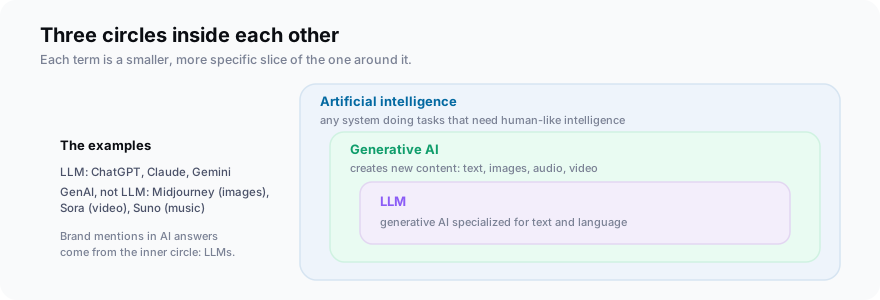
It helps to see how the terms nest.
Artificial intelligence is the outermost circle, any system doing tasks that need human-like intelligence. Inside it sits generative AI, the part that creates content. Inside that sits the LLM, the part specialized for language. Each is a smaller, more specific circle than the one around it.
LLM vs generative AI: examples side by side
The fastest way to feel the difference is to look at real tools. Some are LLMs, some are generative AI but not LLMs, and the split always comes down to whether the output is language.
| Tool | What it makes | LLM? |
|---|---|---|
| ChatGPT, Claude, Gemini | Text answers | Yes, an LLM |
| Midjourney, DALL-E | Images | No, image model |
| Sora, Veo | Video | No, video model |
| Suno, Udio | Music and audio | No, audio model |
| GitHub Copilot | Code, which is text | Yes, LLM-based |
Every row on the no side is still generative AI. It just is not a language model.
Notice the pattern in the yes rows: the output is always words, even when it looks technical. Code is text, so a coding assistant is an LLM at heart.
The moment the output becomes pixels, sound, or motion, you have left LLM territory and you are in the wider generative AI world. That single test, is the output language, is more reliable than any brand name or marketing label.
There is one more wrinkle worth naming: multimodal models. Newer systems like GPT and Gemini can handle images and audio alongside text, which blurs the edges a little.
Even then, the language part is the LLM at the core, extended to see and hear. The text engine is still what reasons and answers, so calling these products LLMs stays fair, even as they grow extra senses.
Why do people mix up the two terms?
People blur LLM and generative AI because the tool that made both famous is the same one. ChatGPT is a large language model, and it is also generative AI, so the first thing most people met happened to be both at once. When one example represents two ideas, the words start to feel like synonyms.
Marketing made it worse, not better.
Vendors slap generative AI on anything with a prompt box, because it sounds bigger and newer than LLM. So a product that is really just an LLM wrapper gets sold as generative AI, and the precise term quietly loses its edges in the noise.
The fix is the simple test from earlier: look at the output. If it makes words, you are dealing with an LLM. If it makes pixels, audio, or video, it is generative AI but not a language model. That one question sorts almost everything, and it does not care what the marketing page calls the product.
Why the difference matters for your brand's visibility
It matters because the AI answers that mention brands come from LLMs, not from image or video models. When someone asks ChatGPT or Perplexity for the best tool in your category, a language model writes that answer and decides whether to name you. So being visible in AI is really being visible to LLMs, the text branch of generative AI.
That narrows a fuzzy goal into a concrete one.
You are not trying to show up in all of generative AI, which would include image and music tools where a brand mention makes no sense. You are trying to be the source language models reach for when they answer a question about your space. Everything in AI visibility work points at that.
It also tells you which models to actually watch. The ones that matter for your brand are the LLM-based assistants: ChatGPT, Claude, Gemini, Perplexity, Grok, and the tools built on them.
You do not need to track Midjourney or Sora to know whether AI recommends you, because they do not answer questions with brand names. Narrowing your attention to the language models is not a limitation; it is the correct focus, and it saves you from chasing corners of generative AI that have nothing to do with whether a buyer hears about you.
If you want the practical side, our guide on LLM SEO covers how to get cited by these models, and AI visibility covers how to measure whether it is working.
Frequently asked questions
Is an LLM the same as generative AI?
Is ChatGPT an LLM or generative AI?
Are all LLMs generative AI?
What is an example of generative AI that is not an LLM?
What is the difference between AI, generative AI, and LLMs?
Does the LLM vs generative AI difference matter for marketing?
Know which circle you are optimizing for
Here is the takeaway to keep: generative AI is the family, and the LLM is the member of it that works in words. When people say AI is answering questions and naming brands, they mean LLMs.
So point your effort there, at the language models. Make your pages the clearest, best-sourced answer a language model can quote, then measure whether the LLMs actually cite you with MentionsAPI. The broad term is generative AI, but the one that decides your visibility is the LLM.
None of this means the rest of generative AI does not matter to your business. Image and video models change how you make creative, and that is real.
It just is not the same job as being named in an answer. Keep the two straight, and you spend your visibility budget on the models that actually mention brands, instead of on a category so broad it includes tools that will never say your name.