You have seen SEO, then AEO, then GEO, and now LLMO. Fair to be tired.
Here is the honest version. LLMO is worth knowing not because it is a brand-new discipline, but because it names a real shift: people are asking language models for answers instead of scrolling a page of links.
When they do, the model names a few sources. LLMO is the work of being one of them.
What is LLMO (large language model optimization)?
LLMO, large language model optimization, is the practice of structuring, publishing, and distributing content so large language models incorporate your brand, products, and expertise into their generated answers. The target is a citation inside an AI answer from ChatGPT, Claude, Gemini, or Llama, not a ranking in a list of links. As BrightEdge puts it, the goal is citation presence and share of voice across AI-generated responses.
The name emphasizes the model layer on purpose. GEO leans toward AI search surfaces, but LLMO covers any place a language model answers, a chat assistant, a coding tool, an internal enterprise bot, wherever a model synthesizes a reply and names sources.
Strip away the acronym and it is simple.
You want your content to be legible to a language model: easy to retrieve, easy to parse, and easy to quote. When a model can do those three things with your page, it can name you in an answer. When it cannot, it names someone else.
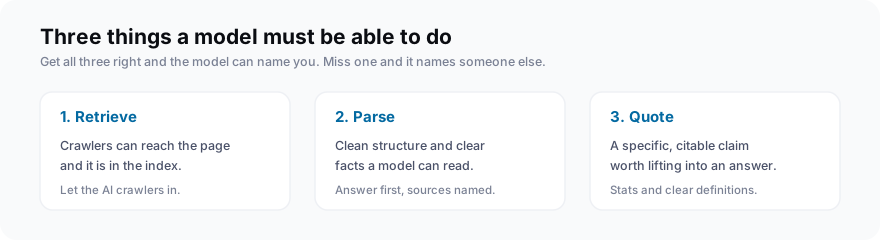
LLMO is making your content the thing a language model reaches for when it answers a question in your space.LLMO in one sentence
Why does LLMO matter now?
LLMO matters now because a real share of your customers has stopped clicking links and started reading AI answers. When the answer comes from a model, the model, not the searcher, decides which brands get named. If you are not one of them, you are invisible at the exact moment a decision is forming.
The scale is not small anymore.
ChatGPT alone reached a billion weekly users in 2026, and Google's AI Overviews now reach roughly 2.5 billion people a month. That is a huge and growing slice of search behavior where the output is a generated answer with a few cited sources, not ten blue links.
So LLMO is not a bet on the future. It is a response to where a large audience already looks for answers, and to the fact that being unranked and being uncited are now two different kinds of invisible.
And the gap compounds. Every month more of your buyers form an opinion inside an AI answer before they ever reach your site, so a brand the models do not know keeps losing decisions it never even sees.
How is LLMO different from traditional SEO?
LLMO and SEO share the same foundations but chase different outcomes. SEO aims to rank a page in a search index so a person clicks it. LLMO aims to be cited inside an AI-generated answer so a model repeats you, often with no click at all. The content work rhymes; the target and the metric change.
That metric shift is the part that trips people up.
In SEO you watch positions and traffic. In LLMO you watch whether the model mentions you and cites your page, because most people read the AI answer and never visit the source. A page that never ranks first can still be the one an assistant quotes.
The good news is that the inputs overlap. Crawlable pages, clean structure, clear facts, and real authority help you in both. LLMO does not throw out SEO; it points the same discipline at a new surface.
There is one real divergence worth naming. SEO rewards a single best page for a keyword, while LLMO rewards a consistent, well-covered entity.
A model does not rank your page against ten others. It reads across everything it knows about you and decides whether you are the trustworthy answer, so contradictions and thin coverage hurt more in LLMO than a single missing keyword ever did in SEO.
LLMO vs GEO vs AEO: what actually differs?
The three are close cousins that emphasize different surfaces. AEO, answer engine optimization, targets direct answers like featured snippets and voice. GEO, generative engine optimization, targets AI search like Google AI Overviews and Perplexity. LLMO is framed broadest, covering any place a language model answers, including chat assistants and tools built on them. Same goal, different emphasis.
Here is how the four terms line up.
| Term | Targets | You win by |
|---|---|---|
| SEO | Ranking in search results | Ranking and traffic |
| AEO | Direct answers, snippets, voice | Being the concise answer |
| GEO | AI search, AI Overviews, Perplexity | Being cited in AI search |
| LLMO | Any large language model answer | Being cited across LLMs |
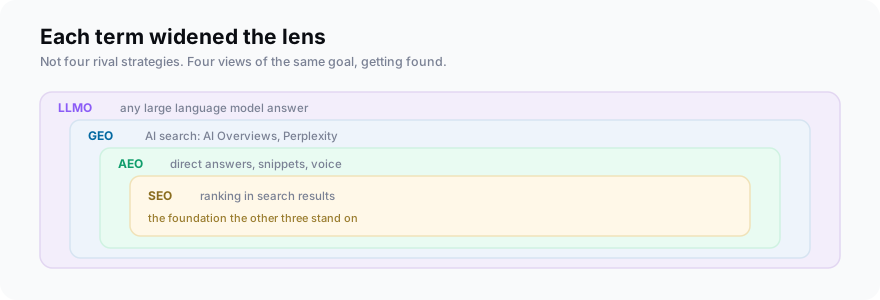
Notice the pattern. Each new term did not replace the last; it widened the lens from a search box toward any answer a model gives.
That is why the acronym fights are mostly a waste of time. A team can call the same work AEO, GEO, or LLMO and still do exactly the right things.
What actually matters is which surfaces your buyers use and whether you show up there. The label is bookkeeping; the citation is the result.
If you want the AEO and GEO distinction in depth, we cover it in AEO vs GEO, and the practice side of this in LLM SEO. This piece is about the term LLMO itself and where it fits.
Is LLMO just a rebrand of SEO?
Partly, and it is fair to be skeptical. Much of LLMO is good content and technical SEO wearing a newer label, and the vendors coining terms have an incentive to make each sound like a fresh discipline you must buy help for. But underneath the naming, one real thing did change: the place your customer reads the answer.
That change is not marketing. It is measurable.
When an answer comes from a model instead of a ranked list, being on page one is not the same as being in the answer. You can rank first and go unmentioned, or rank fifth and be the source the model quotes.
So the genuinely new part is not a technique. It is a second scoreboard.
For twenty years there was one question that mattered: where do you rank? Now there is a second one running alongside it: does the model cite you? You can win one and lose the other, which is exactly why LLMO earned a name instead of staying folded into SEO.
A quick example makes the gap concrete. Say a buyer asks an assistant for the best approach to a problem your product solves.
The model might synthesize an answer from a Reddit thread, a well-structured guide, and one vendor's docs, then name two brands. Your beautifully ranked landing page can sit at position one in Google and play no part in that answer at all, because the model never had a reason to reach for it. That gap is the whole reason LLMO exists as its own conversation.
How do you actually do LLMO?
You do LLMO by making your content the clearest, most consistent, most citable source on your topic, then making sure models can reach it. It is disciplined content work, not a trick. The core moves are well established.
- Define your brand and key terms clearly on indexable pages. Glossary and definition pages pay off, because models quote clean definitions directly.
- Build genuine topical depth, so you cover a subject thoroughly rather than with one thin post.
- Publish original data and research. Statistics and named findings get cited far more often than opinions.
- Keep your facts consistent across pages, since conflicting descriptions make a model unsure which to trust.
- Let the AI crawlers reach you, and structure answers so a model can lift them cleanly, answer first, sources named.
None of that is exotic. It is the same craft good publishers already practice, aimed at being quoted rather than ranked.
If you want the one move with the best return, it is the definition page. Models lean on clean, self-contained definitions when they explain a concept.
Own the clear definition of your category and the terms around it, and you become the phrasing a model reaches for. It is not a coincidence that this article is itself a definition page for LLMO, written to be exactly the kind of source a model can quote.
One research-backed point is worth calling out. A Princeton study presented at KDD 2024 found that adding statistics, quotations, and cited sources raised a page's visibility in generative answers by up to 40%. Specificity is not decoration here; it is what gets you pulled into the answer.
How do you measure LLMO?
You measure LLMO by citations, not rankings. Run the questions your buyers actually ask through each model, then record whether it named you and which page it cited. Watch that citation share per engine over time, because ChatGPT, Claude, Gemini, and Perplexity cite different sources, and a single blended number hides which of your pages is winning.
This is where LLMO gets real, and where a lot of it stalls.
Rankings have had trackers for twenty years. Citations are newer, so many teams simply do not measure them and are flying blind on whether any of the work landed. You cannot improve a number you never look at.
The metrics that matter here are different from SEO's. Watch your citation share, whether you are named at all, and how you are described, since a model can mention you and get you wrong.
Track those per engine, not blended. ChatGPT, Claude, Gemini, and Perplexity pull from different sources, so one number tells you nothing about where a fix is needed. The engine that ignores you and the engine that quotes you need different work, and only a per-engine view shows you which is which.
Frequently asked questions
What does LLMO stand for?
Is LLMO the same as GEO?
Is LLMO the same as LLM SEO?
Does LLMO replace SEO?
How do you do LLMO?
How do you measure whether LLMO is working?
Skip the acronym war, earn the citation
Do this next: pick one high-value topic, make your page on it the clearest and best-sourced answer on the web, add a real definition and a statistic worth quoting, and confirm the AI crawlers can reach it. That is LLMO in one page.
Then measure it. Run your buyer prompts through the models with MentionsAPI, see who gets cited, and keep your LLM SEO and GEO work pointed at the same goal.
The label will keep changing. A new three-letter acronym will land next year, and someone will sell a course on it.
Being the clearest, most consistent, most citable source in your space will still be the thing that works, whatever the acronym of the month happens to be. Optimize for that, call it whatever you like, and measure the citation that proves it worked.