For twenty years, winning search meant ranking. Now half the answer never shows a ranked link at all.
SEO and GEO chase the same goal, visibility, by two different routes.
SEO optimizes your pages to rank in Google's list of links and earn the click. GEO, or generative engine optimization, optimizes so AI engines like ChatGPT and Perplexity name and cite you inside their answers.
They share a foundation, but reward different things at the surface, and GEO does not replace SEO. Here is how they differ, what each one rewards, and how to run both.
GEO vs SEO: the short answer
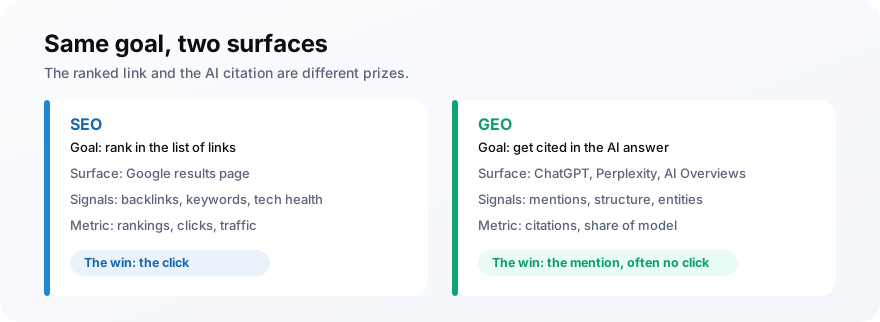
SEO wins the ranked link; GEO wins the citation in the AI answer. Traditional SEO competes for a position in Google's results and the click that follows. GEO competes to be one of the sources an AI names when it answers a question. Same aim of being found, different surface: a results page for SEO, a generated answer for GEO.
| Dimension | SEO | GEO |
|---|---|---|
| Goal | Rank in the list of links | Get cited in the AI answer |
| Surface | Google results page | ChatGPT, Perplexity, AI Overviews |
| Main signals | Backlinks, keywords, technical health | Mentions, structure, entity grounding |
| Success metric | Rankings, clicks, traffic | Citations, mentions, share of model |
| The win | The visit to your site | The mention, often with no click |
If you want the AI acronyms untangled, that is a separate question.
GEO and AEO both aim at AI answers rather than blue links, and people use them loosely. Our AEO vs GEO guide covers that nuance. Against SEO, though, AEO and GEO sit on the same side of the line: optimizing for the answer, not the ranking.
SEO gets you into the list. GEO gets you into the answer. They are not the same job, and ranking first no longer guarantees the second.The one line to remember
What does GEO vs SEO look like for one query?
Take a buyer researching project management tools. The SEO job is to rank your page for best project management software so they click it from Google. The GEO job is to be one of the tools ChatGPT names when asked the same thing, with a line describing you, ideally cited to your page.
The same content can win one and lose the other.
Your page might rank on page one of Google and never get named by ChatGPT, because the model built its answer from a G2 list and a Reddit thread instead. Or you might be named by every AI yet rank poorly on Google, because your page is a clear answer but weak on backlinks. Winning both means doing both jobs on the same topic.
Done right, the two feed each other.
A strong SEO page gives the AI something authoritative to cite, and an AI that names you sends warm, pre-sold traffic back to that same page. Run together on one topic, SEO and GEO compound instead of competing for the same budget line.
How are the goals different?
SEO measures success in rankings, clicks, and traffic. GEO measures it in citations, mentions, and share of the answer. That changes what winning looks like: in SEO you want position one and the visit, while in GEO you want to be named in the answer, often with no click at all. The buyer sees a list in one and a verdict in the other.
That last difference is bigger than it sounds.
A ranked link is an invitation to click and judge for yourself. An AI citation is the model already having judged, and telling the buyer you are one of the answers. The second carries more weight with the buyer and gives you less control, because you did not write the sentence your brand appears in.
Control is the quiet cost of the trade.
In SEO you own the page, the headline, and the pitch the searcher reads. In GEO the model paraphrases you, places you beside rivals, and sometimes gets you wrong. You give up control of the message in exchange for the credibility of being the option the AI chose to name.
What does each one reward?
Different signals. SEO leans on backlinks and keyword relevance to earn a ranking. GEO leans on brand mentions, clean extractable structure, and entity grounding to earn citations. One telling finding: a Seer Interactive study found that ranking on Google's first page correlated with getting cited by AI, while backlinks and domain authority showed little direct influence on the citations themselves.
Some old SEO habits even work against you in GEO.
Keyword stuffing, which never helped much, actively hurts citation: the Princeton GEO study found keyword density slightly lowered AI visibility, while adding statistics or citations raised it by 30 to 40%. GEO rewards content that reads like a clear, sourced answer rather than a page tuned for a crawler.
Entities matter more than they used to, as well.
AI engines lean on structured knowledge about who you are, so a consistent brand entity across your site, your schema, and third-party sources like Wikidata and review platforms helps a model connect the dots and name you with confidence. Traditional SEO cared about this too, but for GEO it sits much closer to the center.
Structure is where the daylight is widest.
AI engines lift tables, lists, direct definitions, and concise fact-dense passages far more easily than long narrative prose. The same 2,000-word article that performs fine in SEO can be nearly uncitable in GEO if the answer is buried. Our GEO guide covers how to structure for extraction.
Does GEO replace SEO?
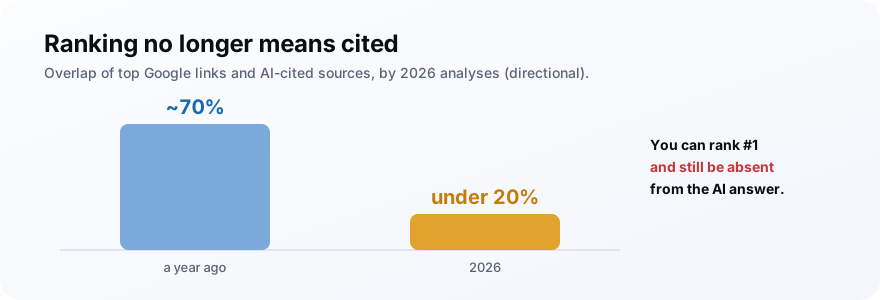
No, but it is pulling away from it. The overlap between what ranks on Google and what AI engines cite has fallen sharply, by several 2026 analyses from around 70% to under 20% in a year, so you can hold position one and still be absent from the AI answer. GEO is a second front, not a replacement. It runs on the same foundation, but it needs its own work.
Treat those percentages as a trend, not gospel.
The exact numbers come from a handful of vendor analyses and vary by method, so I would not bank on 70 or 20 specifically. What is consistent across every source is the direction: the gap between ranking and being cited is widening, which is the entire argument for doing GEO at all.
The Google case is the big exception.
Because AI Overviews are built from Google's own index, ranking and citation overlap heavily there, as GEO-vs-SEO comparisons note, so strong SEO carries much of your GEO weight on Google. It is ChatGPT and Perplexity, which run their own crawlers and selection logic, where the two diverge most and GEO needs dedicated work.
What stays the same across both?
More than the hype admits. Fast, well-structured pages, clean schema, real expertise, and genuinely useful content help you in both Google rankings and AI citations, and thin content fails in both. For Google specifically, the two overlap heavily, since AI Overviews draw on the same index a page that cannot rank organically rarely shows up in Gemini either.
The shared base is bigger than the differences:
- Quality and E-E-A-T: real experience and expertise lift both rankings and citations.
- Technical health: fast, crawlable, well-structured pages are table stakes for both.
- Clear structure: good hierarchy and schema help Google parse you and help AI extract you.
- The index link: for Google's AI answers, ranking and citation feed from the same crawl.
- Brand trust: a brand buyers recognize gets clicked in search and trusted in AI answers alike.
So GEO is not a reason to abandon SEO.
It is a reason to extend it. Most of the foundational work you already do for SEO is the price of entry for GEO too, which means the two are far more allies than rivals once you get past the acronyms.
If you have done SEO well, you are not starting GEO from zero.
A fast, well-structured, genuinely expert site is most of the way there. The GEO-specific work, extractable structure, entity signals, and earning third-party mentions, builds on that base rather than tearing it down and starting over.
Should you do GEO or SEO?
Both, in that order. Build the SEO base first, because it still drives most of your search traffic and AI often needs your page in the index to cite it at all. Then add GEO where your buyers actually research with AI. Measure each on its own terms: rankings and clicks for SEO, citations and share of model for GEO. One scoreboard cannot track both.
The split depends on where your buyers are.
If your category still lives mostly on Google, weight toward SEO and layer GEO on your best pages. If your buyers have moved into ChatGPT and Perplexity, as many B2B and software audiences have, GEO stops being optional. The honest answer is a blend that shifts as your market does.
Think of it as a budget split, not a switch.
A 2026 GEO-vs-SEO analysis frames it as a Venn diagram rather than an either-or: keep the SEO spend that still earns traffic, carve out a GEO line for the questions buyers now ask AI, and let the ratio follow your own data rather than a rule of thumb. Most teams are not dropping SEO. They are adding a column.
Whatever the split, measure the GEO side deliberately.
Your SEO tools cannot see citations, so track them on purpose with an AI visibility score and watch it with the same discipline you give rankings. Our guide on improving your AI visibility score covers the GEO-side work once you are measuring it.
The trap is grading GEO with SEO tools.
If you only watch Search Console, the GEO side stays invisible, and you will not notice a competitor taking over the AI answers until your pipeline dips for no reason the analytics can explain. Give citations their own tracking so both fronts are actually on the dashboard.
Frequently asked questions
What is the difference between GEO and SEO?
Does GEO replace SEO?
Is GEO the same as AEO?
What are GEO ranking factors vs SEO ranking factors?
Should I invest in GEO or SEO first?
How do you measure GEO vs SEO?
Run both fronts, measure both
Do this next: keep doing the SEO that earns your rankings, then check the other front. Ask the AI engines the questions your buyers ask and see whether you are named, because ranking first tells you nothing about whether the answer includes you.
Then measure it like you mean it. Track your citations and share of model with MentionsAPI alongside your rankings, and treat GEO as the second scoreboard it is. The link and the answer are different prizes now, and the brands that win this era are the ones going after both at once.